

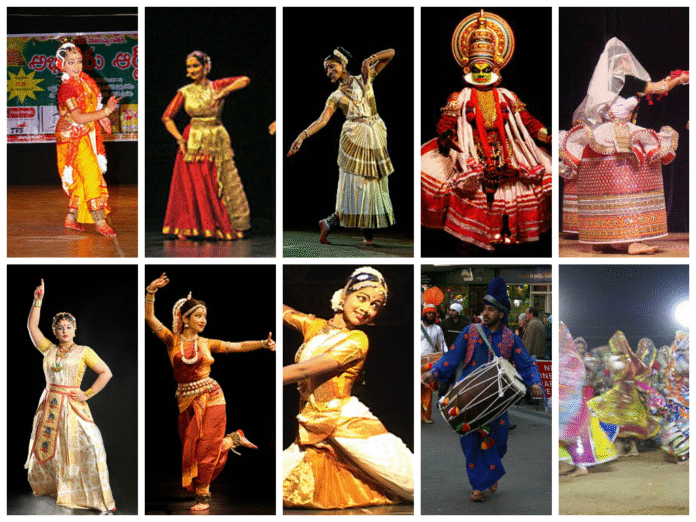
India’s dance traditions are a living expression of its layered history, spirituality, and regional diversity. Guided in spirit by the ancient Natya Shastra, these forms are far more than performance—they are storytelling in motion, where rhythm, gesture, and emotion come together to reflect life itself. From temple courtyards to festive gatherings, each dance form carries a distinct identity shaped by its geography and cultural memory.
Bharatanatyam (Tamil Nadu) stands among the oldest classical traditions, born in temple rituals where dance was an offering to the divine. Its strong, grounded stance, precise footwork, and expressive storytelling transform the dancer into both narrator and character. The richly pleated costume enhances each movement, making geometry and grace visually inseparable.
Kathak (North India) traces its roots to itinerant storytellers who narrated epics through movement. Over time, it absorbed influences from royal courts, evolving into a form known for swift spins, intricate footwork, and rhythmic dialogue with music. The dancer’s ankle bells become an instrument, turning each step into sound as much as motion.
In Kerala, Kathakali elevates dance into theatrical spectacle. Performers, adorned with elaborate makeup and grand costumes, embody mythological characters with astonishing intensity. Without spoken words, they rely on precise facial expressions and controlled eye movements to convey complex emotions, turning every performance into a dramatic visual narrative.
Odissi (Odisha), inspired by temple sculptures, is lyrical and fluid. Its signature tribhangi posture creates a gentle curvature of the body, giving the dance a sculptural elegance. Through soft expressions and devotional themes, the dancer appears almost like a figure brought to life from stone carvings.
From Andhra Pradesh, Kuchipudi blends dance with drama in a vibrant and expressive style. Rooted in theatrical traditions, it carries a playful energy, often incorporating challenging elements like balancing on a brass plate. Its movements are light yet dynamic, bridging storytelling with technical brilliance.
Manipuri (Manipur) offers a contrast with its serene and devotional quality, often centered on the life of Krishna. The movements are soft, rounded, and almost weightless, accompanied by delicate costumes that enhance its ethereal charm. Rather than dramatic expressions, it focuses on quiet devotion and grace.
Also from Kerala, Mohiniyattam embodies gentle femininity and elegance. Its slow, swaying movements and subtle expressions create an atmosphere of calm beauty. The understated white-and-gold attire complements its restrained aesthetic, allowing emotion to unfold softly rather than dramatically.
Sattriya (Assam) originated in monastic settings under the guidance of Srimanta Sankardev. Rooted in spiritual storytelling, it combines dance and drama to convey devotional themes, maintaining a disciplined structure while retaining a deep sense of bhakti (devotion).
The energetic Chhau (Eastern India) draws from martial arts and folk traditions, resulting in powerful, acrobatic movements. In many styles, dancers wear elaborate masks, transforming into mythological or symbolic figures. Its vigorous energy and dramatic storytelling make it visually striking and distinct from more classical forms.
Among folk traditions, Garba (Gujarat) is a vibrant celebration performed during . Dancers move in circular formations, clapping rhythmically as music builds a collective energy. It is as much about community and celebration as it is about dance, bringing people together in joyous unity.
Bhangra (Punjab) radiates exuberance and vitality. Originally linked to harvest celebrations, it has grown into a global symbol of Punjabi culture. With lively beats, energetic jumps, and colorful attire, Bhangra captures the spirit of festivity and shared happiness.
From Maharashtra, Lavani combines rhythm and expression in a bold, engaging style. Performed to the beats of the dholki, it uses swift movements and expressive storytelling to captivate audiences, often blending entertainment with social themes in a uniquely powerful way.
Finally, Ghoomar (Rajasthan) reflects the grace and cultural richness of desert traditions. Performed primarily by women during auspicious occasions, it is marked by gentle twirls and circular movements. As dancers spin in flowing ghagras, the swirling fabric creates a mesmerizing visual rhythm, embodying both elegance and celebration in its simplest, most captivating form.
Together, these dance forms create a vibrant tapestry of India’s artistic soul. Each step, gesture, and rhythm carries echoes of history and identity, reminding us that in India, dance is not just an art form—it is a way of experiencing and expressing life itself.