

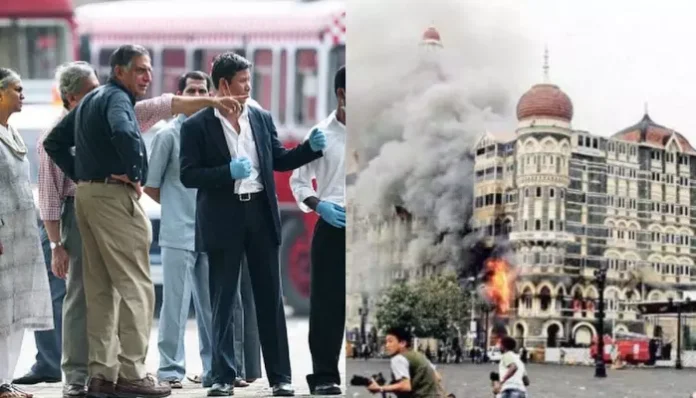
From standing alongside rescue teams during the Taj Hotel siege to ensuring lifelong support for victims and employees, Ratan Tata’s response to the 2008 Mumbai attacks became an enduring example of leadership rooted in humanity.
The 26/11 Mumbai terror attacks of 2008 remain one of the darkest chapters in India’s history. While the city struggled through a 60-hour siege that claimed 166 lives, the attacks also revealed extraordinary examples of courage, compassion and leadership. Among those remembered for his response was Ratan Tata, the then Chairman of the Tata Group, whose actions during and after the attacks demonstrated that leadership extends beyond business and becomes most meaningful during moments of crisis.
On the night of November 26, 2008, terrorists attacked several locations across Mumbai, including the iconic Taj Mahal Palace Hotel, one of the flagship properties of the Tata Group. As the hotel came under attack and parts of its heritage wing were engulfed in flames, Tata remained closely involved in the unfolding situation. Rather than distancing himself from the crisis, he stayed near the hotel premises, monitoring rescue operations and remaining in contact with those involved. His presence also offered reassurance to distressed employees and their families during the prolonged siege.
Even as the extent of the destruction became clear, Tata’s resolve to rebuild the Taj remained firm. The hotel was not merely a business establishment but an institution deeply connected with Mumbai’s history and identity. His decision to restore it reflected a determination that terrorism would not destroy the spirit of the city or the institution. The rebuilding of the Taj subsequently became a powerful symbol of resilience and recovery.
However, Tata’s response went far beyond restoring the damaged property. Following the conclusion of the security operations, he personally visited injured employees and guests in hospitals and met the families of employees who had lost their lives. He ensured that the welfare of the people affected by the tragedy remained a priority, particularly those whose livelihoods and families had been devastated.
Within weeks of the attacks, the Tata Group and Indian Hotels Company Limited (IHCL) established the Taj Public Service Welfare Trust (TPSWT) to provide long-term assistance to victims and their families. The initiative was designed to support medical treatment, financial rehabilitation, education and livelihood recovery. Importantly, its assistance was not restricted to permanent employees of the Taj. Temporary and casual workers, including those who had worked at the hotel for a very short period, were also included in the relief measures.
One of the most remarkable aspects of the response was the support extended to the families of deceased employees. The welfare measures included continued financial assistance, housing support and educational assistance for their children. Employees who were injured received medical and rehabilitation support, while those unable to work during the hotel’s closure continued to receive salaries. These initiatives reflected an approach that recognised employees not simply as members of an organisation but as individuals and families deserving long-term care.
The relief efforts also extended beyond the Taj Hotel. The welfare trust reached out to people affected at other locations, including victims and families connected with the attacks at Chhatrapati Shivaji Terminus (CST), security personnel, street vendors and shopkeepers whose livelihoods were disrupted or destroyed. Financial assistance, medical support and livelihood rehabilitation were among the measures undertaken to help affected communities rebuild their lives.
At the same time, the restoration of the Taj became an important part of Mumbai’s recovery. The hotel’s Tower wing reopened on December 21, 2008, just 21 days after the attacks ended. The historic heritage wing underwent extensive restoration and was fully reopened in August 2010. The reopening represented more than the return of a landmark hotel; it reflected the determination of its employees, the Tata Group and the city to move forward despite the devastation.
Ratan Tata’s response to 26/11 remains an important example of how institutions can demonstrate responsibility during a national crisis. His actions brought attention to the human side of corporate leadership, where employee welfare, community support and long-term rehabilitation become as important as organisational recovery.
Years after the attacks, the story of the Taj and its people continues to represent resilience, solidarity and compassion. While November 26 is remembered for the lives lost and the sacrifices made by security personnel, it also recalls the leadership that helped victims and survivors rebuild. Ratan Tata’s legacy during 26/11 lies not only in rebuilding a historic hotel but also in standing with the people whose lives were changed forever.