

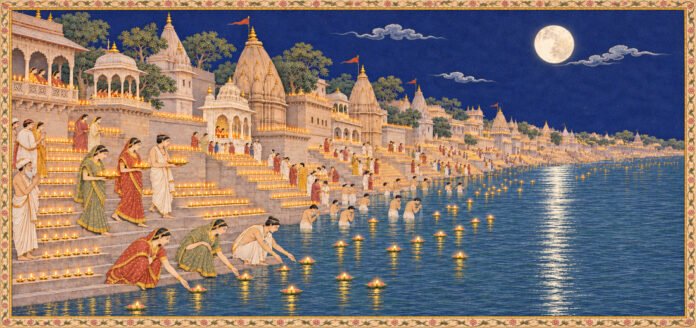
Kartik Purnima, one of the most auspicious full moon days in the Hindu calendar, will be observed on November 24, 2026. Celebrated on the fifteenth day of the bright fortnight (Shukla Paksha) of the Hindu month of Kartik, the festival marks the culmination of the sacred month and holds special religious and spiritual significance. Also known as Dev Deepawali, Tripurari Purnima and Tripuri Purnima, the occasion is associated with the victory of good over evil, devotion, charity and the worship of Lord Shiva and Lord Vishnu.
Across India, devotees observe the day through holy river baths, prayers, fasting, charitable activities and the lighting of thousands of earthen lamps.
Why Is Kartik Purnima Celebrated?
Kartik Purnima derives its name from the Hindu month of Kartik, which is considered particularly sacred for religious observances. The full moon day is believed to be an especially auspicious time for prayers, spiritual practices, bathing in holy rivers and charitable donations. It is also associated with several important events in Hindu mythology.
The festival is primarily celebrated to commemorate Lord Shiva’s victory over the demon Tripurasura, which gives the day its name, Tripurari Purnima. The occasion is also significant in Vaishnav traditions, with devotees worshipping Lord Vishnu and observing various religious rituals. For the Sikh community, the day often coincides with Guru Nanak Jayanti, the birth anniversary of Guru Nanak Dev Ji, the founder of Sikhism.
The Story Behind Kartik Purnima: Lord Shiva and Tripurasura
According to Hindu mythology, the story of Kartik Purnima is associated with three powerful demon brothers, Tarakaksha, Kamalaksha and Vidyunmali, who were the sons of demon Tarakasura. After performing intense penance, they received a boon from Lord Brahma that allowed them to build three magnificent flying cities, collectively known as Tripura. These cities were made of gold, silver and iron and could be destroyed only when they aligned in a particular position.
Over time, the three brothers became arrogant and began troubling the gods and disturbing the balance of the universe. Unable to control their growing power, the gods approached Lord Shiva for help. Responding to their prayers, Lord Shiva took the form of Tripurantaka and destroyed all three cities with a single arrow when they aligned.
His victory marked the destruction of evil and the restoration of cosmic balance. The gods celebrated the occasion by lighting lamps in honour of Lord Shiva. This legendary celebration is believed to be the origin of Dev Deepawali, meaning the Diwali of the Gods. Lord Shiva is also known as Tripurari, the destroyer of Tripura, which is why Kartik Purnima is called Tripurari Purnima.
Rituals and Traditions Associated with Kartik Purnima
One of the most significant traditions of Kartik Purnima is Kartik Snan, the ritual bathing in sacred rivers and water bodies. Devotees wake up before sunrise and take a holy dip, particularly in the Ganga, Yamuna and other sacred rivers. Many believe that bathing on this day washes away sins and brings spiritual purification.
Another important ritual is Deep Daan, the offering of earthen lamps. Devotees light diyas in temples, homes, near Tulsi plants and along riverbanks. In several places, small lamps are also floated on rivers as an offering of devotion. Worship of Lord Shiva and Lord Vishnu, recitation of religious texts, fasting and performing charity are other common observances. Many devotees donate food, clothes and other essentials to the underprivileged.
Dev Deepawali: The Grand Celebration in Varanasi
Kartik Purnima is particularly famous for Dev Deepawali, celebrated on the ghats of Varanasi in Uttar Pradesh. The city’s riverfront transforms into a spectacular sight as thousands of earthen lamps illuminate the steps of the Ganga. Temples, homes and public spaces are decorated with lights, while devotees gather to witness the grand Ganga Aarti.
Unlike the main festival of Diwali, which falls on Amavasya, Dev Deepawali is celebrated fifteen days later on the full moon of Kartik. According to religious belief, the gods descend to Earth on this day to bathe in the sacred Ganga and celebrate Lord Shiva’s victory over Tripurasura.
Regional Celebrations and Cultural Significance
Kartik Purnima is observed through several regional traditions across India. In Pushkar, Rajasthan, the occasion marks the culmination of the famous Pushkar Fair, which attracts pilgrims, tourists and traders from different parts of the country. Devotees gather at Pushkar Lake to take a holy dip and offer prayers.
In Odisha, the festival is associated with Boita Bandana, a traditional ceremony that remembers the state’s ancient maritime trade and seafaring heritage. People float miniature boats made of banana stems, paper or cork in rivers and water bodies, commemorating the voyages of ancient Odia merchants.
The festival also holds significance for Jain devotees, particularly as an important occasion for pilgrimage to the Shatrunjaya hills in Palitana, Gujarat.
Beyond its religious rituals and celebrations, Kartik Purnima conveys a universal message of faith, righteousness, generosity and the triumph of good over evil. The lighting of lamps symbolises the removal of darkness and the arrival of knowledge and positivity. Through its diverse traditions, the festival brings together spirituality, mythology and cultural heritage, making it one of the most significant celebrations of the Indian festive calendar.