

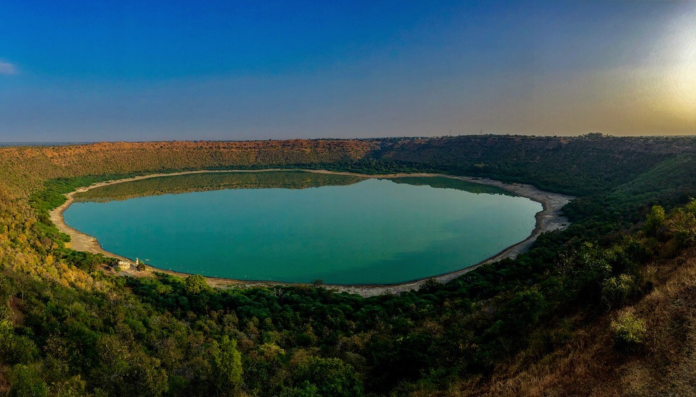
Lonar Lake in Maharashtra’s Buldhana district has earned international recognition after being included in the International Union of Geological Sciences (IUGS) Third 100 Geological Heritage Sites list. The recognition highlights the lake’s unique meteorite-impact crater, geological significance and scientific importance.
Lonar Lake, located in Maharashtra’s Buldhana district, has been included in the International Union of Geological Sciences’ (IUGS) prestigious list of the Third 100 Geological Heritage Sites. The Ministry of Mines confirmed the recognition on November 13, 2026.
The announcement was made during the IUGS Geoheritage Event held in Algarve, Portugal, from November 4 to 8, 2026. The Geological Survey of India (GSI) had submitted the nomination for Lonar Lake, which received preliminary approval at the 82nd meeting of the IUGS Executive Committee in Bogotá, Colombia, in January 2026.
Lonar Lake’s Geological Significance
Lonar Lake is a hypervelocity meteorite-impact crater measuring approximately 1.88 kilometres in diameter. Scientists estimate that the crater is around 12,000 years old.
The lake is situated within the Deccan Traps, a vast volcanic formation consisting of basalt rocks that originated approximately 65 million years ago. Lonar is among the five known hypervelocity impact craters on Earth formed in basaltic rocks, making it particularly significant for geological research.
Its inclusion in the IUGS Geological Heritage Sites list is expected to strengthen scientific research, promote geological education and encourage conservation efforts. The international recognition could also boost tourism in the Buldhana district and the wider Vidarbha region.
India’s Geological Heritage Sites Recognised by IUGS
With the latest recognition, India has three sites featured in the IUGS Geological Heritage Sites list:
- Mawmluh Cave, Meghalaya: Recognised in 2022.
- Deccan Traps, Mahabaleshwar, Maharashtra: Recognised in 2024.
- Lonar Lake Impact Crater, Maharashtra: Recognised in 2026.
Important Geological Facts About Lonar Lake
- Impact evidence: Drill cores collected beneath the crater floor contain coarse breccia, shatter cones and maskelynite, providing evidence of impact-related shock metamorphism.
- Unique water chemistry: Lonar Lake is saline and highly alkaline. It is located within an endorheic basin, where water does not flow out into an external river or sea.
- Meteorite impact origin: Geological investigations established that the crater was formed by a meteorite impact, overturning earlier theories that linked its origin to volcanic activity.
- Scientific importance: Its formation in basaltic rock makes Lonar an important natural laboratory for studying meteorite impacts and planetary geology