

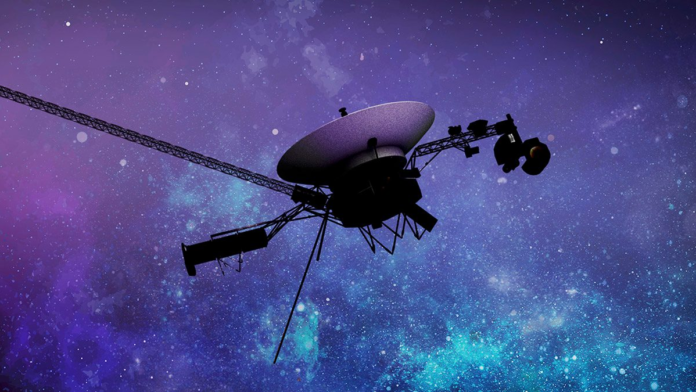
NASA’s Voyager 1 spacecraft is approaching a historic milestone in space exploration. On 18 November 2026, at approximately 10:16 UTC, Voyager 1 is projected to become the first human-made object to travel one light-day away from Earth. At that point, the spacecraft will be approximately 25.902 billion kilometres (16.094 billion miles) from our planet.
This achievement will highlight the extraordinary journey of Voyager 1, which has been exploring interstellar space since becoming the first spacecraft to cross the heliopause in 2012.
Voyager 1: Key Highlights
- Expected milestone: 18 November 2026.
- Expected time: 10:16 UTC.
- Distance from Earth: Approximately 25.902 billion km (16.094 billion miles).
- Distance milestone: One light-day.
- Launch date: 5 September 1977.
- Current location: Interstellar space.
- Speed: Approximately 61,000 km per hour.
- Destination direction: Gliese 445 (AC+79 3888), in the constellation Ursa Minor.
- Space agency: National Aeronautics and Space Administration (NASA).
What Does One Light-Day Mean?
A light-day is the distance travelled by light in one day through a vacuum. Since light travels at approximately 299,792 kilometres per second, one light-day equals about 25.9 billion kilometres. Voyager 1 reaching this distance means that its radio signals will require approximately 24 hours to travel from the spacecraft to Earth. As a result, communication with Voyager 1 involves a considerable delay. A command sent from Earth takes nearly 24 hours to reach the spacecraft, while the response requires another 24 hours. Therefore, a complete communication cycle takes approximately two days.
Voyager 1’s Distance and Communication Delay
As of 3 November 2026, Voyager 1 was approximately 25.86 billion kilometres away from Earth. Its radio signal required around 23 hours, 57 minutes and 49 seconds to reach Earth. This long communication delay presents significant challenges for NASA engineers, who must plan spacecraft operations carefully and cannot control the spacecraft in real time.
Recent Communication Problem in October 2026
In October 2026, NASA temporarily lost contact with Voyager 1 after the Deep Space Network failed to detect its signal during scheduled communication attempts The communication interruption lasted approximately 48 hours, but contact was successfully restored on 20 October 2026. Engineers at NASA’s Jet Propulsion Laboratory (JPL) traced the problem to a group of thrusters that had gone offline.
The spacecraft’s backup thrusters took over, triggering its fault protection system. This system is designed to protect the spacecraft when unexpected technical problems occur. NASA is also switching off power-hungry heating devices to conserve electricity and extend the operational life of Voyager 1.
Voyager 1 Mission: An Overview
Voyager 1 was launched by NASA on 5 September 1977 as part of the Voyager programme. Initially designed to explore the outer planets of the Solar System, the spacecraft conducted important observations of Jupiter and Saturn before continuing its journey towards interstellar space. On 25 August 2012, Voyager 1 crossed the heliopause, the boundary separating the Sun’s heliosphere from interstellar space. It became the first spacecraft to enter interstellar space. Despite operating for nearly five decades, Voyager 1 continues to transmit scientific information to Earth.
Why Did Voyager 1 Visit Titan Instead of Pluto?
One important historical decision in Voyager 1’s mission involved its trajectory. NASA prioritised a close encounter with Saturn’s moon Titan rather than continuing towards Pluto. The main reason was that scientists already knew Titan possessed a substantial atmosphere. Studying Titan’s atmosphere was considered scientifically valuable, making the encounter a priority. The selected trajectory allowed Voyager 1 to conduct its Titan flyby but changed its path so that it could not continue towards Pluto.
How Does Voyager 1 Generate Electricity?
Voyager 1 operates using Radioisotope Thermoelectric Generators (RTGs). These generators convert heat produced by the radioactive decay of plutonium-238 into electrical energy. However, the spacecraft’s available electrical power decreases over time due to two factors:
- The radioactive fuel gradually decays.
- The thermocouples inside the RTGs degrade over time.
To conserve electricity, NASA engineers periodically switch off non-essential instruments and heating systems. These power-management measures help extend the spacecraft’s operational lifetime.
Voyager 1’s Data Storage System
Voyager 1 uses a digital tape recorder to store scientific information when communication with Earth is unavailable. Its data storage capacity is approximately 64 megabytes. The stored information can subsequently be transmitted to Earth when communication is restored. This system is particularly important because Voyager 1 operates at an enormous distance from Earth, where communication interruptions and transmission delays create operational challenges.
Voyager 2: When Will It Reach One Light-Day?
Voyager 1’s twin spacecraft, Voyager 2, is also travelling through interstellar space. However, Voyager 2 is significantly closer to Earth than Voyager 1. It is expected to reach the one-light-day distance milestone in November 2035. Both spacecraft continue to provide valuable scientific information about the outer Solar System and interstellar space.
Important Facts About Voyager 1
| Question | Answer |
|---|---|
| Which space agency launched Voyager 1? | NASA |
| When was Voyager 1 launched? | 5 September 1977 |
| When will Voyager 1 reach one light-day from Earth? | 18 November 2026 (projected) |
| What is one light-day? | Distance travelled by light in 24 hours |
| What is the approximate distance of one light-day? | 25.9 billion km |
| When did Voyager 1 enter interstellar space? | 25 August 2012 |
| What boundary did Voyager 1 cross? | Heliopause |
| Which planet’s moon influenced its trajectory? | Titan (moon of Saturn) |
| Why was Titan selected? | Its substantial atmosphere |
| Which technology powers Voyager 1? | Radioisotope Thermoelectric Generator (RTG) |
| Which radioactive material is used in its RTGs? | Plutonium-238 |
| What is Voyager 1’s approximate speed? | 61,000 km/h |
| What is its digital tape recorder capacity? | Approximately 64 MB |
| Which constellation contains Gliese 445? | Ursa Minor |
| When is Voyager 2 expected to reach one light-day? | November 2035 |
Significance of Voyager 1’s Achievement
Voyager 1 reaching one light-day from Earth represents an extraordinary achievement in human space exploration. It demonstrates the long-term reliability of spacecraft engineering and the scientific importance of missions that continue far beyond their original operational lifetimes. The mission also helps scientists understand the environment beyond the heliosphere and investigate the properties of interstellar space. The increasing communication delay highlights the challenges that future deep-space missions will face as spacecraft travel farther from Earth.
Conclusion
Voyager 1’s projected achievement of reaching one light-day from Earth on 18 November 2026 will mark another historic chapter in space exploration. Launched in 1977, the spacecraft has travelled beyond the planets, crossed the heliopause and continued exploring interstellar space. Its remarkable journey demonstrates the capabilities of human engineering and the importance of long-duration scientific missions. Voyager 1 was launched on 5 September 1977, crossed the heliopause on 25 August 2012 and is projected to become the first human-made object one light-day away from Earth on 18 November 2026.