

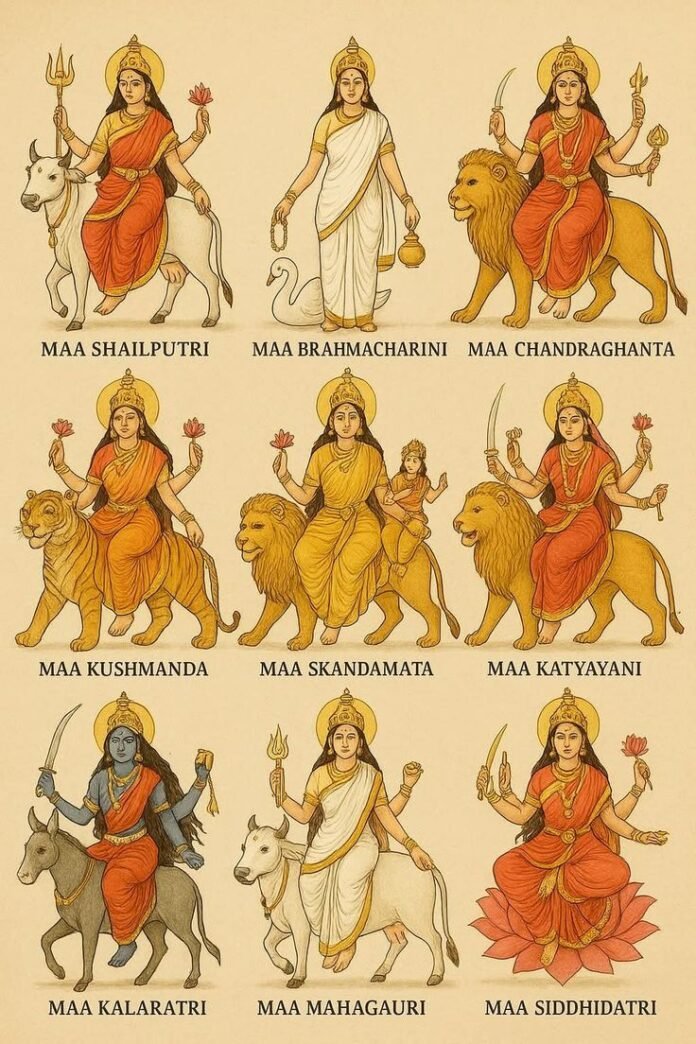
Sharad Navratri is one of the most significant Hindu festivals dedicated to Goddess Durga and the divine feminine power, or Shakti. Observed over nine nights and ten days in the month of Ashwin, the festival honours nine manifestations of Goddess Durga, collectively known as Navadurga. Each form carries a distinct name, appearance, symbolism and spiritual significance, reflecting different dimensions of Shakti, from strength and austerity to motherhood, courage, purity and spiritual attainment.
1. Maa Shailaputri
The first form, Shailaputri, means “daughter of the mountain”. She is identified with Parvati, the daughter of Himavan, and is traditionally depicted riding Nandi, the bull, while carrying a trident and lotus. Her association with the mountains represents steadiness, strength and a firm beginning to the spiritual journey.
2. Maa Brahmacharini
On the second day, devotees worship Brahmacharini, the form associated with penance, devotion and spiritual discipline. She is traditionally shown walking barefoot, holding a japa mala in one hand and a kamandalu in the other. The form recalls Parvati’s intense austerities undertaken in her pursuit of Lord Shiva and represents determination, self-control and steadfastness.
3. Maa Chandraghanta
The third form is Chandraghanta, whose name refers to the crescent moon resembling a bell on her forehead. Her iconography presents her as a powerful and alert form of the Goddess, associated with courage and fearlessness. She represents the strength required to confront adversity while maintaining inner balance.
4. Maa Kushmanda
Kushmanda, worshipped on the fourth day, is associated with cosmic energy and creation. Her name is traditionally connected with the cosmic egg, and she is understood as a manifestation of the creative energy of the universe. Her worship signifies vitality, well-being and the life-giving power of Shakti.
5. Maa Skandamata
The fifth form, Skandamata, literally means the mother of Skanda, another name for Lord Kartikeya. She is generally depicted seated on a lotus with her son Skanda in her lap. Her form expresses maternal affection, protection and nurturing, while also being associated with knowledge and wisdom.
6. Maa Katyayani
On the sixth day, devotees worship Maa Katyayani, a powerful form of Shakti traditionally associated with the sage Katyayana. She represents courage, valor and the power to overcome obstacles. In devotional traditions, she is also associated with the destruction of forces that threaten righteousness.
7. Maa Kalaratri
The seventh form is Kalaratri, the fierce and formidable manifestation of the Goddess. Traditionally depicted with a dark complexion and a powerful appearance, she represents the destruction of darkness, fear and ignorance. Though fearsome in appearance, Kalaratri is regarded as a protective form of the Mother who grants fearlessness to devotees.
8. Maa Mahagauri
Mahagauri, worshipped on the eighth day, represents purity, serenity and grace. She is traditionally portrayed in a radiant, fair form and is associated with peace, wisdom and liberation. Her presence marks a movement from the fierce energy of Kalaratri towards a calmer and more tranquil expression of Shakti.
9. Maa Siddhidatri
The ninth and final form is Maa Siddhidatri, whose name refers to the giver of siddhis, or spiritual attainments. She represents fulfilment, perfection and the culmination of the Navratri journey. Her worship signifies the completion of the spiritual progression through the nine manifestations of the Goddess.
The nine forms of Navadurga together present a broad vision of Shakti. From Shailaputri’s strength and Brahmacharini’s discipline to Kalaratri’s fearlessness, Mahagauri’s serenity and Siddhidatri’s fulfilment, Sharad Navratri becomes not merely a period of worship but a symbolic journey through different expressions of divine feminine energy. Across India, these nine days are observed through prayer, fasting, rituals and regional traditions, culminating in the celebration of victory over evil.