

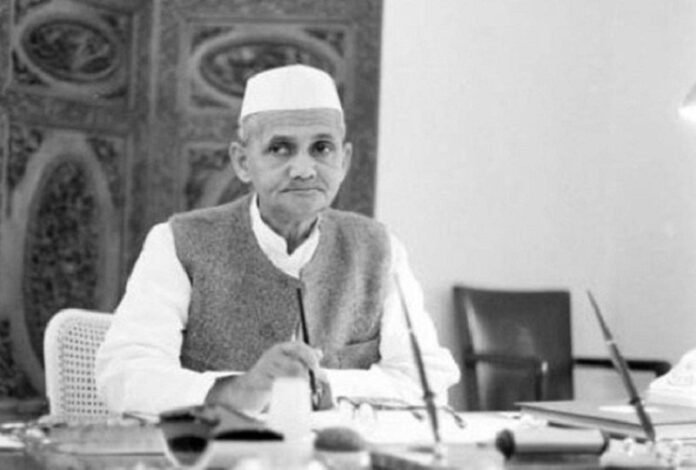
Lal Bahadur Shastri Jayanti is observed every year on October 2 to remember one of India’s most respected leaders, whose life was marked by simplicity, integrity, courage and a deep sense of duty towards the nation. Born on October 2, 1904, Shastri went on to become the second Prime Minister of independent India and led the country through one of its most challenging periods.
From a humble childhood to the freedom movement
Lal Bahadur Shastri was born in Mughalsarai, present-day Deen Dayal Upadhyaya Nagar in Uttar Pradesh. His father, Sharada Prasad Srivastava, was a school teacher who died when Shastri was only about one-and-a-half years old. He was raised by his mother, Ramdulari Devi, in modest circumstances.
His childhood was shaped by financial difficulties. He reportedly walked several miles to school, sometimes without footwear. However, these hardships did not prevent him from pursuing education or developing a strong sense of responsibility.
As a young boy, Shastri became influenced by the freedom movement and the ideas of Mahatma Gandhi. At the age of 16, he responded to Gandhi’s call during the Non-Cooperation Movement and gave up his studies. He later joined Kashi Vidya Peeth in Varanasi, where he received the academic title of ‘Shastri’, meaning a scholar. The title eventually became part of his name.
He actively participated in the freedom struggle and was imprisoned several times by the British. In total, he spent around seven years in British jails. The experience strengthened his commitment to public service and shaped the disciplined and determined leader he would later become.
A journey of public service
After Independence, Shastri took on several responsibilities in public life. He served in the government of Uttar Pradesh before moving to the national political scene. He held several important positions in the Union Cabinet, including Minister for Railways, Transport and Communications, Commerce and Industry, and Home Affairs.
One of the most remembered moments of his ministerial career came after a major railway accident. Shastri resigned as Railway Minister, accepting moral responsibility for the tragedy. His resignation was widely seen as an example of accountability in public office.
In June 1964, following the death of Jawaharlal Nehru, Lal Bahadur Shastri became the second Prime Minister of India.
Leading India through a difficult period
Shastri became Prime Minister at a time when India faced serious challenges, including food shortages and security concerns. His leadership came under particular focus during the India-Pakistan War of 1965.
It was during this period that he gave the famous call, “Jai Jawan, Jai Kisan”, bringing together the contribution of soldiers defending the country and farmers supporting its food security. The slogan became closely associated with his vision of national strength and self-reliance.
Shastri also encouraged citizens to respond to the food shortage through discipline and sacrifice. His appeal for people to voluntarily reduce food consumption reflected his belief that national challenges required participation not only from the government but also from ordinary citizens.
His tenure also coincided with important developments in agriculture and efforts to strengthen India’s food production. His emphasis on farmers and food security became an important part of his legacy.
Tashkent and his final days
After the 1965 war, Shastri travelled to Tashkent in the Soviet Union for talks with Pakistan’s President Ayub Khan. On January 10, 1966, the two sides signed the Tashkent Declaration, committing themselves to restoring peaceful relations and withdrawing armed forces to positions held before the conflict.
Tragically, Shastri died in Tashkent in the early hours of January 11, 1966, only a few hours after the declaration was signed. He was 61.
Later in 1966, he was posthumously awarded the Bharat Ratna, India’s highest civilian honour.
Why Lal Bahadur Shastri is still remembered
More than his position as Prime Minister, Shastri is remembered for the values associated with his public life. He came from a modest background, lived simply and remained closely connected to the ordinary citizen.
His life demonstrated that leadership did not always have to be loud or larger than life. His public image was built around honesty, discipline, responsibility and inner strength. His resignation as Railway Minister, his leadership during the 1965 war and his appeal to citizens during a period of food shortage remain significant chapters of his political journey.
Lal Bahadur Shastri Jayanti, therefore, is not only an occasion to remember a former Prime Minister. It is also a reminder of a style of leadership rooted in humility, accountability and service. Decades after his death, his words “Jai Jawan, Jai Kisan” continue to be remembered as a simple expression of the two pillars he believed were essential to a strong India: the courage of its soldiers and the hard work of its farmers.