

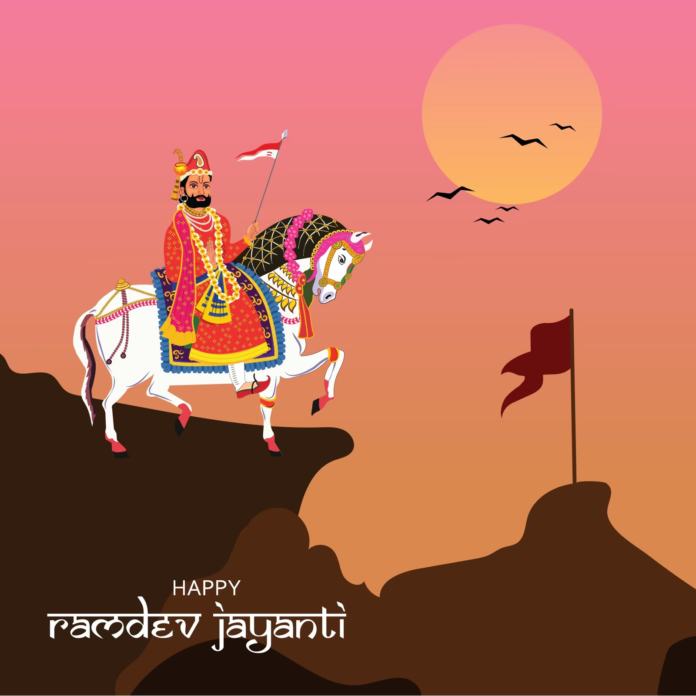
Baba Ramdev Jayanti 2026: Revered across Rajasthan and western India as a powerful symbol of faith and social harmony, Baba Ramdevji is known among Hindus as Ramdevji and revered by Muslims as Ramsa Peer or Ramapir. Every year, a grand fair is held at his Samadhi in Runicha (Ramdevra), attracting hundreds of thousands of devotees from across India and Pakistan. Many pilgrims undertake the journey on foot as an expression of their devotion.
This year, Baba Ramdevji’s Jayanti will be celebrated on Sunday, September 13, 2026. Here is the story of the revered folk deity known as the ‘Peer of Peers’.
Where Was Baba Ramdevji Born?
According to tradition, Baba Ramdevji was born in Vikram Samvat 1409 on Bhadrapad Shukla Paksha Dwitiya, the second day of the bright fortnight of Bhadrapad, locally known as Bhadva Sudi Beej.
He was born in Udukasmer (Undu-Kashmir), in the present-day Shiv tehsil of Rajasthan’s Barmer district. His father was the Tanwar (Tomar) Rajput ruler King Ajmalji, and his mother was Mainade.
Why Is Baba Ramdevji Considered an Incarnation of Lord Krishna?
According to popular religious tradition, King Ajmalji and his wife Mainade were childless and deeply devoted to Dwarkadhish Shri Krishna. Pleased with their devotion, Krishna is believed to have granted them a boon and promised to be born into their family as their son.
For this reason, Baba Ramdevji is revered by many devotees as an incarnation of Lord Krishna.
Baba Ramdevji and the Liberation of the People
Folklore surrounding Baba Ramdevji describes him as a protector of the oppressed and a champion of righteousness. It is believed that, even as a child, he liberated people in the Pokaran region from the terror of a demon named Bhairav and gave them a sense of fearlessness.
According to tradition, Baba Ramdevji performed 24 great miracles during his lifetime, primarily to relieve suffering and uphold Dharma. His teachings are traditionally associated with the ‘Chaubees Vaniyan’, or Twenty-Four Utterances.
Baba Ramdevji’s Message of Equality
Baba Ramdevji’s legacy is also closely associated with social equality and harmony. According to tradition, he challenged caste-based discrimination and social divisions prevalent in his time.
His relationship with Dali Bai, a devotee from the Meghwal community whom he regarded as his sister, is remembered as a powerful symbol of social harmony and equality.
This inclusive legacy has helped Baba Ramdevji become a figure of reverence across religious communities. While many Hindus worship him as an incarnation of Lord Krishna, Muslim devotees honour him as Ramapir or Ramsa Peer.
How Did Baba Ramdevji Earn the Title ‘Ramsa Peer’?
One of the most famous legends associated with Baba Ramdevji tells of five Pirs who travelled from Mecca to test his spiritual powers.
According to the legend, Baba Ramdevji asked them to dine with him. When they said that they wished to eat from their own bowls, Baba is said to have miraculously summoned their original dining vessels from Mecca.
Amazed by the miracle, the Pirs are traditionally believed to have acknowledged his spiritual greatness and declared that while they were Pirs, he was the ‘Pir of Pirs’—giving rise to the revered name Ramsa Peer.
Baba Ramdevji’s Jivant Samadhi
According to tradition, Baba Ramdevji attained Jivant Samadhi at Ram Sarovar in Runicha (Ramdevra) on Bhadrapad Shukla Paksha Ekadashi, in Vikram Samvat 1442, at the age of just 33.
Two days earlier, on Navami, his devoted disciple Dali Bai is said to have taken Samadhi. Her shrine stands close to Baba Ramdevji’s Samadhi within the main temple complex.
The Runicha temple complex also houses the Samadhis of members of Baba Ramdevji’s family.
Ramdevra Fair: A Grand Pilgrimage of Faith
The annual Ramdevra Fair is held at the shrine in Jaisalmer district from Bhadrapad Shukla Paksha Dwitiya to Ekadashi. The festival draws hundreds of thousands of devotees from Rajasthan as well as neighbouring states including Gujarat, Madhya Pradesh, Haryana and Punjab.
Many pilgrims undertake the journey on foot, carrying colourful five-coloured flags (neja) and chanting devotional greetings such as “Khamma-Khamma” and “Jai Babe Ri.”
The magnificent temple at Ramdevra stands at the sacred site associated with Baba Ramdevji’s Samadhi. According to local tradition, the temple was constructed by Maharaja Ganga Singh of Bikaner.
For generations, the Ramdevra pilgrimage has remained a significant expression of devotion, interfaith reverence and the enduring cultural legacy of Baba Ramdevji—Ramsa Peer, the ‘Peer of Peers.’