

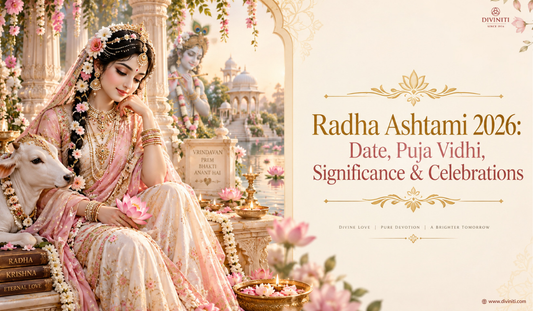
Among the many festivals dedicated to Radha and Krishna, Radha Ashtami holds a special place in the Vaishnav tradition. Celebrated on the eighth day, or Ashtami, of the bright fortnight of the month of Bhadrapada, the festival commemorates the appearance or birth of Radha, who is revered as the beloved of Lord Krishna and, in many devotional traditions, as the embodiment of divine love and devotion. The festival is observed with particular devotion in Barsana, Vrindavan, Mathura and other parts of North India.
According to Hindu devotional traditions, Radha was born in Barsana, in present-day Uttar Pradesh, to Vrishabhanu and Kirtida. Her birth is traditionally believed to have taken place on Bhadrapada Shukla Ashtami, about two weeks after Janmashtami, which celebrates the birth of Krishna. Devotees therefore regard Radha Ashtami as a celebration of the divine feminine and of the spiritual bond between Radha and Krishna.
The stories surrounding Radha’s childhood form an important part of the devotional traditions of Braj. She is described as growing up in the pastoral landscape of Braj, surrounded by the world in which Krishna spent his childhood. Radha and Krishna are traditionally associated with the forests, groves, ponds and villages of the region, and their stories became central to Braj’s devotional culture.
Radha’s relationship with Krishna is understood differently across Hindu philosophical and devotional traditions, but in many Vaishnav traditions she represents the highest form of bhakti, or loving devotion. Her love is not understood merely as an earthly romantic relationship. Instead, it represents the soul’s longing and complete devotion towards the Divine. This symbolism is one reason Radha occupies such an important place in devotional literature, music, poetry and art.
The historical and scriptural traditions surrounding Radha are complex. Unlike Krishna, whose life and deeds are described extensively in texts such as the Mahabharata and Bhagavata Purana, Radha’s prominence developed particularly strongly in later devotional literature and traditions associated with Braj. Texts such as Jayadeva’s Gita Govinda, as well as later works of Vaishnav poets and theologians, played an important role in shaping the rich literary and devotional tradition surrounding Radha and Krishna.
Radha Ashtami is marked by elaborate worship in temples and homes. Devotees wake early, bathe and prepare for the day’s observances. Temples dedicated to Radha and Krishna are beautifully decorated with flowers, lamps and colourful fabrics. In many temples, a special abhishek, or ceremonial bathing of Radha’s image, is performed using milk, yoghurt, honey, ghee and other traditional offerings. The deity is then dressed in elaborate garments and ornaments before being presented for darshan.
Fasting is another important practice for many devotees. Some observe a complete fast, while others follow a partial fast depending on their health and personal religious practice. Devotees spend the day chanting Radha-Krishna’s names, listening to devotional stories, singing bhajans and kirtans, and participating in special prayers.
The celebrations are particularly vibrant in Barsana, which is traditionally regarded as Radha’s birthplace. The Radha Rani Temple becomes a major centre of devotion, attracting pilgrims from different parts of India. The surrounding Braj region also celebrates the occasion through devotional singing, processions, temple rituals and cultural performances.
Vrindavan and Mathura also observe Radha Ashtami with great enthusiasm. Temples hold special ceremonies and devotees visit sacred places associated with the Radha-Krishna tradition. The atmosphere of Braj during the festival reflects the region’s centuries-old culture of devotion, in which music, poetry, dance and worship are closely intertwined.
Beyond its rituals, the deeper significance of Radha Ashtami lies in the idea of unconditional devotion. Radha is celebrated not simply as Krishna’s beloved, but as a symbol of complete surrender and love for the Divine. Her devotion is portrayed as selfless, intense and free from expectations. In this interpretation, Radha becomes an example of bhakti in its purest form.
The festival also celebrates the importance of thefeminine principle in Vaishnav devotion. In traditions that identify Radha with Krishna’s divine energy or Shakti, Radha and Krishna are understood as inseparable aspects of the Divine. Their relationship represents a union in which love itself becomes a path to spiritual realisation.
Radha Ashtami, therefore, is not only a celebration of a sacred birth. It is a celebration of love, devotion and spiritual longing. From the lanes of Barsana and Vrindavan to homes and temples across India, devotees remember Radha through prayers, music and stories that have travelled across generations.
Her story continues to inspire poets, artists, musicians and devotees because it speaks to a universal human emotion: the longing to be close to that which one loves completely. In the devotional imagination of Braj, Radha’s love for Krishna becomes more than a story from the past. It becomes a spiritual ideal, reminding devotees that the path to the Divine can also be a path of love.