

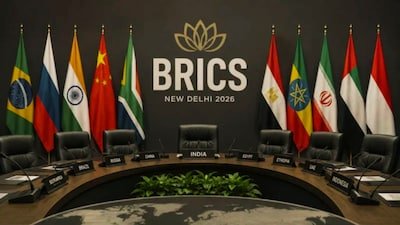
Modi, Putin, Xi and other leaders set to converge in the capital as India hosts the 18th BRICS Summit amid discussions on trade, technology, energy and global governance
New Delhi: The national capital is preparing to host one of the most closely watched diplomatic gatherings of 2026 as India gets ready for the 18th BRICS Leaders’ Summit on September 12 and 13 at Bharat Mandapam, New Delhi. The summit marks the culmination of India’s year-long BRICS Chairship and comes at a significant moment for the grouping, which is celebrating two decades of its formal existence while simultaneously navigating a major expansion in membership and an increasingly complex global geopolitical environment.
India assumed the BRICS Chairship on January 1, 2026, for the fourth time. Its presidency is centred on the theme “Building for Resilience, Innovation, Cooperation and Sustainability”, with a broader people-centric approach described through the principle of “Humanity First.”
The summit is expected to bring together leaders from the 11 BRICS member countries, along with representatives from partner countries and senior international officials. The discussions are likely to focus on strengthening the voice of the Global South, expanding economic cooperation, digital public infrastructure, artificial intelligence, energy security, sustainable development and reforms in global governance.
An expanded BRICS arrives in New Delhi
The BRICS grouping has undergone a significant transformation since its early years as a platform bringing together Brazil, Russia, India and China. South Africa joined in 2011, while a major expansion followed in 2024 with the inclusion of Egypt, Ethiopia, Iran, Saudi Arabia and the United Arab Emirates. Indonesia became a full member in 2025, taking the number of BRICS members to 11.
The present BRICS membership comprises Brazil, Russia, India, China, South Africa, Egypt, Ethiopia, Indonesia, Iran, Saudi Arabia and the United Arab Emirates.
The grouping has also developed a partner-country mechanism, widening its engagement across the Global South. The partner group includes Belarus, Bolivia, Cuba, Kazakhstan, Malaysia, Nigeria, Thailand, Uganda, Uzbekistan and Vietnam.
This expansion has increased BRICS’ geographical and economic weight, but has also made consensus more complicated. The New Delhi summit will therefore be an important test of whether the enlarged grouping can translate its growing influence into practical cooperation.
Putin’s India visit confirmed
Among the most significant confirmed developments ahead of the summit is the participation of Russian President Vladimir Putin.
Prime Minister Narendra Modi met Putin on the sidelines of the Shanghai Cooperation Organisation summit in Bishkek on August 31. During their meeting, the two leaders reviewed bilateral cooperation in political, economic, defence, energy, space and mobility sectors and discussed developments in BRICS under India’s chairship. Modi also said that he looked forward to welcoming Putin to India for the September 12-13 BRICS Summit.
Putin’s presence is expected to give considerable importance to India-Russia discussions on energy, trade, defence, technology and the wider geopolitical situation, particularly the conflicts in West Asia and the Black Sea region.
Xi Jinping’s participation in focus
Chinese President Xi Jinping is also expected to be one of the most prominent participants at the summit. His potential visit is particularly significant because it would be his first visit to India in several years.
A possible meeting between Prime Minister Modi and Xi on the sidelines of the summit is therefore being closely watched. India-China relations have seen efforts towards stabilisation following years of tensions, while issues involving the border, trade, connectivity and strategic competition remain important.
For New Delhi, the summit provides an opportunity to maintain dialogue with Beijing while simultaneously advancing India’s larger BRICS and Global South agenda.
Iran and the West Asia dimension
Iranian President Masoud Pezeshkian is another important figure expected to participate in the summit. His presence assumes particular significance amid continuing instability in West Asia.
India and Iran have traditionally maintained important economic and connectivity ties, including cooperation around Chabahar Port, which provides India with a strategic route towards Afghanistan and Central Asia.
With energy security, maritime trade and regional stability increasingly interconnected, West Asia is likely to form an important backdrop to discussions in New Delhi.
Other major BRICS leaders
The summit is expected to bring together leaders and senior representatives from across the expanded BRICS grouping, including Brazil, South Africa, Egypt, Ethiopia, Indonesia, Saudi Arabia and the UAE, besides India, Russia, China and Iran.
The participation of these countries gives the summit a distinctive geographical character. BRICS now spans major economies and emerging markets across Asia, Africa, the Middle East and Latin America, making it one of the most important platforms through which the Global South can coordinate on international economic and political issues.
The summit will also include engagement with BRICS partner countries, further widening India’s diplomatic outreach.
Global governance at the centre
One of India’s key priorities during its chairship has been strengthening the voice of developing countries in international decision-making.
Reform of global institutions, including the United Nations and international financial architecture, is expected to be an important subject of discussion. BRICS countries have repeatedly argued that existing institutions do not adequately reflect the economic and demographic weight of emerging economies.
The New Delhi summit therefore comes at a time when the question is not simply whether BRICS can expand, but whether it can emerge as a more effective platform for shaping global governance.
Trade, local currencies and economic cooperation
Economic cooperation will remain another major pillar.
India hosted the 16th BRICS Trade Ministers’ Meeting in Jaipur in August, where members discussed strengthening intra-BRICS trade, expanding trade in services and building resilient and diversified global value chains.
The meeting also recorded progress towards finalising the Strategy for BRICS Economic Partnership 2030, covering trade, services, the digital economy, industry, innovation, technology, investment, financial cooperation and sustainable development.
The Jaipur meeting also produced guiding principles aimed at improving MSME access to credit and global markets.
At the leaders’ summit, discussions are expected to build on these outcomes, including the use of national currencies in trade and strengthening financial cooperation. Rather than an immediate common BRICS currency, the focus is increasingly on practical mechanisms that can facilitate trade and payments between member economies.
Digital infrastructure and artificial intelligence
Technology is emerging as another important area under India’s chairship.
At the 12th BRICS Communications Ministers’ Meeting in Pune, member countries discussed sustainable digital infrastructure, cybersecurity, digital skills, startups, artificial intelligence, next-generation networks and digital public infrastructure.
India has also placed its experience with digital public infrastructure at the centre of its international engagement. The objective is to explore how technology can support inclusive development while ensuring that emerging technologies remain secure, accessible and people-centric.
AI, therefore, is expected to feature prominently in the broader conversation about the future of development and digital cooperation.
Climate, environment and sustainable development
Sustainability is directly embedded in India’s BRICS theme.
At the BRICS Environment Ministers’ Meeting in August, member countries adopted a joint ministerial statement and launched knowledge compendiums focusing on environmental cooperation. Discussions covered climate change, biodiversity loss, pollution, disaster risks and the need to ensure that developing countries are not left behind in the transition towards sustainable development.
Energy security will also remain important given the presence of major oil and gas producers within BRICS alongside some of the world’s largest energy-consuming economies.
A year of BRICS activity across India
The September summit is the culmination of a much larger programme conducted across India throughout the year.
The Indian chairship has hosted ministerial and official-level meetings covering trade, finance, education, labour, communications, environment, urbanisation, auditing, health and several other sectors.
The education ministers’ meeting in Bhubaneswar, for instance, adopted a declaration focusing on early childhood education, foundational learning, digital solutions, academic collaboration and knowledge exchange.
The BRICS Urbanisation Forum in New Delhi brought together officials from member countries to discuss affordable housing, sustainable construction, urban infrastructure and resilient cities.
These sectoral meetings are important because their recommendations will feed into the broader agenda being considered by the leaders.
Delhi gets ready
With heads of government and senior delegations arriving from across the world, preparations in New Delhi have intensified.
Bharat Mandapam will serve as the principal venue for the leaders’ summit, while hotels, the airport and major diplomatic and administrative zones are being prepared for the movement of visiting dignitaries.
The summit is also being presented as an opportunity to showcase India’s cultural diversity and development story to visiting delegations.
Why the summit matters
The 18th BRICS Summit is significant because it comes at the intersection of three developments: the expansion of BRICS, growing geopolitical uncertainty and India’s increasingly prominent role in the Global South.
The grouping now represents a much broader collection of countries than it did two decades ago. Its members differ considerably in political systems, economic structures and foreign-policy priorities, making consensus challenging.
India’s task as chair is therefore to keep the grouping focused on areas where cooperation is possible: trade, technology, development finance, energy, climate action, health, education and reform of global institutions.
As Narendra Modi welcomes leaders to Bharat Mandapam on September 12 and 13, the summit will ultimately be judged not only by the number of leaders in the room, but by whether the expanded BRICS can produce practical outcomes for its member countries and strengthen the collective voice of the developing world.
For India, hosting the summit at the 20-year milestone is both a diplomatic responsibility and an opportunity to shape the next phase of BRICS, from an influential emerging-economy grouping into a broader platform for cooperation across the Global South.