

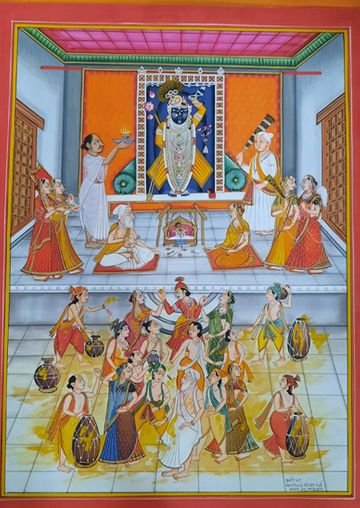
Nathdwara, Rajasthan: In most parts of India, Janmashtami is marked by midnight prayers, devotional songs, temple celebrations and the ceremonial birth of Lord Krishna. But in Nathdwara, the arrival of Krishna is announced in a tradition unlike any other.
As the clock strikes midnight, the historic town of Nathdwara comes alive with the sound of 21 cannon shots fired in honour of Shrinathji, marking the divine moment of Krishna’s birth. The tradition, associated with the Shrinathji temple, has continued for centuries and has become one of the most distinctive features of Janmashtami celebrations in the town. In 2025, the temple administration described the practice as a 352-year-old tradition.
A Midnight Salute to the Birth of Krishna
At midnight on Janmashtami, the atmosphere around Nathdwara’s Risala Chowk changes dramatically. The birth of Krishna is commemorated with a ceremonial 21-gun salute from two traditional cannons, referred to as ‘Nar’ and ‘Mada’.
The cannon salute is not simply a spectacle. It forms part of Nathdwara’s distinctive temple tradition, in which the birth of the divine child is celebrated with the symbolism and grandeur traditionally associated with royalty.
In 2026, the midnight salute is again scheduled as part of the Janmashtami celebrations, with the two cannons firing 21 rounds at Risala Chowk.
The sound carries across Nathdwara as devotees gather to celebrate the moment with chants and cries of devotion.
“Hathi Ghoda Palki, Jai Kanhaiya Lal Ki” and “Nand Ghar Anand Bhayo” become part of the celebrations as the town welcomes Krishna.
Janmashtami Begins With Darshan
The celebration at Shrinathji’s temple is not confined to midnight.
Janmashtami follows the temple’s elaborate seva and darshan tradition, with devotees arriving from the early hours of the morning. In 2026, the day’s schedule began with Mangala Darshan at around 4:45 am, followed by Shringar, Rajbhog, Bhog-Aarti and Jagran Darshan.
The entire day therefore unfolds as a sequence of devotional rituals, gradually building towards the midnight celebration of Krishna’s birth.
An evening procession from Risala Chowk further adds to the festive atmosphere before the midnight cannon salute.
The Celebration Does Not End at Midnight
While midnight marks Krishna’s birth, Nathdwara’s Janmashtami celebration continues into the following day with Nand Mahotsav, celebrating the joy in Nanda’s household after the birth of Krishna.
This is where Nathdwara’s distinctive Pushtimarg tradition becomes particularly visible.
On Nand Mahotsav, Shrinathji is treated as the beloved divine child. The celebration is filled with the imagery of Nand Baba’s home rejoicing at the arrival of Krishna.
Devotees participate in the joyous rituals, with traditional chants, music and the playful celebration associated with Nandotsav.
A Celebration of Milk, Curd and Saffron
One of the most visually striking elements of Nand Mahotsav in Nathdwara is the use of milk, curd, buttermilk and saffron in the festivities.
On September 5, 2026, special darshan associated with the sprinkling of saffron-infused curd and buttermilk was scheduled from the morning.
The imagery recalls the pastoral world of Krishna’s childhood and the celebrations traditionally associated with Nanda’s household.
The atmosphere becomes one of collective joy rather than solemn worship. Devotees sing, dance and celebrate as if participating in the festivities of Gokul itself.
A recent visual report from Nathdwara also captures devotees participating enthusiastically in the Nand Mahotsav, reflecting the continuing public character of the celebration.
Shrinathji as the Divine Child
What makes Nathdwara’s Janmashtami especially distinctive is the way the festival connects directly with the child form of Krishna.
Shrinathji is traditionally depicted as a seven-year-old Krishna lifting Govardhan Hill. The Pushtimarg tradition therefore places great emphasis on intimate seva and the loving relationship between the devotee and the deity.
During festivals such as Janmashtami and Nand Mahotsav, this relationship takes on a particularly celebratory character.
The deity is not merely worshipped as a distant divine figure. He is welcomed, dressed, fed, adorned and celebrated as the beloved child of the household.
A Town That Becomes Part of the Festival
Janmashtami in Nathdwara extends beyond the temple walls.
The town itself becomes part of the celebration as thousands of devotees arrive for darshan. In 2026, the administration anticipated a major influx of devotees and introduced special arrangements for entry, exit, parking and crowd management. Separate entry routes were designated for men and women, while special parking areas were arranged across the town.
The temple administration also suspended various darshan and protocol passes for September 4 and 5 because of the expected crowds.
The result is a festival in which the spiritual life of the temple and the everyday life of Nathdwara become deeply intertwined.
More Than a Festival
For Nathdwara, Janmashtami is not simply a celebration of Krishna’s birth.
It is a continuation of a living tradition in which devotion, royal symbolism, music, seva, ritual and community celebration come together.
The 21 cannon shots announce the arrival of the divine child. The temple’s darshans carry the celebration through the day. And Nand Mahotsav transforms the following morning into a celebration of the joy of Nanda’s household.
From the echo of the cannons at midnight to the shower of saffron-infused curd and buttermilk the next morning, Nathdwara offers one of India’s most distinctive expressions of Krishna devotion.
Here, Krishna’s birth is not merely remembered.
It is announced, celebrated and lived.