

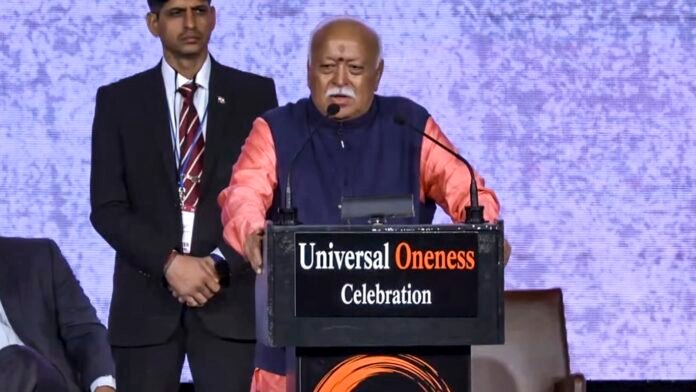
Rashtriya Swayamsevak Sangh (RSS) chief Mohan Bhagwat’s recent address in New York has drawn attention for both its message of religious harmony and the political controversy surrounding his visit. Speaking at events in New York on August 29 and 30, 2026, Bhagwat emphasised India’s civilisational idea of unity in diversity, the dignity of every individual and the need for different religious communities to coexist peacefully. His visit comes as the RSS approaches the centenary of its founding.
At the main “Universal Oneness Celebration” at Madison Square Garden, Bhagwat told a large gathering of members of the Indian-American community and interfaith leaders that unity and diversity were both fundamental to India. Drawing on the philosophy associated with India’s civilisational traditions, he said diversity should not be viewed as a threat but as a natural feature of human society. He also invoked Swami Vivekananda’s idea that every nation has a mission and a destiny, arguing that Bharat’s role was to demonstrate unity underlying diversity to the world.
A significant part of Bhagwat’s message centred on the relationship between different faiths. At another New York event, he said that different religions may have different rituals and paths, but their ultimate purpose is the pursuit of truth and divinity. He argued that religious practices should not obscure the larger spiritual objective of faith. His remarks presented religious diversity as compatible with a deeper sense of human unity.
Bhagwat also made a direct reference to the place of Muslims in India. Recalling a conversation with Muslims who had questioned him about the RSS concept of Hindutva and the idea of a Hindu Rashtra, he said that a Hindu who believes there should be no Muslims in Bharat cannot be considered a true Hindu. He stressed that every human being possesses dignity and that different religious paths can lead towards the same ultimate goal.
He cited the example of the 1996 Charkhi Dadri mid-air collision to illustrate his point about humanitarian service. According to Bhagwat, RSS volunteers who reached the site helped with the injured, identification of victims and funeral arrangements without considering the religious identity of those involved. The crash, involving a Saudi Arabian Airlines aircraft and a Kazakhstan Airlines aircraft, killed all 349 people aboard.
The RSS chief also spoke about the responsibilities of the Indian diaspora. Addressing Indians living in the United States, he said that those who live, work and earn in America have a duty towards their “karmabhoomi”, or land of action. At the same time, he said their connection with Bharat as their “janmabhoomi”, or birthplace, could continue through the values and principles they carry with them. He particularly emphasised the idea of giving back to society, arguing that how much a person distributes and contributes is more important than simply how much they earn.
His speech also touched upon environmental responsibility and sustainable living. Bhagwat linked India’s traditions of respecting nature with the broader idea that human beings have responsibilities towards the world around them. He urged people to begin with their own lives and gradually extend positive changes to society.
However, Bhagwat’s visit and the platform given to him also generated criticism in the United States. New York City Mayor Zohran Mamdani had criticised the RSS and expressed opposition to what he described as an exclusionary vision of India. US lawmakers including Rashida Tlaib and Jim McGovern also criticised Bhagwat’s visit, alleging that the RSS has been associated with discrimination against religious minorities. Their objections contrasted sharply with the message of religious harmony presented in Bhagwat’s speeches.
The controversy has therefore become an important part of the discussion surrounding Bhagwat’s international outreach. Supporters have highlighted his emphasis on coexistence, human dignity and India’s plural traditions, while critics have questioned the gap between such statements and their perception of the RSS’s ideological and political influence in India.
Bhagwat’s New York address ultimately placed the idea of “unity in diversity” at the centre of his message. Whether viewed through the lens of Indian philosophy, diaspora engagement or contemporary debates over religion and politics, his remarks have generated discussion far beyond the auditorium. At a time when societies across the world continue to grapple with religious divisions and cultural differences, the speech sought to present coexistence and human dignity as values that can unite people despite their differences.