

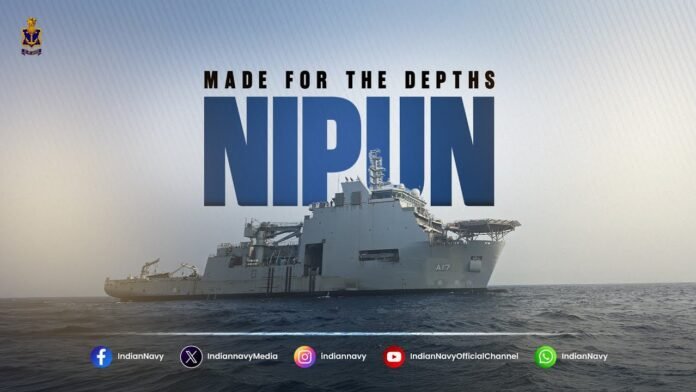
The Indian Navy has commissioned INS Nipun, its second indigenous Diving Support Vessel (DSV), at the Naval Dockyard in Mumbai. The commissioning, held on August 31, 2026, marks an important addition to India’s deep-sea diving, underwater intervention and submarine rescue capabilities. The ceremony was presided over by Chief of the Naval Staff Admiral Krishna Swaminathan.
Built by Hindustan Shipyard Limited (HSL), Visakhapatnam, INS Nipun is the second vessel of the Nistar-class Diving Support Vessels. It was delivered to the Indian Navy on July 30, 2026, after completing an extensive programme of outfitting and trials. The vessel has been indigenously designed and constructed, with nearly 75 per cent indigenous content, reflecting India’s growing capacity to build specialised naval platforms domestically.
The name Nipun comes from Sanskrit and refers to someone who is skilled, capable and well-versed in a particular discipline. The vessel is designed for complex underwater missions and is equipped with modern diving systems, underwater intervention facilities and advanced navigation and station-keeping systems. It can support deep-sea saturation diving operations at depths of up to 300 metres, allowing specialised divers to work for extended periods in challenging underwater environments.
One of INS Nipun’s most important roles is its contribution to submarine rescue operations. The vessel can serve as a mother ship for a Deep Submergence Rescue Vessel, or DSRV, which can be deployed to rescue personnel from a submarine during an emergency. Remotely Operated Vehicles also enhance its ability to monitor divers and conduct underwater inspection and salvage operations.
The vessel’s capabilities extend beyond military operations. Its specialised facilities can support underwater intervention, inspection, maintenance and salvage activities. It also has medical support facilities designed to assist personnel involved in demanding diving operations. According to reports, the vessel can additionally be deployed for disaster relief and humanitarian assistance when required.
The induction of INS Nipun also has strategic significance because it strengthens India’s ability to conduct underwater operations along its western seaboard. With its sister vessel INS Nistar already serving on the eastern coast, the Navy now has a two-ship, two-coast configuration for specialised deep-sea diving and submarine rescue operations. This gives India greater flexibility and readiness in responding to underwater emergencies and other maritime requirements.
The commissioning is also a significant milestone in India’s push for self-reliance in defence production. Specialised vessels such as Nipun require sophisticated shipbuilding, diving, rescue, navigation and medical technologies. Their construction within India demonstrates the expanding capabilities of the country’s naval shipbuilding ecosystem and supports the broader objective of Aatmanirbhar Bharat in defence.
INS Nipun therefore represents more than another addition to the Indian Navy’s fleet. It is a specialised platform designed to operate beneath the surface, support divers, assist in submarine rescue and undertake complex underwater missions. Its induction strengthens India’s maritime preparedness while showcasing the country’s increasing ability to design and build advanced defence platforms at home.