

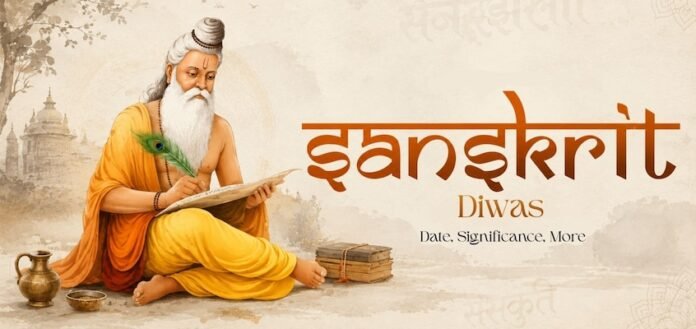
Every year, on the full moon day of the Hindu month of Shravan, India observes Sanskrit Diwas, or World Sanskrit Day, to celebrate one of the country’s oldest classical languages and its extraordinary literary and intellectual heritage. In 2026, Sanskrit Diwas falls on August 28, coinciding with Shravan Purnima. The day is dedicated not simply to remembering an ancient language, but to recognising its continuing contribution to literature, philosophy, science, linguistics, art and India’s wider knowledge traditions.
Sanskrit occupies a distinctive place in the history of India. The earliest form of the language, known as Vedic Sanskrit, is associated with the Vedas, including the Rigveda. Over centuries, Sanskrit developed into a highly sophisticated literary and scholarly language.
The classical form of Sanskrit was systematically described by the ancient grammarian Panini, whose Ashtadhyayi remains one of the most remarkable works in the history of linguistics. Sanskrit’s grammatical tradition subsequently influenced generations of scholars and continues to attract interest among linguists around the world.
The language became a major vehicle for the transmission of knowledge. The Ramayana and Mahabharata, the works of Kalidasa, the philosophical Upanishads, texts on Ayurveda, mathematics, astronomy, politics, architecture, grammar, music and aesthetics represent only a part of the enormous Sanskrit literary tradition. The Government of India’s Sanskrit promotion programmes describe this heritage as encompassing fields ranging from mathematics and medicine to metallurgy, drama, poetry and political thought.
Sanskrit’s importance also extends beyond the texts written directly in the language. It has had a profound influence on the development and vocabulary of numerous Indian languages. Pali and Prakrit traditions developed alongside and in interaction with Sanskrit, while later Indo-Aryan languages inherited and adapted a vast Sanskrit vocabulary. Even languages belonging to other linguistic families, including several Dravidian languages, have been significantly enriched by Sanskrit vocabulary and literary traditions.
The origins of Sanskrit Diwas as an official observance in modern India can be traced to 1969, when the Government of India initiated the celebration of Sanskrit Day at the central and state levels. Shravan Purnima was selected for the observance because of its traditional association with the beginning of Vedic study in ancient educational traditions. The day therefore carries both linguistic and educational significance.
The choice of Shravan Purnima is particularly meaningful. In the traditional gurukula system, this period was associated with the commencement or resumption of Vedic learning. Sanskrit, being the principal language of a vast body of Vedic and classical literature, naturally became connected with the day dedicated to learning and the remembrance of ancient teachers and sages.
Sanskrit Diwas is therefore not intended merely as a celebration of the past. Its larger purpose is to encourage people, particularly younger generations, to engage with Sanskrit and understand the knowledge preserved through it. Schools, universities and cultural institutions mark the occasion through Sanskrit-speaking activities, poetry and shloka recitations, essay competitions, lectures, seminars and literary programmes.
The Government of India has also established institutional and financial mechanisms for the promotion of Sanskrit. The Central Sanskrit University, which received its present status through an Act of Parliament in 2020, serves as an important institution for the development and propagation of Sanskrit. Government schemes also support Sanskrit education, research, scholars and the preservation of manuscripts.
One of the most important challenges today is to make Sanskrit accessible beyond traditional academic circles. For centuries, its study was often associated with specialised scholarship. Today, digital tools, online learning, spoken Sanskrit initiatives and manuscript digitisation are opening new possibilities for bringing the language to a wider audience. The Government’s Gyan Bharatam Mission, for instance, includes efforts towards the digitisation of manuscripts, helping make India’s textual heritage more accessible for research and future generations.
The relevance of Sanskrit in the modern world does not depend on treating it as a language frozen in antiquity. Its value lies precisely in the enormous body of ideas, literature and knowledge that it allows us to access. Learning Sanskrit can offer a closer understanding of classical Indian texts, while studying its grammatical tradition provides an insight into one of the world’s highly developed systems of linguistic analysis.
Sanskrit Diwas, therefore, is ultimately a celebration of continuity. It connects ancient manuscripts with modern classrooms, traditional scholarship with digital technology, and generations of learners with a literary heritage that has survived for thousands of years. The language may belong to an ancient tradition, but the questions it preserves about knowledge, society, ethics, nature, language and human life continue to invite contemporary readers.
On Sanskrit Diwas, the most meaningful tribute to Sanskrit may not simply be to praise its antiquity, but to read it, learn it, translate it, research it and make its vast intellectual heritage accessible to a new generation.