

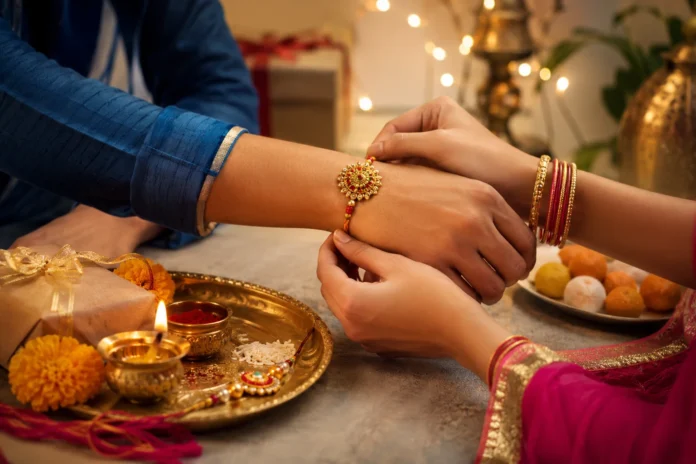
Raksha Bandhan is one of India’s most cherished festivals, celebrating the bond between brothers and sisters through a simple yet deeply meaningful ritual. Observed on the full moon day of the Hindu month of Shravan, the festival brings families together around the tying of the rakhi, a sacred thread that symbolises affection, trust, care and a lifelong bond.
The word Raksha Bandhan literally means “the bond of protection”. Traditionally, sisters tie a rakhi around their brothers’ wrists, offer prayers for their well-being and apply tilak on their foreheads. Brothers, in turn, promise to stand by their sisters and often give them gifts. But beyond these rituals, the festival represents something larger: the assurance that family remains a source of strength through changing circumstances and different stages of life.
The history and traditions associated with Raksha Bandhan have evolved over centuries, and the festival has acquired different meanings across regions and communities. Various stories from Indian mythology and history are associated with the sacred thread. One popular tradition connects it with Lord Krishna and Draupadi, while another well-known historical account speaks of Rani Karnavati sending a rakhi to Mughal emperor Humayun seeking protection. Though these narratives are interpreted differently by historians and traditions, they reflect the cultural idea of a thread carrying a promise of care and solidarity.
In many parts of India, Raksha Bandhan is also known by regional names and is accompanied by local customs. In Rajasthan, for instance, the festival is celebrated with traditional enthusiasm, with families preparing festive food, exchanging gifts and observing rituals at home. The occasion is particularly significant in a culture where family relationships and traditions remain closely woven into everyday life.
Yet, the meaning of Raksha Bandhan has changed with time. Protection is no longer understood only as a brother’s responsibility towards his sister. Today, the festival increasingly celebrates mutual support. Sisters stand beside brothers during difficult times, brothers support sisters in their aspirations, and siblings become each other’s emotional anchors. The rakhi, therefore, can be seen not merely as a promise of protection but as a reminder of responsibility towards one another.
Modern celebrations have also expanded beyond biological siblings. Rakhis are exchanged among cousins, adopted siblings and people who share a bond that resembles family. For those living away from home, a rakhi may arrive by post or courier, accompanied by a handwritten note or a video call. Technology has made it possible for families separated by distance to participate in the celebration together.
The festival also has an important emotional dimension. Childhood memories often form the heart of Raksha Bandhan: sharing sweets, fighting over small things, teasing each other and growing up together. As siblings become adults and move to different cities or countries, these ordinary memories often become more precious. Raksha Bandhan creates an annual moment to pause, reconnect and acknowledge a relationship that can otherwise get lost in the pace of everyday life.
At the same time, the festival offers an opportunity to reflect on what protection and equality should mean within families. A meaningful sibling relationship is built not only through promises but through respect, understanding and the freedom to support each other’s choices. The modern rakhi can therefore represent a two-way commitment: to be present, to listen, to encourage and to stand together.
For many families, the celebration begins with a decorated thali carrying a rakhi, roli, rice, sweets and a diya. After the rituals, conversations continue over festive meals and gifts. The details may differ from one household to another, but the sentiment remains familiar.
Raksha Bandhan ultimately reminds us that some of life’s strongest relationships are built through years of shared experiences rather than grand gestures. The thread tied around a wrist may be small, but the emotions attached to it can span an entire lifetime. In a rapidly changing world, the festival continues to offer a simple message: relationships need to be celebrated, cared for and carried forward.