

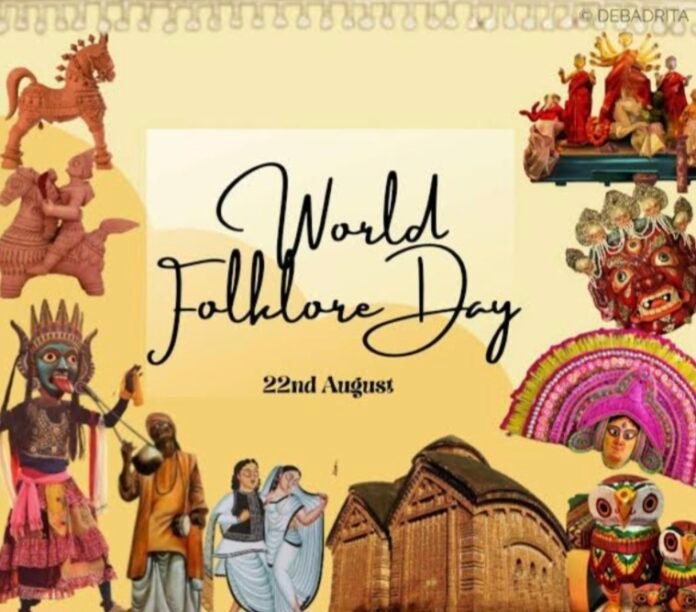
Every culture has stories that are passed from one generation to another. Some are told around village fires, some are sung during festivals, some are performed through dance and theatre, while others survive in proverbs, riddles, rituals and everyday traditions. World Folklore Day, observed every year on August 22, celebrates this rich and diverse world of traditional knowledge and storytelling.
The day offers an opportunity to look beyond folklore as simply a collection of old tales. Folklore is a living record of how communities understand their world. It carries memories of places and people, explains customs and beliefs, preserves local languages and reflects the values, fears, humour and imagination of generations.
The Story Behind World Folklore Day
World Folklore Day is associated with August 22, 1846, when British antiquarian William John Thoms introduced the term “folklore” in an article published in The Athenaeum. He used the word to describe what he called the traditional knowledge, customs and beliefs of ordinary people.
The word itself combines “folk”, meaning people, and “lore”, meaning knowledge or learning. Over time, the study of folklore developed into an important field of cultural research, examining everything from myths and legends to songs, dances, crafts, festivals and oral traditions.
August 22 is now observed in many parts of the world as World Folklore Day, providing a moment to recognise the communities and traditions that continue to keep folklore alive.
India’s Endless World of Folklore
Few countries offer a cultural landscape as diverse as India, and its folklore reflects this extraordinary variety.
From the heroic ballads of Rajasthan and the legends of Punjab to the folk theatre of Maharashtra, the stories of Bengal, the oral traditions of Northeast India and the tribal narratives of central India, every region has its own storytelling traditions.
In Rajasthan, folklore is deeply woven into everyday cultural life. Pabuji ki Phad, for instance, combines storytelling, painting, music and performance to narrate the heroic tale of the folk deity Pabuji. The Panihari songs of Rajasthan capture the experiences and emotions of women, while traditional forms such as Kathputli use puppetry to bring stories of kings, warriors and ordinary people to life.
Elsewhere in India, traditions such as Pandavani in Chhattisgarh, Yakshagana in Karnataka, Baul music in Bengal and Bihu traditions in Assam demonstrate how folklore can take many different forms.
These traditions are not simply performances for entertainment. They are repositories of collective memory.
More Than Myths and Legends
Folklore includes much more than stories about gods, kings, ghosts and heroes.
Folk songs preserve memories of migration, love, separation and work. Proverbs contain generations of practical wisdom. Traditional recipes tell stories about geography and available resources. Wedding customs, harvest celebrations and seasonal rituals reveal how communities have understood their relationship with nature and one another.
Even children’s rhymes and games form part of folklore. They may appear simple, but they often preserve words, rhythms and cultural references that might otherwise disappear.
In this sense, folklore acts almost like an informal archive, one that is carried not in books, but in people’s memories and practices.
Folklore in a Changing World
Modernisation, migration and the rapid growth of digital media have transformed the way folklore is shared. Many traditions that were once passed down orally are now being recorded, documented and presented through films, podcasts, social media and digital archives.
This has created new opportunities for traditional culture to reach younger audiences. A folk song recorded in a village can now travel across the world within minutes. A traditional craft can find new audiences online, while a centuries-old legend can inspire contemporary films, books and visual art.
At the same time, documentation alone cannot guarantee the survival of a tradition. Folklore remains alive when communities continue to practise, perform and reinterpret it.
Keeping Stories Alive
World Folklore Day is therefore also a reminder of the importance of cultural preservation.
When an elderly storyteller teaches a child a local legend, when a musician passes a traditional song to a younger performer, or when a community continues to celebrate an old festival, folklore is not simply being remembered, it is being carried forward.
The challenge is to preserve these traditions without turning them into something frozen in the past. Cultures naturally change, and folklore changes with them. New stories emerge, old ones are retold differently and traditional forms find new expressions.
That is what makes folklore powerful. It belongs to the past, but it continues to evolve in the present.
A World Connected Through Stories
The traditions may differ from one country to another, but the human instinct behind folklore is remarkably universal. People everywhere have created stories to explain the unknown, celebrate heroes, remember ancestors, understand nature and pass wisdom to the next generation.
On World Folklore Day, these stories deserve more than a passing glance. They remind us that culture is not found only in monuments, museums or written history. It also lives in songs remembered by grandparents, stories told to children, dances performed during festivals, crafts made by hand and traditions quietly practised in homes and communities.
In a rapidly changing world, folklore gives people something deeply valuable, a connection to where they came from and a story to carry forward.