

India will host the 12th BRICS Environment Ministers’ Meeting in New Delhi on August 18, bringing together environment ministers, senior officials, policymakers and experts from BRICS member countries to strengthen cooperation on some of the most pressing environmental and climate challenges.
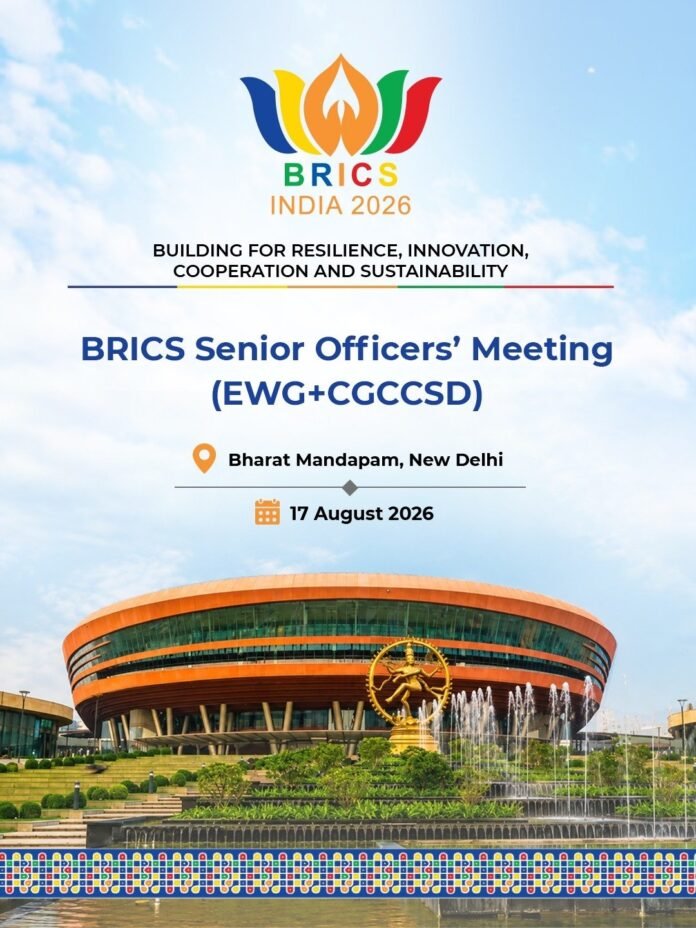
The ministerial meeting will be preceded by the BRICS Senior Officers’ Meeting of the Environment Working Group (EWG) and the Contact Group on Climate Change and Sustainable Development on August 17. The meetings are being held at Bharat Mandapam, New Delhi, under the overarching theme of India’s BRICS Chairship 2026, “Building for Resilience, Innovation, Cooperation and Sustainability.”
The two-day engagement comes as India holds the BRICS chairship for 2026 and seeks to place environmental sustainability and climate resilience prominently within the grouping’s agenda. The Environment Working Group was established in 2015 at the first BRICS Environment Ministers’ Meeting in Moscow, while the Contact Group on Climate Change and Sustainable Development was established in 2024 to strengthen cooperation on climate-related issues among BRICS countries.
Focus on sustainable development
The Senior Officers’ Meeting will deliberate on the priorities of the BRICS Environment Working Group and the Contact Group on Climate Change and Sustainable Development. The discussions are intended to help build consensus and prepare the ground for the ministerial-level deliberations.
Key areas expected to receive attention include sustainable lifestyles, afforestation and forest restoration, disaster resilience, the circular economy and climate adaptation. These issues reflect the shared challenges faced by countries dealing with climate-related risks, resource pressures and the need to pursue economic development while protecting natural ecosystems.
From climate risks to resilience
A major emphasis of India’s BRICS 2026 agenda is expected to be the idea of moving from responding to environmental crises towards building greater resilience.
For developing economies, climate change is closely linked with food and water security, agriculture, livelihoods, infrastructure and disaster preparedness. Cooperation among BRICS countries can provide a platform for sharing experiences, technologies and policy approaches in areas such as climate adaptation, disaster management and ecosystem restoration.
The emphasis on resilience also aligns with the broader theme of India’s BRICS chairship, which places innovation and sustainability alongside cooperation.
Circular economy and sustainable lifestyles
The discussions will also examine the transition towards a circular economy, an approach that seeks to reduce waste by keeping resources and products in use for as long as possible through reuse, repair, recycling and recovery.
Sustainable lifestyles are another important area. The theme reflects India’s emphasis on encouraging environmentally responsible consumption and production rather than treating environmental protection solely as a matter of government regulation.
Strengthening environmental cooperation
The BRICS Environment Ministers’ Meeting is expected to provide a platform for member countries to discuss common priorities, exchange experiences and identify areas for collective action. The meeting will also seek to produce an outcome document reflecting areas of convergence among the participating countries.
The significance of the meeting extends beyond individual environmental programmes. As BRICS expands its cooperation across economic, technological and development issues, environmental collaboration offers another avenue for members to work together on challenges that cross national borders.
India’s BRICS 2026 agenda
India assumed the BRICS chairship in 2026 with the overarching theme “Building for Resilience, Innovation, Cooperation and Sustainability.” The environmental meetings in New Delhi form part of the wider programme of ministerial and working-group engagements being organised during India’s chairship.
The 12th BRICS Environment Ministers’ Meeting therefore comes at a time when climate change, biodiversity loss, extreme weather events and resource security are increasingly interconnected with economic development.
For India, hosting the meeting provides an opportunity to place its environmental priorities and experiences before a wider international grouping while encouraging collective approaches to sustainable development.
As ministers and officials gather in New Delhi, the central challenge before BRICS is clear: how can economic growth, technological innovation and environmental protection advance together? The discussions on August 18 are expected to explore precisely that balance.