

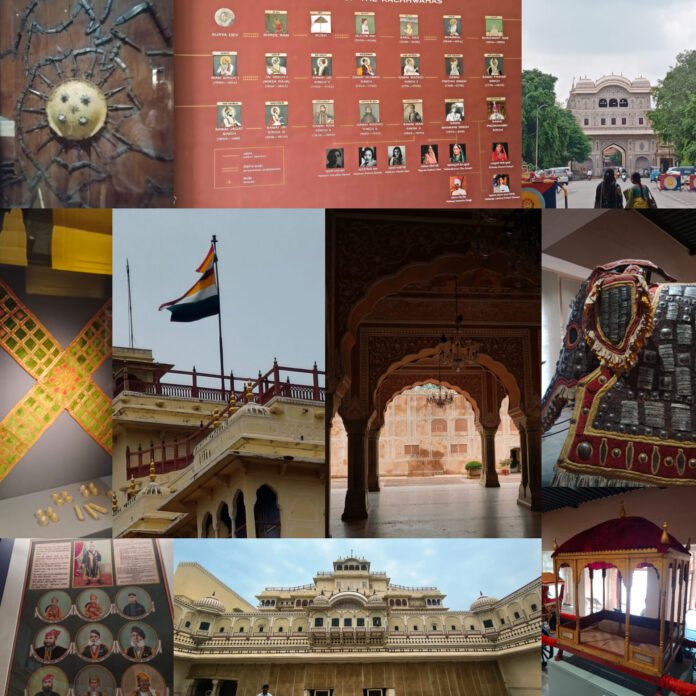
Some places are visited. Some places are experienced. And then there are places that make you feel as though you have temporarily stepped out of the present and into another century. My visit to the City Palace, Jaipur, was exactly that kind of experience.
The moment I entered the palace, I was struck by its magnificent architecture. The beautifully painted walls, elaborate gateways and intricate artwork immediately created an atmosphere of royalty. Every doorway, painting and corridor seemed to carry a story. It felt as though the palace was not simply displaying history; it was allowing us to walk through it.
The City Palace is closely connected with the story of Jaipur itself. Jaipur was founded in 1727 by Maharaja Sawai Jai Singh II, who shifted his capital from Amber and planned the new city with remarkable attention to architecture, geometry and urban planning. Today, Jaipur is celebrated as the Pink City, and its distinctive architecture and cultural grandeur have made it one of India’s most recognisable heritage cities.
Where History Came Alive
As we moved deeper into the palace, we entered the magnificent Darbar Hall. This was perhaps one of the most powerful moments of the entire visit. Standing inside a space associated with royal audiences, I could almost imagine the court coming alive around me.
The hall, with its ornate ceiling, magnificent chandeliers, royal portraits and memorabilia, conveyed the grandeur of a bygone era. The scale of the chandeliers was particularly striking, something that photographs can never quite capture.
But the significance of the space goes far beyond its beauty. The Darbar Hall witnessed an important chapter in the political history of Rajasthan during the process of integration after Independence. Knowing that such historic events unfolded within these walls made the experience feel completely different. I was not merely looking at an old room; I was standing in a place where history had actually happened.
A Palace of Art and Craftsmanship
The more we explored, the more the palace revealed its many layers. The galleries displaying royal textiles and clothing offered a fascinating glimpse into the lifestyle of Jaipur’s former rulers. Seeing the actual garments, with their elaborate embroidery and craftsmanship, made the past feel tangible.
The armoury offered an entirely different experience. Swords, daggers and firearms reflected not only the military traditions of the royal court but also the extraordinary craftsmanship that went into objects of warfare. The weapons were functional, yet many were also works of art, decorated with intricate detailing.
We also explored spaces associated with music, dance and royal celebrations. The contrast was fascinating. The palace was not simply a centre of administration and power; it was also a place where art, music, dance and culture flourished.
The Silver Giants of the Palace
Among the most astonishing objects were the enormous silver vessels known as the Gangajalis. Each vessel is around 1.6 metres tall and capable of holding roughly 4,000 litres of water. They were created from approximately 14,000 melted silver coins, without soldering, and were commissioned by Maharaja Sawai Madho Singh II for his journey to England in 1902 to attend the coronation of King Edward VII.
Standing beside them, their sheer scale was difficult to comprehend. They were not simply examples of royal extravagance; they also reflected the religious beliefs, craftsmanship and technological abilities of their time.
A Carriage with a Royal Connection
The transport gallery offered another glimpse into the world of royal travel. Among the carriages and vehicles on display was a striking European-style cab associated with Queen Victoria and presented to Maharaja Sawai Ram Singh II in 1876.
Even without horses, the carriage seemed to carry the atmosphere of another age. Its design and detailing brought to life a period when royal journeys were themselves elaborate ceremonial occasions.
The Four Gates of Pritam Niwas Chowk
Then came one of the most visually captivating parts of the palace, Pritam Niwas Chowk, known for its four spectacular gates.
Each gate has its own distinctive artistic identity and is traditionally associated with a season. The Peacock Gate represents autumn, the Lotus Gate summer, the Green or Leheriya Gate spring, and the Rose Gate winter. Their designs incorporate flowers, colours, animals and patterns associated with nature and the changing seasons.
What fascinated me was that the decoration was not merely ornamental. Every element seemed to carry meaning, transforming the courtyard into a visual representation of nature, seasons and Indian artistic traditions.
When Royalty Met Science and Photography
The story of Jaipur’s rulers extends well beyond palaces and royal ceremonies. Maharaja Sawai Jai Singh II’s passion for astronomy led to the establishment of Jantar Mantar, reflecting the scientific curiosity that accompanied his architectural vision.
Another ruler who particularly fascinated me was Maharaja Sawai Ram Singh II, whose interest in photography resulted in an extraordinary visual record of the royal household and Jaipur society. His photographs provide a rare window into the people, customs, architecture and everyday life of nineteenth-century Jaipur.
Walking through the galleries, I began to realise that Jaipur’s heritage is not confined to forts and palaces. It also encompasses astronomy, photography, craftsmanship, art, architecture and scientific curiosity.
A Story of Courage Beyond the Palace
Perhaps one of the most unexpected parts of the history was learning about Maharaja Sawai Bhawani Singh. His life extended far beyond the royal world. As a young army officer, he commanded the 10 Para during the 1971 Indo-Pakistan War.
His unit conducted operations deep inside Pakistan’s Sindh region, including the famous Chachro raid. For his leadership and courage during these operations, Bhawani Singh was awarded the Maha Vir Chakra, India’s second-highest wartime gallantry award.
Learning about Bhawani Singh added another dimension to my understanding of the Jaipur royal family. The history I was seeing was not confined to palaces, paintings and jewellery; it also included service, courage and sacrifice.
More Than a Palace
By the end of the visit, I realised that the greatest treasure of the City Palace was not any single painting, garment, chandelier or artefact. It was the continuity of history.
The palace connects astronomy with architecture, photography with art, royal traditions with modern India, and centuries-old craftsmanship with the present day.
As I walked through its halls, I felt that I had experienced far more than a sightseeing trip. I had stood beneath ceilings decorated with extraordinary craftsmanship, admired paintings created generations ago, seen objects that had travelled across continents and walked through spaces where generations of Jaipur’s rulers once lived and held court.
The City Palace taught me something that no history book could quite convey: history becomes truly powerful when you can stand where it happened.
And as I finally stepped away from the palace, one thought stayed with me, perhaps Jaipur’s greatest achievement is not simply that it preserved its past, but that it has allowed that past to remain alive.
The walls still speak. The paintings still tell stories. And the palace still invites us to listen.
(The writer of this article is Akhilesh Saproo, a student of APS Jaipur.)