

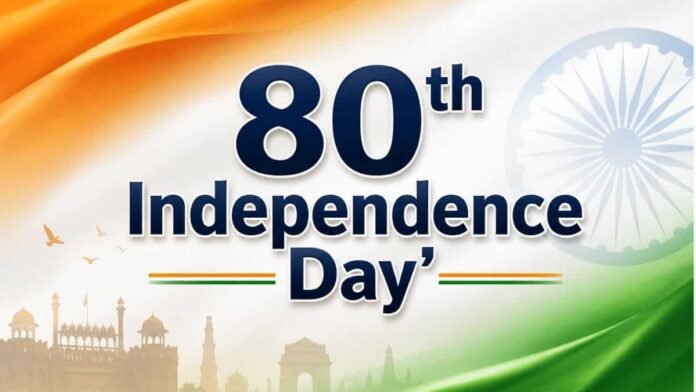
As India marks its 80th Independence Day, the tricolour carries memories of a hard-won freedom, and the aspirations of a nation looking towards 2047
On August 15, 1947, India awoke to freedom after nearly two centuries of British colonial rule. Eight decades later, on August 15, 2026, the tricolour will rise again, this time marking the 80th Independence Day of India.
The distance between those two mornings is more than a measure of time. It is the story of a nation that began its journey as a newly independent country and has since transformed itself through political, economic, scientific, technological and social change.
Yet Independence Day is never only about looking back.
It is also about asking what freedom has enabled, and what responsibilities it places on the generations that inherit it.
From the midnight hour to a nation of possibility
India’s freedom was not handed over peacefully. Generations of Indians participated in a long struggle against colonial rule, facing imprisonment, repression, sacrifice and, in countless cases, death.
The achievement of August 15 was therefore more than a transfer of political power. It was the beginning of India’s experiment with self-government and democracy.
The Constitution would soon give that freedom a democratic framework, placing sovereignty in the hands of the people. Every Independence Day consequently carries two memories: the struggle that won freedom and the democratic responsibility of preserving it.
Eight decades of transformation
The India of 2026 is vastly different from the India of 1947.
From building institutions and expanding education to developing industries, infrastructure and scientific capabilities, the country has travelled a remarkable distance. Indian achievements in space, digital technology, medicine, entrepreneurship and manufacturing have increasingly become part of the country’s global identity.
The transformation can also be seen in something as ordinary as connectivity. A country once divided by enormous distances now operates through digital networks that allow millions to access banking, education, public services and commerce from their phones.
But progress has never been uniform. Poverty, inequality, unemployment, environmental pressures, gaps in education and healthcare, and the challenge of ensuring opportunity for every citizen remain part of India’s unfinished journey.
That is why the meaning of independence continues to evolve.
The India of 2047 begins today
The 80th Independence Day arrives with India’s attention increasingly fixed on 2047, the centenary of independence. The national conversation around Viksit Bharat@2047 places the aspirations of today’s generation at the centre of that journey.
This year’s official celebrations at the Red Fort are built around “Yuva Shakti for Viksit Bharat@2047”, recognising the role of India’s young population in shaping the country’s future.
It is a fitting theme for a country where young Indians will inherit the India of 2047.
The question is no longer simply what India has achieved since 1947, but what kind of country it wants to become by its hundredth year of freedom.
A song, a memory, a nation
The 2026 celebrations also carry special cultural significance as India marks 150 years of Vande Mataram. For the first time, Vande Mataram will be rendered as part of the Independence Day celebrations at the Red Fort.
The National Song has accompanied India’s freedom movement and remained deeply embedded in the country’s national memory. Its presence at the 80th Independence Day celebrations therefore connects the present with the emotional and cultural landscape of the freedom struggle.
The celebrations will also bring together thousands of NCC cadets and My Bharat volunteers, with 2,500 young participants forming “वंदे मातरम्” along the Gyanpath opposite the Red Fort.
Freedom as a responsibility
Every generation inherits a different India.
For those who witnessed 1947, independence meant freedom from colonial rule. For later generations, it became the freedom to vote, to learn, to build businesses, to innovate and to imagine a different future.
For today’s generation, freedom also carries another responsibility, ensuring that progress reaches beyond statistics and skylines.
As the national flag rises on August 15, its three colours will once again bring millions together. But the significance of Independence Day lies not merely in the ceremony.
It lies in remembering that freedom was earned by those who came before us, strengthened by those who built the republic, and ultimately shaped by what we choose to do with it.
At 80, India’s story is not complete. It is still being written, by every citizen, every generation and every choice that shapes the India of tomorrow.