

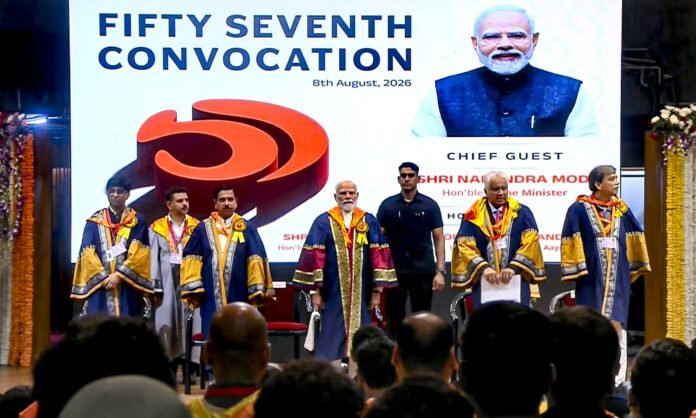
Prime Minister Narendra Modi addressed the 57th Convocation of IIT Delhi on August 8, 2026, calling upon graduating students to preserve their curiosity, continue learning and use their education to contribute to India’s technological and economic progress.
Addressing students, faculty members and families, the Prime Minister said that graduation should not mark the end of learning. He encouraged young professionals to retain the habit of asking questions, experimenting with new ideas and continuously acquiring knowledge throughout their careers.
The convocation came at a time when India is placing increasing emphasis on research, innovation and indigenous technology. During his address, the Prime Minister highlighted the importance of strengthening India’s research ecosystem and announced a ₹1 lakh crore research funding initiative, aimed at supporting research and development and encouraging greater innovation.
The funding push is particularly significant as India seeks to build stronger capabilities in areas such as artificial intelligence, semiconductors, biotechnology, quantum technology, advanced manufacturing and other emerging fields. Institutions such as IIT Delhi are expected to play an important role in translating research into technologies, enterprises and solutions for national and global challenges.
PM Modi also urged graduating students to think beyond individual career success and consider how their knowledge could contribute to society. He emphasised that India’s young engineers and researchers have the opportunity to create solutions that address challenges ranging from energy and climate change to healthcare, agriculture and digital technology.
A notable moment during the ceremony came when the Prime Minister expressed concern over the limited representation of women among the medal winners. Reports from the event noted that only one or two women were among the medal recipients. The observation brought attention to the continuing need to encourage greater participation and achievement of women in engineering, technology and research.
The issue is particularly relevant as India’s technology sector expands rapidly. While women’s participation in higher education has increased substantially, representation can still vary considerably across engineering disciplines and at the highest levels of research, entrepreneurship and technological leadership.
The convocation also marked an important transition for the graduating students. After years of intensive academic training, they now enter workplaces, laboratories, startups, universities and public institutions where their knowledge will be tested against real-world challenges.
For IIT Delhi graduates, the message was therefore broader than simply celebrating an academic milestone. It was a call to remain intellectually curious, take risks, learn from failure and approach innovation with a sense of responsibility.
India’s ambitions to become a developed and technologically advanced economy will depend not only on infrastructure and investment but also on the ability of its institutions and young professionals to generate new ideas and transform them into meaningful solutions.
As the graduating class received its degrees and medals, the convocation served as both a celebration of achievement and a reminder of responsibility. The next chapter for these young engineers and researchers will not be defined solely by the degrees they earned, but by what they choose to build, discover and contribute to the world.