

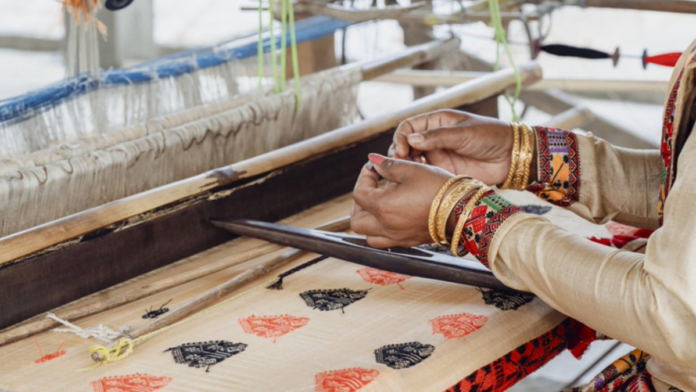
Every thread tells a story. Every motif carries a memory. And behind every handwoven fabric is a skilled artisan whose hands have preserved a tradition passed down through generations.
On August 7, India celebrates National Handloom Day, a day dedicated to the country’s rich weaving heritage and the millions of artisans who keep it alive. More than a celebration of textiles, the occasion recognises handloom as an important part of India’s cultural identity, rural economy, women’s empowerment and growing presence in global markets.
The date itself carries historical significance. August 7 commemorates the launch of the Swadeshi Movement in 1905, when the call to use indigenous products became a powerful expression of economic self-reliance and national pride. In 2015, the Government of India declared August 7 as National Handloom Day, with the first observance inaugurated in Chennai by Prime Minister Narendra Modi.
A heritage woven across India
India’s handloom tradition is as diverse as the country itself. From Banarasi silk and Kanjeevaram to Chanderi, Paithani, Sambalpuri, Jamdani and Rajasthan’s distinctive weaves, every region has developed textiles shaped by its climate, culture, history and artistic vocabulary.
The loom is therefore not simply a tool of production. It is a repository of knowledge. Patterns, dyeing techniques, motifs and methods of weaving are often passed from one generation to another, making every handloom textile a piece of living heritage.
The scale of this diversity is reflected in the government’s 2026 ‘Weaves of India’ Festival, which showcased handwoven creations representing 116 heritage weaves from across the country.
Women at the heart of the loom
Perhaps one of the most significant stories within India’s handloom sector is that of its women workers.
According to government information, the handloom sector provides livelihoods to more than 35 lakh people, with women accounting for over 70 per cent of the workforce.
For many women, weaving and allied activities provide an opportunity to contribute to household incomes while working within their communities. Their role extends across spinning, dyeing, weaving, finishing and other stages of textile production.
This makes handloom not merely a cultural industry but also an important instrument of economic participation and empowerment. Behind the elegance of a handwoven sari or stole is often a woman whose skill represents both livelihood and legacy.
Tradition meets sustainability
At a time when the environmental impact of fast fashion is receiving increasing attention, handloom offers an alternative rooted in slower and more conscious production.
Handloom weaving generally requires relatively little capital and power, while its production processes can have a lower environmental footprint than energy-intensive textile manufacturing. The sector therefore connects traditional knowledge with contemporary conversations around sustainable fashion.
Yet sustainability in handloom is not only about the fabric. It is also about sustaining communities, skills and livelihoods that could otherwise disappear.
From Indian looms to the world
The story of Indian handloom is no longer confined to local markets. Government institutions are increasingly working to connect artisans with designers, consumers and international markets.
The National Handloom Development Corporation identifies market linkages, including export markets, preservation of heritage and sustainable fabrics among its key objectives.
At the same time, innovation is becoming part of the sector’s future. Initiatives such as the Handloom Hackathon 2026 have brought technology, design, entrepreneurship and sustainability into conversations around traditional weaving.
This combination of heritage and innovation could be crucial for ensuring that handloom remains relevant to younger consumers without losing the authenticity that makes it unique.
More than a fabric
National Handloom Day ultimately asks us to look beyond the finished textile.
A handwoven sari is not simply clothing. A shawl is not merely an accessory. They represent hours of labour, inherited knowledge, regional identity and the hands of artisans who transform thread into art.
India’s handloom heritage has survived because generations of weavers continued to create, adapt and pass their knowledge forward. Its future, however, depends on whether the next generation chooses to value that craftsmanship.
To celebrate handloom, therefore, is to celebrate the people behind it. It is to recognise women whose work sustains families, artisans who preserve ancestral knowledge, and traditions that continue to give India a distinctive voice in the world of textiles.
On National Handloom Day, the most meaningful tribute may simply be to remember that when we choose a handwoven textile, we do not just wear a fabric, we carry forward a story.