

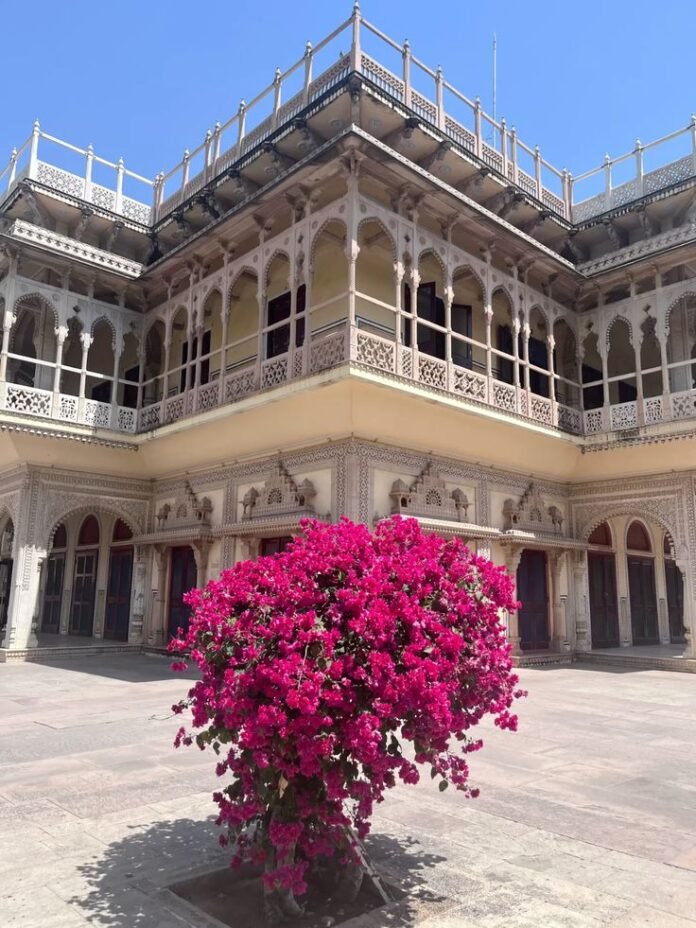
There’s something special about exploring Jaipur’s City Palace. You can wander through its grand courtyards, admire its magnificent gateways, and yet, every few steps, another detail catches your eye. During my visit, one building that immediately made me pause was Mubarak Mahal.
With its gleaming white marble façade, elegant arches, and intricate carvings, the palace has a quiet charm of its own. It doesn’t feel like just another beautiful structure within the City Palace complex. The longer I stood there, the more curious I became about the story behind it.
And that story takes us back to the royal Jaipur of the late nineteenth century.
The Story Behind Mubarak Mahal
Mubarak Mahal, meaning “Auspicious Palace,” was built in 1899 during the reign of Maharaja Sawai Madho Singh II. The palace is generally attributed to Sir Samuel Swinton Jacob, the British architect renowned for his contribution to the development of Indo-Saracenic architecture across Rajasthan.
Interestingly, Mubarak Mahal was never intended to be a royal residence. Instead, it was designed as a reception hall and guest house for visiting dignitaries and distinguished guests.
Knowing its original purpose makes its grand appearance feel even more meaningful. This was the first glimpse of Jaipur’s royal hospitality, where important visitors were welcomed into the world of the Kachwaha rulers.
Where Different Architectural Styles Meet
One of the first things I noticed while exploring Mubarak Mahal was how different architectural influences come together in a single structure.
The palace beautifully blends Rajput, Mughal, and European architectural styles. Its white marble exterior, graceful arches, finely carved pillars, ornamental balconies, and delicate latticework create an elegant appearance, while the overall design reflects the architectural experimentation of its era.
What fascinated me most was that the building doesn’t feel like a random mixture of styles. Instead, every element blends seamlessly, creating a structure that feels uniquely Jaipur.
And honestly, this is one of those places where looking up and appreciating the details is absolutely worth it.
Inside Mubarak Mahal
Today, Mubarak Mahal forms an important part of the Maharaja Sawai Man Singh II Museum, located within the City Palace complex. Once inside, the experience shifts from admiring architecture to discovering the objects that narrate stories of royal life.
The palace houses the renowned Textile and Costume Gallery, which preserves an extraordinary collection of royal garments, ceremonial robes, handwoven textiles, Pashmina shawls, embroidered fabrics, and other objects associated with Jaipur’s former royal family. These exhibits offer a fascinating glimpse into the craftsmanship, artistry, and lifestyle of the royal household.
Walking through these galleries made Jaipur’s royal history feel much more tangible. Rather than simply reading about the lives of kings and queens in history books, here were the very garments and objects that had once been part of that world.
More Than Just a Beautiful Building
What I appreciated most about Mubarak Mahal was that its beauty is only part of its story.
Its architecture reflects a period when traditional Indian craftsmanship met European design influences. Its original purpose speaks of royal hospitality, while its museum collections preserve the everyday elegance of Jaipur’s royal household. Together, they transform the palace into a fascinating window into the city’s rich heritage.
It’s easy to be overwhelmed by the grandeur of the City Palace, but Mubarak Mahal rewards those who choose to slow down.
Look closely at the carvings. Notice the arches. Take a moment to admire the intricate details.
Because sometimes the most memorable part of visiting a historic place isn’t simply seeing it, it’s imagining who stood there before us, what conversations echoed through its halls, and what stories are still quietly waiting to be discovered.
And that’s exactly what Mubarak Mahal felt like to me: a graceful doorway into Jaipur’s royal past, where history and architecture quietly come together.
(The writer of this article is Swagatika, an student of Army Public School, Jaipur)