

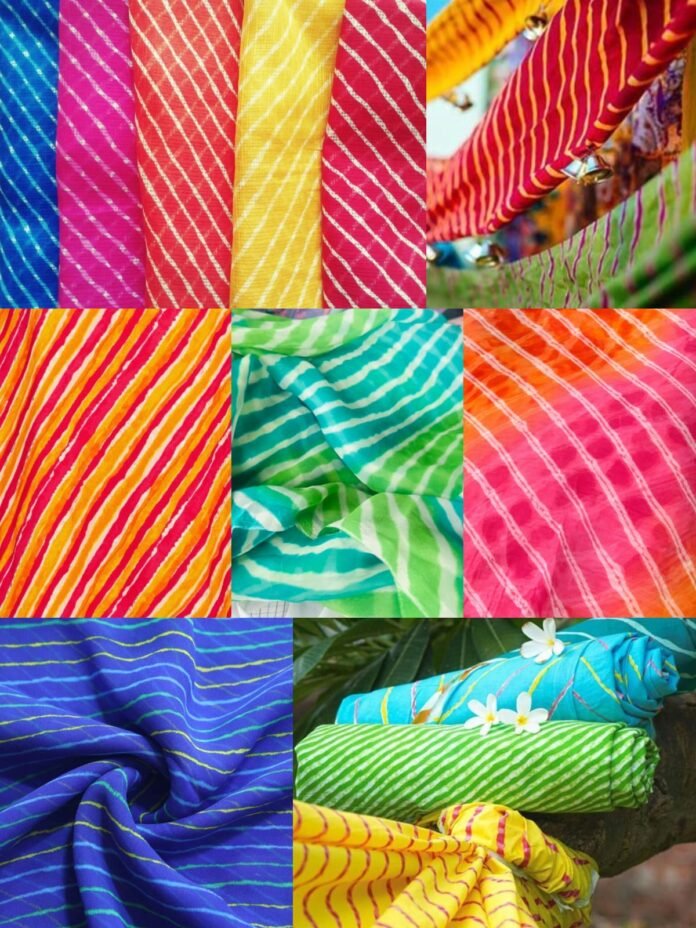
With the arrival of Sawan, Rajasthan bursts into a vibrant celebration of colours, music and traditions. The dry desert landscape comes alive with the festivities of Hariyali Teej, Raksha Bandhan, Shravan Mondays and local fairs, where women adorn themselves in bright traditional attire and men proudly wear colourful turbans. Among the many symbols of this joyous season, one textile stands out as the true fabric of the monsoon, Leheriya.
Graceful, colourful and deeply rooted in Rajasthan’s cultural identity, Leheriya is much more than a tie-and-dye textile. It is a celebration of heritage, craftsmanship and the enduring relationship between the people of Rajasthan and the rains they eagerly await every year.
A Fabric That Welcomes the Monsoon
The name Leheriya is derived from the Hindi and Rajasthani word lehar, meaning “wave”. True to its name, the textile is distinguished by flowing diagonal stripes that resemble rippling waves. In a land known for its vast sand dunes and scarce rainfall, these wave-like patterns beautifully capture the joy and relief brought by the monsoon.
For generations, Leheriya has been closely associated with the rainy season. Women traditionally wear Leheriya sarees, odhnis and dupattas during Hariyali Teej, while colourful Leheriya outfits are also popular during Raksha Bandhan, symbolising happiness, prosperity and new beginnings. In many Rajasthani families, gifting a Leheriya saree or dupatta to daughters and sisters during these festivals remains a cherished custom, carrying wishes for good fortune and marital bliss.
The Story Behind Leheriya
The origins of Leheriya date back to the 17th century, when the craft flourished under the patronage of Rajput rulers and wealthy merchant families in Rajasthan. Cities such as Jaipur, Jodhpur, Udaipur, Nathdwara and Kota became important centres for producing these beautifully dyed textiles.
Initially, Leheriya was largely worn by men as colourful safas and pagris, often reflecting their region, community or social status. Over time, the art became equally popular among women, finding expression in sarees, ghagras, odhnis and dupattas that became synonymous with festive occasions.
The inspiration behind Leheriya is believed to come from Rajasthan’s natural landscape. While some see its flowing lines as an artistic representation of rainwater and rivers, others associate them with the undulating sand dunes of the Thar Desert. Together, these elements capture the essence of movement, renewal and hope.
The Art of Creating Waves
Creating authentic Leheriya is a labour-intensive craft that demands remarkable precision and skill.
The artisan begins by taking lightweight fabrics such as cotton, chiffon, georgette or silk. The fabric is rolled diagonally into a long rope-like form and tightly tied with cotton threads at carefully measured intervals. It is then immersed in vibrant dyes. The tied portions resist the dye, and once the threads are removed, elegant wave-like stripes emerge across the fabric.
To create more elaborate designs, the process may be repeated with multiple colours. This gives rise to distinctive styles such as Panchranga (five colours), Satranga (seven colours) and Mothara, a striking checkered pattern created by tying and dyeing the fabric in opposite diagonal directions.
Traditionally, artisans used natural dyes extracted from plants and minerals. Today, synthetic dyes offer a wider colour palette while helping meet growing market demand.
Tradition Meets Contemporary Fashion
While Leheriya remains deeply connected to Rajasthan’s cultural traditions, it has also found a place in modern fashion. Designers are reinventing the classic wave pattern on kurtas, dresses, jackets, co-ord sets, scarves and even handbags, blending traditional craftsmanship with contemporary silhouettes. Embellishments such as gota patti, mirror work and fine embroidery further enhance its festive appeal.
Despite these innovations, the essence of Leheriya has remained unchanged. Every handcrafted piece continues to preserve the techniques passed down through generations of artisans, ensuring that the craft retains its authenticity even as it evolves with changing fashion trends.
A Living Heritage
Leheriya is not merely a textile, it is an expression of Rajasthan’s soul. Every wave carries stories of royal patronage, skilled craftsmanship, seasonal celebrations and the timeless optimism of people who have long awaited the life-giving rains.
As Sawan paints Rajasthan in shades of green and festivals fill the air with joy, Leheriya once again becomes more than just attire. It becomes a living tradition, connecting generations through colour, culture and craftsmanship. In every flowing stripe lies a reminder that heritage, like the monsoon itself, returns year after year, bringing beauty, hope and renewed celebration.