

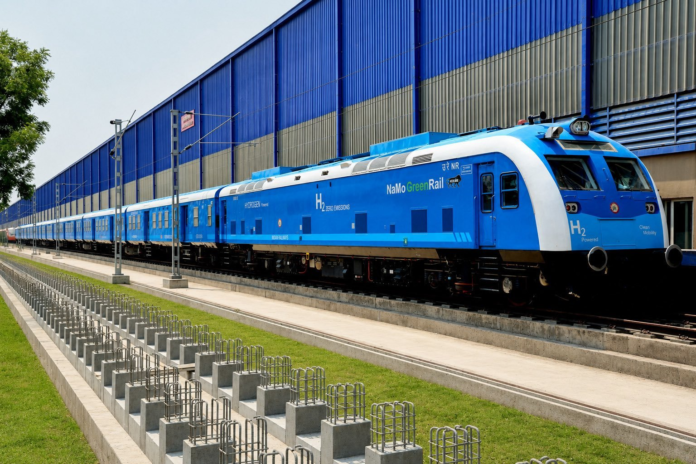
India has entered a new era of sustainable transportation with the launch of its first hydrogen-powered train, flagged off by Prime Minister Narendra Modi on July 17, 2026. The train will operate on the 89-kilometre Jind–Sonipat route in Haryana under the Northern Railway, making India one of the few countries in the world to adopt hydrogen fuel cell technology for passenger rail services.
Calling it a milestone for the country’s railway sector, Prime Minister Modi said India has joined an exclusive group of nations using hydrogen-powered trains, reinforcing its commitment to clean and environmentally friendly transportation.
What Makes the Hydrogen Train Special?
Unlike conventional diesel locomotives, the new train is powered by hydrogen fuel cells, which generate electricity through an electrochemical reaction between hydrogen and oxygen. The only by-products of this process are water and heat, making the train virtually emission-free. The project also includes dedicated hydrogen production, storage, and refuelling infrastructure, laying the foundation for a future hydrogen-powered railway network in India.
Developed as a pilot project, the train will help Indian Railways evaluate the performance, efficiency, safety, and commercial viability of hydrogen technology before expanding it to other non-electrified routes across the country.
Key Features of India’s First Hydrogen Train
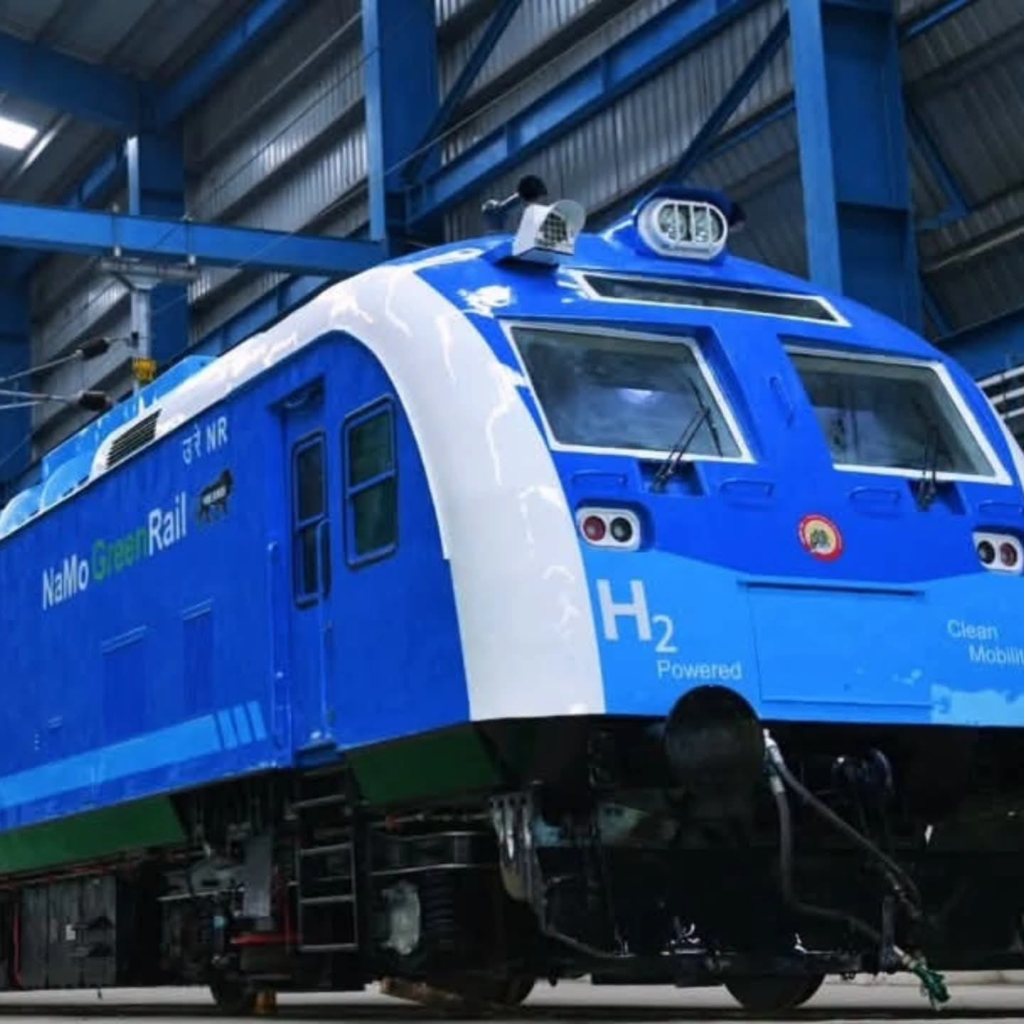
- 10-coach hydrogen fuel cell trainset
- 1,200 kW hydrogen fuel cell propulsion system
- Maximum operational speed: 75 km/h
- Design speed: 110 km/h
- Passenger capacity: Approximately 2,600 passengers
- Developed entirely from the design stage to prototype manufacturing in India
- Equipped with modern passenger amenities while significantly reducing environmental impact
Route and Stations
The hydrogen train will operate on the Jind–Sonipat section of Northern Railway, covering a distance of 89 kilometres.
The train will connect:
- Jind Junction
- Gohana Junction
- Sonipat
It will also serve several intermediate stations, including:
- Jind City
- Pandu Pindara Junction
- Lalit Khera Halt
- Bhambhewa
- Isapur Kheri Halt
- Butana Halt
- Khandrai Halt
- Rabrah Halt
- Lath Halt
- Mohana
- Barwasni Halt
- Sonipat New
How Does a Hydrogen Train Work?
A hydrogen-powered train uses compressed hydrogen stored in onboard tanks. Inside the fuel cell, hydrogen reacts with oxygen from the atmosphere to produce electricity. The electricity powers electric traction motors, while excess energy is stored in batteries for acceleration and regenerative braking. Unlike diesel engines, hydrogen trains:
- Produce zero carbon emissions during operation.
- Emit only water vapour.
- Generate significantly less noise and vibration.
- Reduce dependence on fossil fuels.
- Offer an environmentally friendly solution for routes where electrification is difficult or expensive.
Why Hydrogen Trains Matter
Indian Railways is one of the world’s largest rail networks and has committed to achieving net-zero carbon emissions by 2030.
Although a large part of the railway network has already been electrified, many branch lines and remote routes continue to rely on diesel locomotives. Hydrogen-powered trains provide a clean alternative for such routes without requiring expensive overhead electrification infrastructure.
The introduction of hydrogen technology is expected to:
- Reduce greenhouse gas emissions.
- Lower dependence on imported fossil fuels.
- Promote green hydrogen production under the National Green Hydrogen Mission.
- Support India’s transition towards sustainable transportation.
India Joins a Select Global Club
With the launch of its first hydrogen-powered train, India joins a handful of countries experimenting with or operating hydrogen rail technology.
Germany
Germany became the first country in the world to introduce hydrogen-powered passenger trains with the Alstom Coradia iLint. In 2022, one of these trains completed a 1,175-kilometre journey without refuelling, demonstrating the technology’s long-distance capability. Germany is also expanding hydrogen rail operations across additional regional routes.
Japan
Japan is developing its first hydrogen hybrid train, named HYBARI, which is expected to begin operations by fiscal 2027 on the Tsurumi and Nambu Lines near Tokyo.
United States
The United States introduced its first hydrogen-powered passenger train, ZEMU (Zero-Emission Multiple Unit), in California in 2024 as part of efforts to decarbonise regional rail services.
China
China has also been testing hydrogen-powered trains capable of higher speeds for urban and intercity transport, reflecting the growing global interest in hydrogen mobility.
A Step Towards Green Mobility
The launch of India’s first hydrogen-powered train marks a significant milestone in the country’s efforts to modernise its railway system while reducing its environmental footprint. As the pilot project progresses, Indian Railways is expected to assess its performance and explore the deployment of hydrogen-powered trains on additional routes, particularly where full electrification is not yet feasible.
The initiative aligns with India’s broader vision of achieving sustainable, low-carbon transportation and strengthening its leadership in clean energy technologies.