

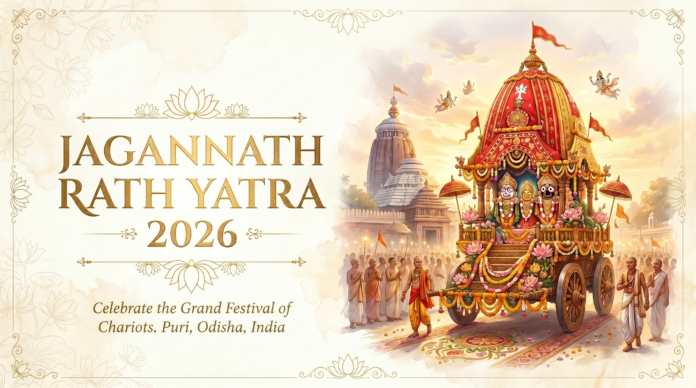
The holy city of Puri is ready to welcome lakhs of devotees as preparations reach their final stage for the annual Jagannath Rath Yatra, which begins on July 16, 2026. Revered as the world’s largest chariot festival, the nine-day celebration will witness Lord Jagannath, Lord Balabhadra, and Devi Subhadra leave the sanctum of the 12th-century Jagannath Temple and travel to the Gundicha Temple in three magnificent wooden chariots.
With an estimated 25 to 30 lakh devotees expected over the course of the festival, the Odisha government, temple administration, security agencies, and emergency services have undertaken one of the country’s largest annual logistical operations to ensure the event is conducted safely and smoothly.
Final Preparations in Full Swing
Preparations have been underway for months. The construction of the three iconic chariots, Nandighosha for Lord Jagannath, Taladhwaja for Lord Balabhadra, and Darpadalana (Devadalana) for Devi Subhadra, began on Akshaya Tritiya. Built entirely from specially selected timber by hereditary artisans, the chariots are assembled according to centuries-old temple traditions and are rebuilt from scratch every year.
In the final stage before the procession, the completed chariots are ceremonially positioned outside the Jagannath Temple following traditional rituals, ready for the deities’ grand departure.
Meanwhile, the Gundicha Temple, the destination of the yatra, has been cleaned, decorated, and prepared to receive the deities, who will stay there for about a week before returning during the Bahuda Yatra.
Massive Security and Crowd Management
Given the enormous gathering expected, Odisha has put in place extensive security arrangements.
Nearly 12,000 police personnel, including 19 senior IPS officers, have been deployed across Puri. The Odisha Fire and Emergency Services have stationed around 1,750 firefighters, supported by specialised K9 search teams, aerial ladder platforms, rescue equipment, and firefighting robots. Multi-agency mock drills involving the NDRF, fire services, district administration, and volunteers have also been conducted to prepare for emergencies.
Authorities have erected extensive barricading along the Grand Road (Bada Danda) to regulate crowd movement, while traffic diversions, medical camps, drinking water facilities, control rooms, and emergency response units have been established throughout the city.
Rituals That Mark the Beginning
One of the most anticipated rituals is Chhera Pahanra, during which the Gajapati Maharaja of Puri ceremonially sweeps the platforms of the three chariots with a golden broom. The ritual symbolises humility and the belief that everyone, regardless of status, is equal before Lord Jagannath.
The deities are then placed on their respective chariots and devotees pull the massive wooden structures along the approximately three-kilometre route to the Gundicha Temple, an act considered highly auspicious.
Planning to Attend? Here’s What You Should Know
Attending the Rath Yatra is a deeply spiritual experience, but it also requires careful planning.
● Reach Puri a day in advance if possible, as roads become heavily congested on the day of the procession.
● Start early and arrive well before the chariots begin moving to secure a safe viewing spot.
● Wear light, comfortable clothing and comfortable footwear suitable for long hours of standing and walking.
● Carry drinking water, basic medicines, sunscreen, and a cap or umbrella to protect yourself from the summer heat.
● Keep your mobile phone charged and carry only essential belongings. Avoid displaying valuables in crowded areas.
● Follow police advisories, use designated pedestrian routes, and avoid pushing or attempting to move too close to the chariots.
● Elderly people, children, and those with health conditions should stay in less crowded areas and remain with their companions at all times.
● If you wish to pull the chariot ropes, wait for instructions from temple volunteers and security personnel and avoid rushing forward.
Experienced devotees also recommend fixing a meeting point with family members beforehand in case anyone gets separated in the crowd.
More Than a Festival
For millions, the Jagannath Rath Yatra is not merely a religious event but a celebration of faith, equality, and community. It is one of the rare occasions when Lord Jagannath comes out of the temple to bless everyone, including those who may never enter the sanctum.
As the three majestic chariots begin rolling through the streets of Puri on July 16, they will carry with them centuries of devotion, craftsmanship, and tradition. For first-time visitors and lifelong devotees alike, witnessing the Rath Yatra is more than attending a festival, it is an unforgettable spiritual journey and one of India’s greatest living cultural traditions.