

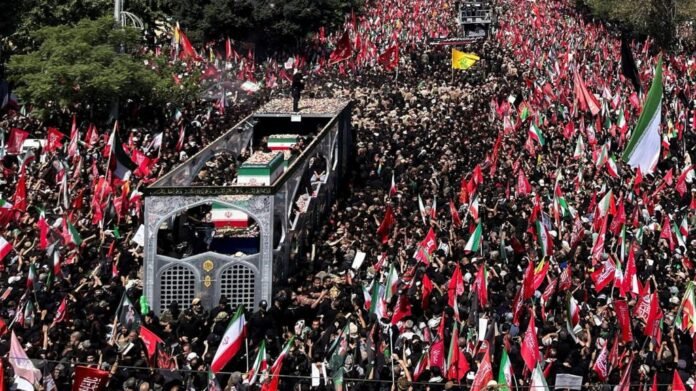
Iran is witnessing an outpouring of grief as the six-day state funeral of former Supreme Leader Ayatollah Ali Khamenei continues, with today’s ceremonies in Tehran drawing hundreds of thousands of mourners and marking one of the largest public gatherings in the country’s recent history. The state funeral, which began on July 4, will conclude on July 9 with Khamenei’s burial at the revered Imam Reza Shrine in Mashhad, his hometown and one of Shia Islam’s holiest sites.
Today’s funeral procession saw enormous crowds dressed in black accompanying the cortege through the streets of Tehran. Mourners carried Iranian flags, portraits of Khamenei, and religious banners while reciting prayers and elegies. Drone footage released by Iranian state media showed packed roads and public squares as people gathered to pay their final respects to the leader who headed the Islamic Republic for more than three decades. Authorities described the turnout as a symbol of national unity and resilience.
Emotions remained intense throughout the procession. Many mourners were seen weeping, praying, and chanting slogans in support of the late leader. At several locations, groups raised anti-American and anti-Israeli slogans, blaming the United States and Israel for Khamenei’s assassination during the recent conflict. Protesters burned American and British flags, while placards demanding revenge and justice were visible across the procession route. Some banners specifically targeted U.S. President Donald Trump and Israeli Prime Minister Benjamin Netanyahu, reflecting the anger among sections of the crowd.
Security arrangements across Tehran were unprecedented. Thousands of police officers, Revolutionary Guard personnel, and security forces were deployed to manage the massive crowds and ensure the smooth conduct of the ceremonies. The funeral has also attracted global attention, with hundreds of international journalists covering the event and several foreign delegations attending the state ceremonies.
One of the most discussed developments today was the absence of Iran’s current Supreme Leader, Mojtaba Khamenei, from the public procession. According to Iranian officials and international reports, he did not attend due to heightened security concerns following the recent conflict. His absence has generated widespread speculation, although authorities have maintained that it was purely a security-related decision.
The funeral ceremonies will continue over the next few days with religious observances and processions at significant sites in Iran and Iraq, allowing people from different regions to pay homage. The final rites are scheduled for July 9, when Ayatollah Ali Khamenei will be laid to rest at the Imam Reza Shrine in Mashhad.
For many supporters, the ongoing funeral is not merely a farewell to a political leader but a tribute to a figure they regard as the guardian of Iran’s Islamic Revolution.
At the same time, the ceremonies have underscored the deep regional tensions that continue to shape West Asia. As Iran prepares for the final burial, the images emerging from Tehran—of mourning crowds, heightened security, and emotionally charged processions—reflect a nation bidding farewell to one of the most influential figures in its modern history.