

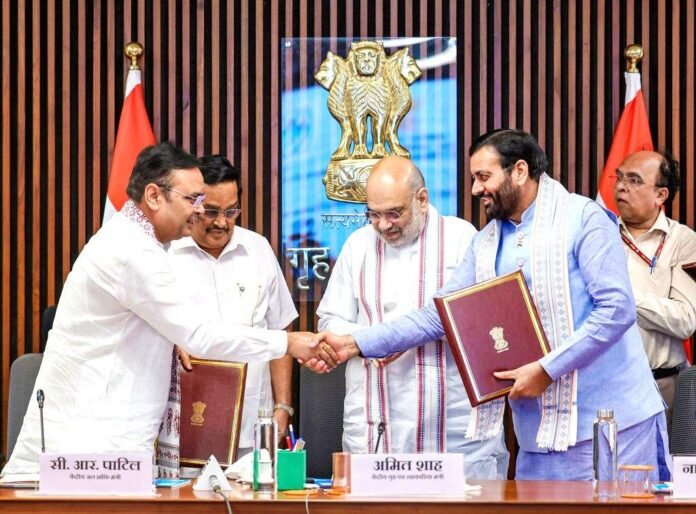
In a landmark step towards resolving a decades-old inter-state water issue, Haryana and Rajasthan have signed a Memorandum of Understanding (MoU) to implement the long-pending 1994 Upper Yamuna River Board (UYRB) Agreement, paving the way for Rajasthan to finally receive its allocated share of Yamuna water.
The agreement, signed in New Delhi in the presence of Union Home Minister Amit Shah, Union Jal Shakti Minister C.R. Patil, Haryana Chief Minister Nayab Singh Saini, and Rajasthan Chief Minister Bhajan Lal Sharma, marks the implementation of a commitment that remained on paper for more than three decades.
What is the 1994 Upper Yamuna Water Agreement?
The foundation of the latest pact dates back to May 12, 1994, when the Upper Yamuna basin states—Haryana, Rajasthan, Uttar Pradesh, Himachal Pradesh, and the National Capital Territory of Delhi—signed an agreement to share the river’s usable surface water. Uttarakhand became part of the arrangement after its formation in 2000.
To oversee the allocation and regulation of water, the Upper Yamuna River Board (UYRB) was established under the Ministry of Jal Shakti. However, despite Rajasthan being allocated a share of Yamuna water, the absence of the required infrastructure meant the state could not receive it for over 30 years.
What Does the New MoU Provide?
The newly signed agreement clears the way for the implementation of the Yamuna Water Project, under which Rajasthan will receive its allocated Yamuna water from the Hathnikund Barrage in Haryana during the monsoon months (July to October).
The water will be transported through a dedicated underground pipeline network of nearly 295 kilometres, a solution designed to minimise water losses through seepage and evaporation while ensuring efficient delivery to water-scarce regions of Rajasthan. The project is estimated to cost ₹34,102 crore.
Relief for Rajasthan’s Water-Scarce Regions
The project is expected to bring substantial relief to Shekhawati, one of Rajasthan’s most water-stressed regions, covering districts such as Jhunjhunu, Sikar, and Churu. The additional water is expected to improve drinking water availability and strengthen long-term water security for millions of residents who have historically depended on limited groundwater resources.
A Milestone in Cooperative Federalism
The agreement is being viewed as a significant example of cooperative federalism, where the Centre and states have worked together to implement a long-pending inter-state commitment through dialogue and consensus.
Speaking at the signing ceremony, Union Home Minister Amit Shah described the agreement as a major achievement in ensuring equitable water distribution and strengthening cooperation between states. Both Haryana and Rajasthan governments termed the pact a historic step towards addressing future water needs through planned infrastructure and coordinated governance.
Political Reactions
While the agreement has been welcomed by both state governments, it has also generated political debate in Haryana. Opposition parties have raised concerns over the state’s own water requirements and the unresolved Sutlej-Yamuna Link (SYL) Canal issue, arguing that Haryana’s water interests must remain protected alongside the implementation of the new agreement.
Why This Agreement Matters
Water-sharing disputes have long been among the most sensitive inter-state issues in India. The implementation of the 1994 Upper Yamuna Agreement demonstrates that negotiated solutions backed by modern infrastructure can revive long-pending commitments.
If executed as planned, the Yamuna Water Project is expected to improve drinking water access, enhance regional water security, and strengthen cooperation between neighbouring states. More importantly, it transforms a 32-year-old promise into an actionable project, offering hope that collaborative governance can address some of India’s most complex resource-sharing challenges.