

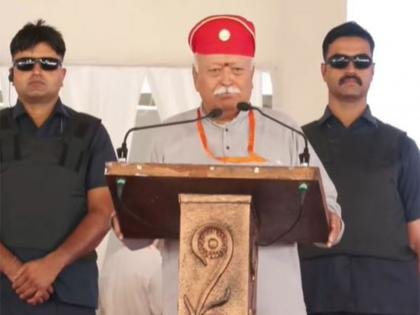
The legacy of Maharana Pratap once again took centre stage in Udaipur as Rashtriya Swayamsevak Sangh (RSS) chief Mohan Bhagwat participated in commemorative events marking the 450th anniversary of the Battle of Haldighati. Addressing a large gathering, Bhagwat described the battle as a victory of Maharana Pratap and the forces that stood for the protection of their homeland, while emphasizing the enduring relevance of unity, cultural pride, and national resolve.
The event coincided with celebrations linked to Maharana Pratap’s birth anniversary and the 450th year of the historic battle fought on June 18, 1576, between the forces of Mewar led by Maharana Pratap and the Mughal army commanded by Man Singh of Amber.
Speaking at the programme, Bhagwat said that the anniversary of Maharana Pratap’s birth and the remembrance of the Battle of Haldighati are deeply interconnected.
“Why did the victory in the Haldighati battle happen? Because Maharana Pratap was born. Today is the reason for yesterday,” he remarked, underlining the ruler’s leadership, determination, and commitment to preserving the independence of Mewar.
Bhagwat asserted that the Battle of Haldighati should be viewed as a victory of Maharana Pratap and those who fought alongside him. He argued that historical narratives surrounding the battle had often been presented through a limited lens and called for a broader understanding of its long-term consequences.
According to him, while the battle may not have resulted in an immediate decisive military outcome, Maharana Pratap’s continued resistance prevented the complete subjugation of Mewar and ultimately ensured the survival of its sovereignty.
The Battle of Haldighati remains one of the most discussed episodes in Indian history. Although many contemporary historians describe the encounter as tactically inconclusive or a Mughal victory due to the withdrawal of Maharana Pratap’s forces from the battlefield, they also acknowledge that Akbar failed to achieve his larger objective of bringing Mewar fully under Mughal control. Maharana Pratap continued his struggle for several years after the battle and later succeeded in regaining significant parts of his kingdom, excluding Chittorgarh and a few strategic forts.
During his address, Bhagwat also stressed the importance of social cohesion and harmony. Referring to the values embodied by Maharana Pratap’s resistance, he said unity should not emerge only during times of crisis but should become a permanent feature of everyday life. A society that remains united in ordinary times, he noted, is better prepared to face extraordinary challenges.
The RSS chief highlighted the diverse composition of Maharana Pratap’s forces, recalling how people from different communities and backgrounds came together in defence of Mewar. Historians have often pointed to figures such as Hakim Khan Sur, an Afghan commander who fought alongside Maharana Pratap, as examples of the broad coalition that supported the Sisodia ruler’s cause.
The commemorative events in Udaipur brought together historians, scholars, public representatives, cultural organisations, and admirers of Maharana Pratap’s legacy. Various programmes, including discussions, cultural presentations, and tributes, were organised to mark the occasion and reflect on the enduring significance of one of Rajasthan’s most revered historical figures.
More than four centuries after his death, Maharana Pratap continues to occupy a unique place in India’s historical consciousness. Celebrated for his courage, resilience, and refusal to surrender despite overwhelming odds, he remains a symbol of self-respect and determination for millions. The anniversary observances in Udaipur served as a reminder that the story of Haldighati is not merely about a single battle but about a larger legacy of perseverance, sacrifice, and the defence of freedom.
As debates over historical interpretation continue, the commemorations underscored one point on which there is broad agreement: Maharana Pratap’s unwavering commitment to Mewar and his enduring influence on Indian history remain as powerful today as they were nearly 450 years ago.