


Artificial Intelligence (AI) is transforming the world at an unprecedented pace. From chatbots and virtual assistants to medical diagnostics and autonomous systems, AI is becoming an integral part of daily life. However, behind every AI-generated response lies a less visible reality, an enormous network of data centres that consume vast quantities of water.
As India races to become a global AI powerhouse, experts are raising concerns about a growing environmental challenge: the water footprint of AI infrastructure.
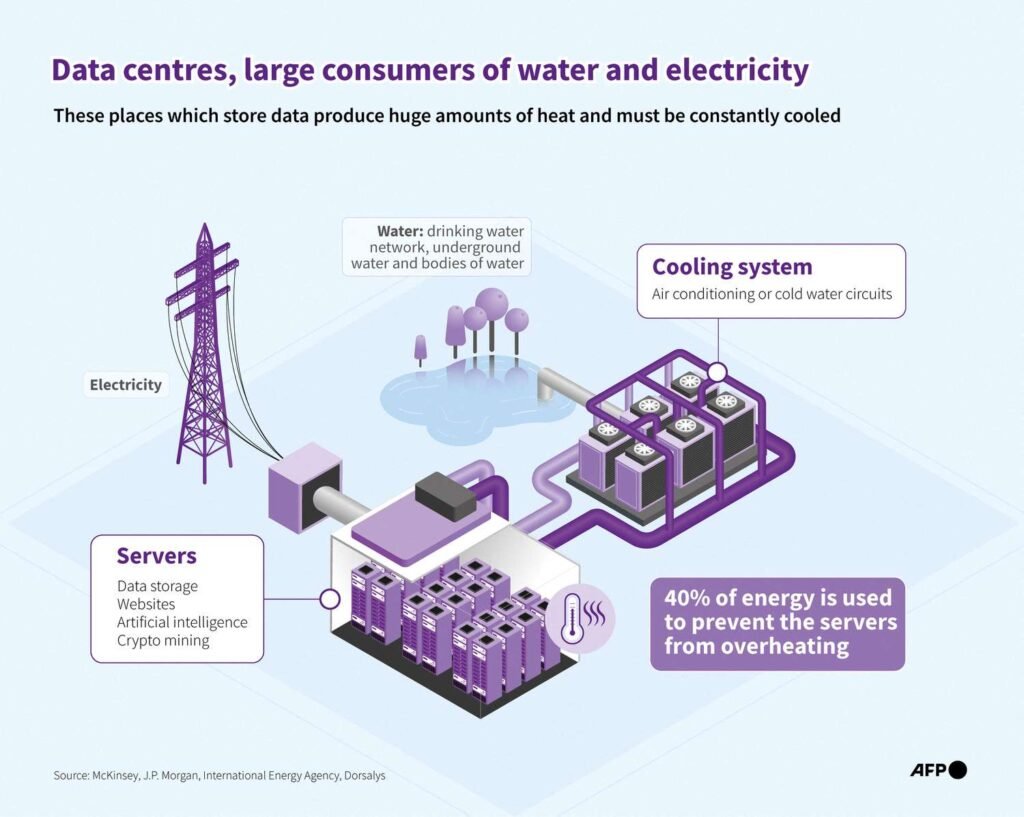
Data centres, the backbone of AI and cloud computing, generate immense heat while processing and storing data. To prevent servers from overheating, these facilities rely on sophisticated cooling systems, many of which consume large amounts of freshwater. A single 100-megawatt data centre can require nearly two million litres of water every day for cooling purposes.
The concern is particularly significant for India, a country that supports nearly 18% of the world’s population but possesses only about 4% of global freshwater resources. As AI adoption accelerates, the demand for data centres is expanding rapidly across cities such as Hyderabad, Bengaluru, Chennai, Mumbai and Delhi NCR, many of which already face recurring water shortages.
According to industry estimates, India’s data centres consumed around 150 billion litres of water in 2025. That figure is projected to rise dramatically to nearly 359 billion litres by 2030 as AI workloads increase and new facilities come online.
The issue is not confined to India. A recent report by the United Nations University warns that global AI-related data centres could consume as much as 9.3 trillion litres of water annually by 2030, equivalent to the basic yearly water needs of approximately 1.3 billion people. Researchers argue that while AI promises greater efficiency and innovation, its physical infrastructure demands enormous quantities of water, electricity, land and raw materials.
Even seemingly simple AI interactions have a hidden environmental cost. Studies suggest that the water required to support AI operation, including cooling and electricity generation, can accumulate rapidly when billions of users interact with AI systems daily. As AI-generated content, image creation and large language models become mainstream, the demand on data-centre infrastructure continues to grow.
Major technology companies are aware of the challenge. Firms such as Microsoft, Google and Amazon are investing in more efficient cooling technologies, including closed-loop liquid cooling systems and water-recycling mechanisms. Some companies have pledged to replenish more water than they consume and are exploring alternative cooling methods that reduce dependence on freshwater.
Yet experts caution that efficiency gains alone may not offset the explosive growth of AI. As the number of data centres multiplies, total water consumption could continue rising despite technological improvements. The challenge is especially acute in regions already experiencing water stress, where competition between industrial demand and community needs is becoming increasingly visible.
The AI revolution is often portrayed as a purely digital phenomenon, but its foundations are deeply physical. Servers require electricity, cooling systems require water, and data centres require land. As nations embrace AI-driven growth, balancing technological progress with environmental sustainability will be crucial.
The future of AI should not be measured solely by computational power and innovation. It must also be judged by how responsibly it uses the planet’s most precious resources. The challenge for India, and the world, is to ensure that the pursuit of artificial intelligence does not come at the cost of water security.