

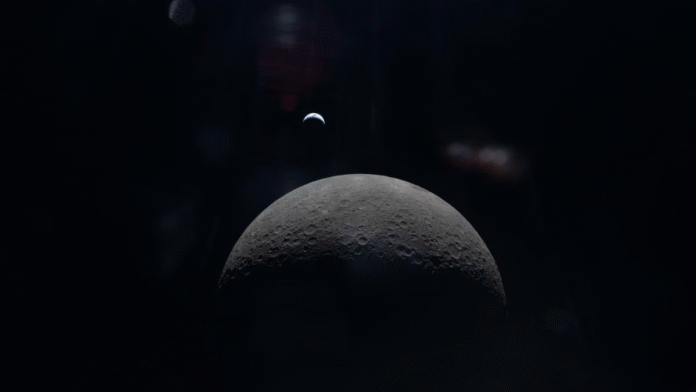
A newly discovered fuel-saving route to the Moon could reshape the future of low-cost space logistics, according to research published in April 2026 in the journal Astrodynamics. The study, led by an international team from University of São Paulo and University of Coimbra, reveals a lunar transfer trajectory that significantly reduces the amount of fuel needed for Earth-to-Moon missions.
The research was led by Allan Kardec de Almeida Júnior, with Vitor Martins de Oliveira contributing to the work. Their findings point to a route that cuts fuel use by at least 58.8 metres per second of delta-v compared with previously known optimal trajectories.
A New Path Through Space
Travel between Earth and the Moon depends on carefully calculated transfer trajectories that balance orbital mechanics with the gravitational pull of celestial bodies. In spaceflight, even small reductions in delta-v — the change in velocity required for manoeuvres — can translate into major savings in fuel, launch costs, and spacecraft mass.
The newly identified route exploits the combined gravitational influence of Earth and the Moon and follows pathways associated with the Interplanetary Transportation Network, a system of low-energy routes through the Solar System. Instead of approaching the Moon directly, the trajectory swings around the Earth-Moon L1 Lagrange point — a gravitational equilibrium zone located between the two bodies — before arriving from the Moon’s far side.
Inspired by Earlier Missions
Low-energy lunar transfers are not entirely new. Similar techniques were used by Hiten during its pioneering 1991 mission and later by GRAIL, which mapped the Moon’s gravity field using twin spacecraft.
What sets the new trajectory apart is its combination of fuel efficiency and operational advantages. According to the researchers, the route maintains uninterrupted communication with Earth throughout the journey. Traditional lunar transfers often experience signal blackouts when spacecraft pass behind the Moon, but this path avoids those communication dead zones entirely.
Millions of Simulations
To identify the route, the scientists relied on advanced computer modelling and a mathematical approach known as the theory of functional connections. The team simulated roughly 30 million possible trajectories and referenced around 280,000 cases before isolating the most efficient pathway.
The current model considered only the gravitational effects of Earth and the Moon. Future research could incorporate the Sun’s gravity, potentially uncovering even more efficient mission profiles tailored to specific launch windows.
Slow but Economical
The trade-off for the fuel savings is time. The journey takes nearly 32 days to reach the Moon, far longer than conventional lunar missions. That makes the route unsuitable for crewed missions requiring rapid transit, but highly attractive for non-urgent cargo transport, scientific payloads, and robotic missions where cost efficiency matters more than speed.
As international interest in lunar exploration grows, including plans for permanent lunar infrastructure and commercial cargo delivery, low-energy trajectories like this one could become essential for reducing mission costs and expanding sustainable access to deep space.