

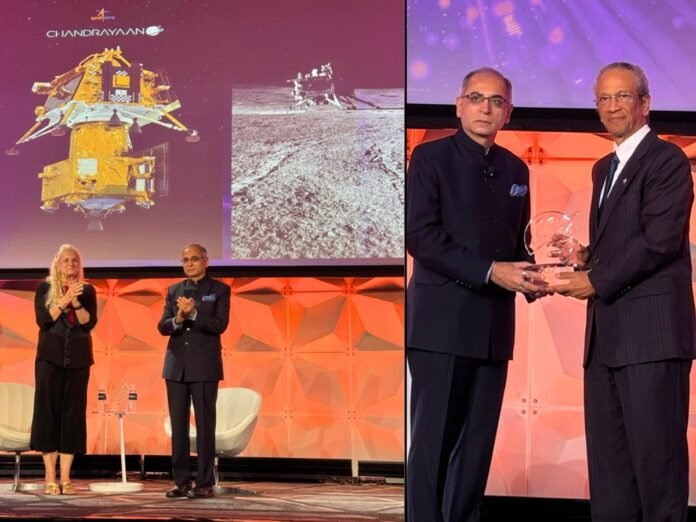
India’s historic Chandrayaan-3 mission has added another remarkable achievement to its legacy by receiving the prestigious 2026 Goddard Astronautics Award from the American Institute of Aeronautics and Astronautics (AIAA), one of the world’s leading aerospace organisations. The award recognises exceptional contributions to astronautics and space exploration and places the Indian Space Research Organisation (ISRO) among the most respected names in global space science.
The honour comes nearly three years after Chandrayaan-3 achieved its historic soft landing near the Moon’s south polar region on August 23, 2023 — a feat accomplished by only a handful of nations. More significantly, India became the first country in the world to land a spacecraft near the Moon’s south pole, an area considered scientifically important because of the possibility of water ice deposits.
The AIAA Goddard Astronautics Award has previously recognised some of the biggest achievements in global space exploration. By selecting Chandrayaan-3, the organisation acknowledged the mission’s innovation, cost-effectiveness and scientific importance. The award particularly celebrates ISRO’s successful demonstration of precision lunar landing technology under highly challenging conditions.
Chandrayaan-3 consisted primarily of the Vikram lander and Pragyan rover. After landing successfully, the rover conducted experiments on the lunar surface, studying soil composition, temperature and seismic activity. The mission also demonstrated India’s growing capability in autonomous navigation, landing systems and deep-space communication.
The achievement holds special significance because it came after the setback of Chandrayaan-2 in 2019, whose lander lost communication moments before touchdown. Rather than slowing down India’s ambitions, the earlier setback became a learning experience that strengthened ISRO’s engineering and mission planning. Chandrayaan-3’s success was therefore celebrated not just as a technological victory, but as a story of resilience and scientific determination.
Global recognition for the mission reflects India’s rising stature in the international space community. Over the years, ISRO has earned worldwide respect for conducting ambitious missions at comparatively low costs. From launching satellites for multiple countries to successful Mars and Moon missions, India’s space programme is increasingly seen as a model of innovation and efficiency.
The recognition also comes at a time when India is rapidly expanding its space ambitions. ISRO is currently working on projects including the Gaganyaan human spaceflight mission, further lunar exploration and advanced solar studies. The success of Chandrayaan-3 has inspired a new generation of students and young scientists across the country, reinforcing the idea that India is emerging as a major force in global space exploration.
For millions of Indians, the award is more than an international honour — it is a moment of national pride. It symbolises how Indian science, perseverance and vision have carried the country from Earth’s laboratories to the unexplored frontiers of the Moon.