

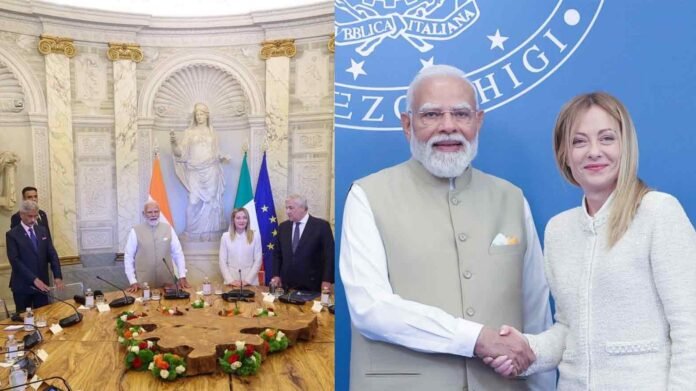
Prime Minister Narendra Modi’s visit to Italy marked a major diplomatic milestone in India’s engagement with Europe, with New Delhi and Rome announcing a strengthened strategic partnership focused on trade, defence, connectivity, clean energy and emerging technologies. The Italy leg concluded PM Modi’s six-day, five-nation diplomatic tour covering the UAE, the Netherlands, Sweden and Norway.
PM Modi held extensive bilateral talks in Rome with Italian Prime Minister Giorgia Meloni, during which both leaders reviewed the growing India-Italy relationship and agreed to deepen cooperation across multiple sectors. According to the joint declaration issued after the talks, the two countries reaffirmed their commitment to the India-Italy Joint Strategic Action Plan 2025–2029 and unveiled an ambitious roadmap for expanding economic and technological collaboration.
One of the key highlights of the visit was the emphasis on the India-Middle East-Europe Economic Corridor (IMEC), a major connectivity initiative aimed at linking India with Europe through the Middle East. Both India and Italy described the corridor as strategically important for trade, logistics, energy connectivity and resilient global supply chains. The leaders stressed the need for secure and diversified connectivity routes amid evolving geopolitical challenges.
Trade and investment cooperation formed another major pillar of the discussions. India and Italy agreed to enhance collaboration in manufacturing, semiconductors, artificial intelligence, renewable energy, critical minerals, aerospace and defence industries. Italy expressed strong interest in expanding investments in India’s growing manufacturing and infrastructure sectors under the “Make in India” initiative.
Defence cooperation also received significant attention during the talks. Both countries agreed to strengthen maritime security collaboration, defence industrial partnerships and counter-terrorism cooperation. Discussions reportedly included joint ventures in defence manufacturing and technological collaboration between Indian and Italian industries.
Energy transition and sustainability emerged as important areas of partnership. India and Italy committed to increasing cooperation in green hydrogen, clean mobility, climate resilience and circular economy initiatives. The two countries also discussed collaboration in scientific research, higher education and innovation ecosystems.
PM Modi and Prime Minister Meloni additionally explored ways to boost cultural and people-to-people ties. Mobility for students, researchers and professionals was discussed, along with efforts to promote tourism and cultural exchanges between the two nations.
The visit also drew international attention for the warm personal rapport between PM Modi and Giorgia Meloni. Ahead of formal talks, the two leaders shared a car ride, informal dinner discussions and a visit to the historic Colosseum in Rome, images of which became widely shared across social media platforms. Analysts viewed the interactions as symbolic of the increasingly close ties between India and Italy.
During the visit, PM Modi also interacted with members of the Indian diaspora and emphasized India’s rapid economic transformation, technological progress and growing role in global affairs. He highlighted that India today is emerging as a major hub for innovation, manufacturing and digital growth.
The Italy visit is being viewed as strategically significant because it reinforces India’s expanding partnerships with major European nations at a time of shifting global economic and geopolitical dynamics. Experts believe the agreements and understandings reached during the visit could strengthen India’s access to advanced technologies, investments and European markets while also enhancing cooperation in global governance and connectivity initiatives.
With the successful conclusion of the Italy leg, PM Modi wrapped up a diplomatic tour that significantly advanced India’s partnerships in energy, technology, trade and strategic cooperation across the Gulf and Europe.