

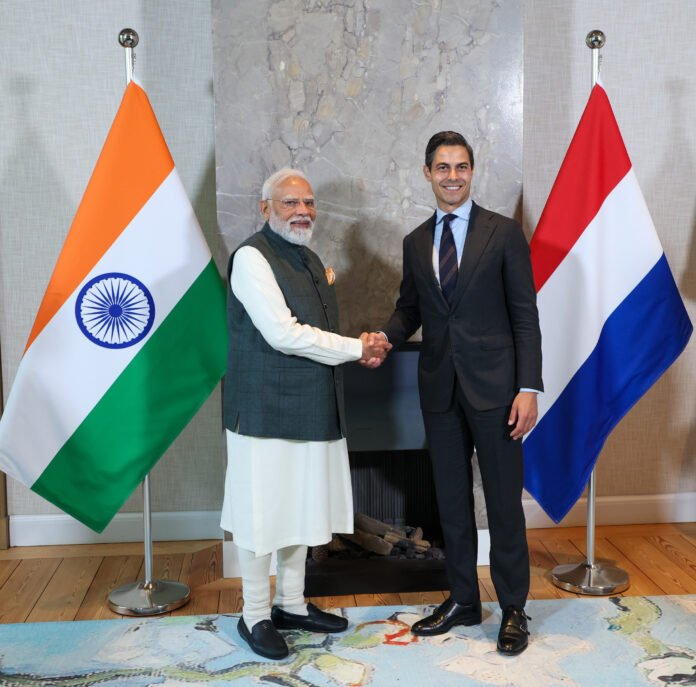
Prime Minister Narendra Modi’s visit to the Netherlands has emerged as one of the most significant diplomatic successes of his ongoing five-nation tour, with India and the Netherlands officially elevating their relationship to a “Strategic Partnership.” The two countries signed 17 major agreements and unveiled a comprehensive roadmap aimed at expanding cooperation across defence, semiconductors, green energy, critical technologies, trade and innovation.
During his visit to The Hague, PM Modi held extensive bilateral talks with Dutch Prime Minister Rob Jetten, focusing on strengthening collaboration in emerging and strategic sectors. Both leaders emphasized that India and the Netherlands share common democratic values, support for a rules-based international order and a commitment to sustainable development.
One of the biggest outcomes of the visit was the launch of the “India–Netherlands Strategic Partnership Roadmap,” which outlines cooperation in trade and investment, defence and security, clean energy, semiconductors, artificial intelligence, quantum computing, cyber security and space technology.
The agreements signed during the visit covered several key sectors. Both nations agreed to deepen cooperation in green hydrogen, renewable energy transition, water management, climate resilience and sustainable agriculture. A Joint Statement of Intent was also signed between NITI Aayog and Dutch authorities for collaboration in the energy sector and energy transition projects.
Defence and security cooperation featured prominently in the discussions. India and the Netherlands agreed to strengthen maritime security collaboration and defence partnerships amid growing global geopolitical uncertainties. Critical minerals and supply chain resilience were also discussed, reflecting Europe’s increasing interest in diversifying strategic partnerships with India.
Technology and semiconductor cooperation emerged as another major pillar of the visit. The Netherlands is home to some of the world’s leading semiconductor technology firms, and India is seeking stronger partnerships to support its expanding electronics and chip manufacturing ambitions under the “Make in India” initiative. Discussions also explored collaboration in artificial intelligence, digital innovation and research partnerships between universities and institutions from both countries.
PM Modi also highlighted the strong people-to-people ties between the two countries and praised the Indian diaspora in the Netherlands for contributing to bilateral relations. The leaders discussed ways to increase mobility for students, researchers, skilled professionals and businesses.
The Ministry of External Affairs described the visit as “highly successful,” noting that the outcomes would provide “new momentum” to India-Netherlands ties. PM Modi himself stated that the agreements and initiatives signed during the visit would give “unparalleled momentum” to the growing partnership between the two countries.
Analysts believe the visit has strategic significance far beyond bilateral ties. At a time of shifting global supply chains and geopolitical realignments, the Netherlands is increasingly viewing India as a trusted economic and strategic partner in the Indo-Pacific region. For India, the strengthened partnership opens new opportunities in advanced technology, green energy, defence cooperation and access to European markets.