

The Netherlands has officially returned the famous Anaimangalam copper plates, also known as the Leiden Plates, to India. But this was more than the return of centuries-old inscriptions. For historians, archaeologists, and heritage lovers, it marked the homecoming of a lost piece of India’s past, a silent witness to the glory of the Chola Empire that had spent generations far from the land where its story began.
The story of the plates begins during the reign of the great Chola emperor Rajaraja Chola I, who ruled South India from 985 CE to 1014 CE. His empire was powerful, wealthy, and deeply connected to trade routes across Asia. Rajaraja Chola I is remembered not only as a conqueror but also as a visionary ruler who built the magnificent Brihadisvara Temple, now recognised as a UNESCO World Heritage Site.
During his reign, the Anaimangalam copper plates were created to record royal grants and tax arrangements for the Chudamani Vihara, a Buddhist monastery located at Nagapattinam in present-day Tamil Nadu. In ancient India, copper-plate inscriptions were the official documents of kings. They preserved important announcements such as land donations, tax exemptions, and royal orders. Unlike paper, copper could survive centuries.
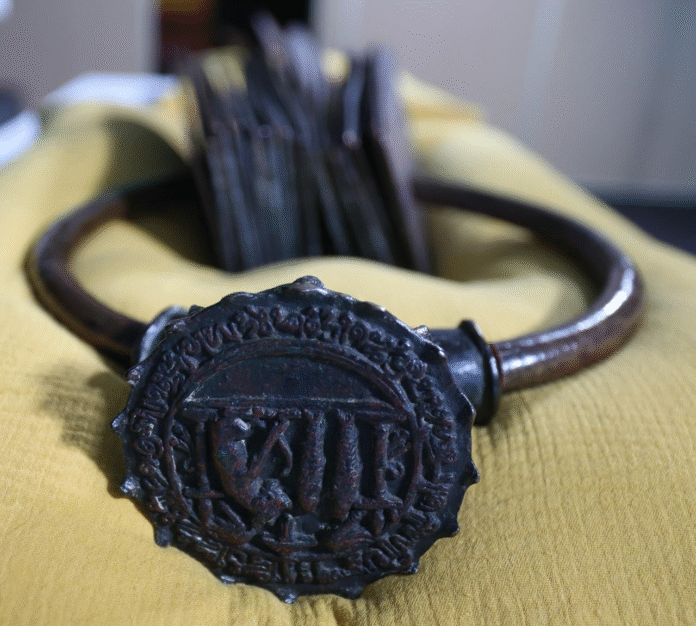
The plates themselves are remarkable. The collection contains 21 large plates and three smaller ones, weighing nearly 30 kilograms altogether. They are held together by a thick copper ring stamped with the royal seal of the Cholas — a symbol of authority and power from an empire that once ruled much of South India between the 9th and 13th centuries.
But over time, the plates drifted far from home.
In the 18th century, Dutch official Florentius Camper acquired them on the Coromandel Coast, then part of the Dutch colonial sphere in India. Eventually, the artefacts were taken to Leiden University in the Netherlands, where they remained for generations. Scholars studied them, historians translated them, and museums preserved them — yet the plates stayed separated from the land whose story they told.
The return of the Leiden Plates did not happen overnight. It followed years of diplomatic discussions between India, the Dutch government, and Leiden University. In 2022, the Netherlands introduced a restitution policy for colonial-era artefacts, opening the path for the return of cultural treasures taken during colonial times.
When the copper plates finally returned to India in 2026, the moment carried deep symbolic meaning. It reflected a growing global effort to restore cultural property to its rightful home. More than ancient objects, these plates are witnesses to India’s rich past — to the administrative brilliance of the Cholas, the spread of Buddhism in South India, and the enduring power of written history.
After centuries abroad, the voice engraved on copper had come home again.