

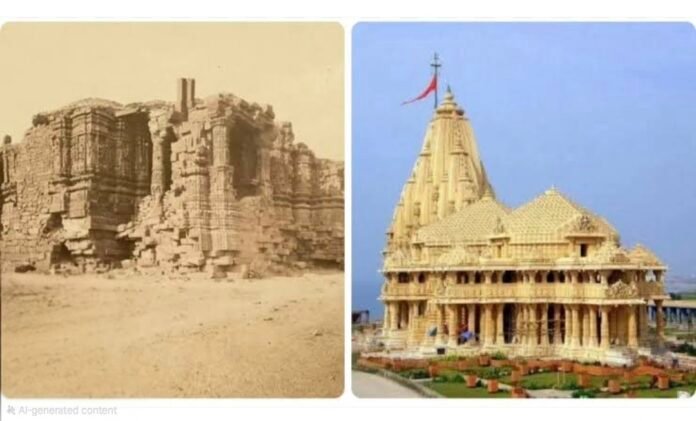
Standing majestically on the shores of the Arabian Sea in Somnath Temple, the Somnath Temple is far more than a place of worship. Revered as the first among the twelve Jyotirlingas of Lord Shiva, Somnath represents faith, resilience and the enduring spirit of Indian civilisation. Over centuries, the temple has been destroyed, rebuilt and revived multiple times, becoming one of the most powerful symbols of cultural continuity in India.
The word “Somnath” means “Lord of the Moon.” According to Hindu mythology, the Moon God, Soma, built the original temple in gold to worship Lord Shiva and seek freedom from a curse. Ancient legends later describe reconstructions in silver by Ravana and in sandalwood by Lord Krishna. While these accounts belong to mythology, they underline the temple’s immense spiritual importance in Hindu tradition.
Historically, Somnath has been an important pilgrimage centre since ancient times. Located at Prabhas Patan in Gujarat’s Saurashtra region, near the confluence of the rivers Kapila, Hiran and the mythical Saraswati, the site was mentioned in several ancient texts and inscriptions.
The temple’s history is deeply tied to repeated invasions and reconstructions. The most famous attack came in 1026 CE when Mahmud of Ghazni invaded the temple, looted its immense wealth and destroyed the shrine. Historical records describe Somnath at the time as one of the richest temples in India. Yet the temple rose again. Kings and rulers from different dynasties, including Bhima I of Gujarat and later Kumarapala, rebuilt and restored it repeatedly.
Over the centuries, the temple continued to face attacks under different invading rulers, including during the Delhi Sultanate and Mughal periods. Emperor Aurangzeb is believed to have ordered its destruction again in the early 18th century. However, despite repeated devastation, Somnath never disappeared from public memory or devotion.
The modern chapter of Somnath began after India’s Independence in 1947. Sardar Vallabhbhai Patel, India’s first Deputy Prime Minister, visited the ruins and resolved to rebuild the temple as a symbol of national pride and cultural restoration. The reconstruction effort, supported by K.M. Munshi and funded through public contributions, became one of independent India’s earliest cultural revival projects.
The present temple, built in the grand Chalukyan or Kailash Mahameru style of architecture, was inaugurated on 11 May 1951 by India’s first President, Dr Rajendra Prasad. Its towering shikhara, intricate carvings and sea-facing location make it one of India’s most iconic temples.
Today, Somnath attracts millions of devotees and tourists every year. But beyond religion, it continues to stand as a symbol of survival and renewal. Its story is not merely about destruction and reconstruction; it is about a civilisation’s ability to preserve faith and identity across centuries of change and conflict.
For many, Somnath is not just a temple — it is a reminder that while structures may fall, cultural memory and belief can endure through time.