

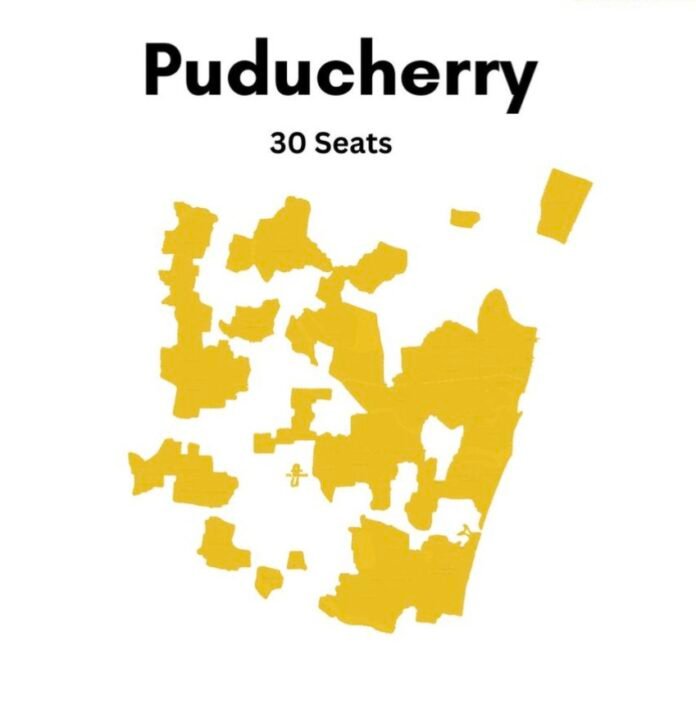
The 2026 Puducherry Assembly election has reaffirmed the dominance of the National Democratic Alliance (NDA) in the Union Territory, with the All India N.R. Congress (AINRC)–led alliance securing a clear majority and returning to power for another term. The result ensures the continuation of N. Rangasamy as Chief Minister, marking a significant endorsement of his leadership.
The Final Verdict: Seat Tally and Majority
The Puducherry Legislative Assembly has 30 elected seats, with 17 required for a majority. According to the latest results and confirmed trends, the NDA has comfortably crossed this mark.
●NDA (AINRC + BJP + allies): around 18 seats (majority)
●Opposition (DMK, Congress, others): around 10–12 seats
Party-wise trends indicate that AINRC emerged as the single largest party, supported by the Bharatiya Janata Party (BJP) and smaller allies, ensuring a stable government.
Rangasamy Factor: Leadership at the Core
At the heart of the NDA’s victory is the continued popularity of N. Rangasamy. A veteran leader and founder of AINRC, Rangasamy retained his seat and is set to begin another term in office.
His appeal among voters—often described as simple, accessible, and welfare-oriented—played a decisive role. Welfare schemes, financial assistance programs, and a relatively stable administration contributed to a pro-incumbency wave, which is relatively rare in Indian politics.
A High-Turnout Election
One of the standout features of the 2026 election was the record voter turnout, touching nearly 90%, the highest in Puducherry’s electoral history.
This high participation reflects strong public engagement and interest in the political process. Analysts attribute it to increased voter awareness, mobilisation by political parties, and active participation of youth voters.
Opposition Struggles and Fragmentation
The opposition alliance—primarily comprising the Dravida Munnetra Kazhagam (DMK) and the Indian National Congress—failed to mount a cohesive challenge.
Internal coordination issues, seat-sharing disagreements, and a lack of a strong unified campaign weakened their prospects. In several constituencies, confusion among voters and divided opposition votes worked to the advantage of the NDA.
Key Highlights and Constituency Battles
The election saw several closely fought contests across constituencies. Chief Minister Rangasamy’s victory from Thattanchavady was one of the earliest major results, setting the tone for the NDA’s performance.
In constituencies like Lawspet, AINRC candidates secured narrow but decisive wins, reflecting competitive local battles but an overall favourable trend for the ruling alliance.
Why the NDA Won
The NDA’s success in Puducherry can be attributed to a combination of factors. The most important among them was leadership credibility. Rangasamy’s personal image and governance record resonated strongly with voters.
Additionally, the alliance structure—bringing together AINRC, BJP, and regional partners—helped consolidate votes across communities. The absence of a strong, united opposition further amplified the NDA’s advantage.
There was also a visible element of pro-incumbency, suggesting that voters preferred continuity over change in the Union Territory.
What This Means for Puducherry
The 2026 verdict ensures political stability in Puducherry, with the NDA continuing its governance agenda. It also strengthens the BJP’s presence in the Union Territory through its alliance with AINRC.
For the opposition, the result serves as a signal to reorganise and rebuild a stronger, more unified challenge in the future.
Conclusion
The Puducherry Assembly election of 2026 may not have delivered a dramatic political upset like some other states, but it has reinforced a clear message—voters have backed continuity and leadership stability
With N. Rangasamy set to lead once again, Puducherry enters its next political phase with a familiar face at the helm, supported by a decisive mandate.