

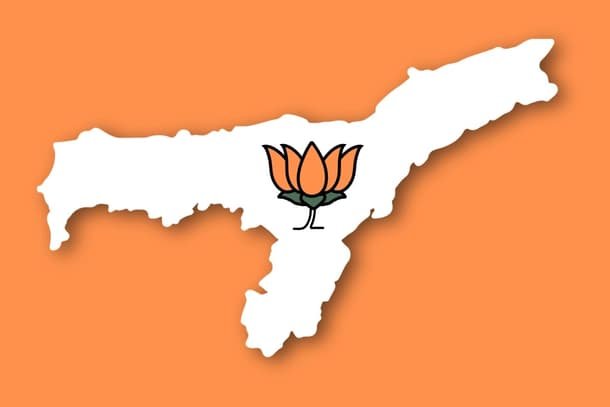
In a significant political endorsement, the Bharatiya Janata Party (BJP)-led alliance has returned to power in Assam for a third consecutive term in the 2026 Assembly elections. The verdict reinforces the party’s stronghold in the Northeast and marks a continuation of the leadership of Himanta Biswa Sarma.
Clear Mandate: Seat Tally and Outcome
The Assam Legislative Assembly has 126 seats, with 64 required for a majority. Early trends and confirmed results indicate a decisive victory for the BJP-led National Democratic Alliance (NDA).
●BJP-led NDA: around 88–100 seats (clear majority)
●Congress and allies: significantly behind
●Regional parties like AGP and BPF: contributing to NDA tally
Early counting trends showed BJP leading in nearly 79 seats, far ahead of the Congress, which trailed at around 24 seats.
With this performance, the NDA has comfortably crossed the majority mark, ensuring a stable government for a third straight term.
A Hat-Trick in the Northeast
This victory is particularly significant because:
●BJP has now won Assam three times in a row (2016, 2021, 2026)
●It strengthens the party’s long-term dominance in the Northeast
●Assam remains one of BJP’s most important political bases outside Hindi-speaking regions
Reports suggest that this result reflects continuity in governance and sustained voter trust in the BJP’s leadership.
What Worked for the BJP
The BJP’s victory in Assam is rooted in a combination of governance, organisation, and political strategy.
One of the biggest factors has been the leadership of Himanta Biswa Sarma, whose administration focused on infrastructure, welfare schemes, and regional stability. The party’s campaign highlighted development projects, law and order improvements, and efforts to address identity and migration-related concerns—key issues in Assam’s politics.
Additionally, the BJP’s alliance with regional partners like the Asom Gana Parishad (AGP) and Bodoland People’s Front (BPF) helped consolidate votes across different regions and communities.
Weak Opposition and Fragmented Contest
The Indian National Congress, which led the opposition, struggled to mount a strong challenge. Despite attempts to form alliances, the opposition vote remained fragmented.
Another notable development has been the sharp decline of the All India United Democratic Front (AIUDF), which saw its influence shrink significantly in this election.
This fragmentation allowed the BJP-led alliance to convert its vote share into a larger number of seats.
Regional Dynamics and Voter Trends
The BJP performed strongly across Upper Assam, Lower Assam, and key tribal regions, indicating a broad-based appeal. High voter turnout across constituencies also reflected strong public participation in the democratic process.
Local contests in constituencies like Barkhetri and Sibsagar showed competitive races, but the overall trend remained firmly in favour of the ruling alliance.
What This Means for National Politics
The Assam result, along with victories in other states, strengthens the BJP’s national position. It demonstrates the party’s ability to retain power over multiple terms, a challenge in many Indian states where anti-incumbency often plays a decisive role.
It also weakens the opposition’s prospects in the Northeast, where the BJP has steadily expanded its footprint over the past decade.
Conclusion: Continuity and Consolidation
The 2026 Assam Assembly election result is a clear mandate for continuity. With the BJP-led alliance securing a third straight term, the state is set to continue under the leadership of Himanta Biswa Sarma.
More than just a victory, this result represents political consolidation, where governance, organisation, and strategic alliances have come together to produce a decisive outcome. Assam, once politically volatile, now appears firmly aligned with a stable ruling formation—at least for the foreseeable future.