

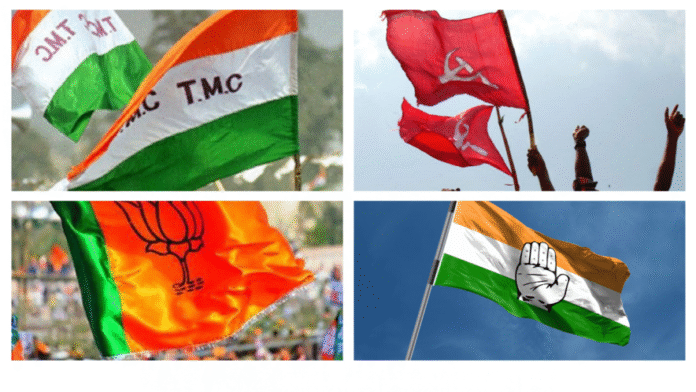
The politics of West Bengal presents one of the most fascinating and stable—yet periodically transformative—stories in Indian democracy. Marked by long ideological dominance and dramatic shifts, the state’s political journey reflects deeper social currents: class struggles, regional identity, and evolving aspirations.
Historical Background: From Congress to the Left
In the decades following Independence, the Indian National Congress dominated West Bengal, as it did much of India. However, political instability in the 1960s and growing discontent among workers, peasants, and the urban poor paved the way for Left-wing mobilization.
This culminated in the rise of the Left Front in 1977, led by the Communist Party of India (Marxist). The Left Front went on to rule West Bengal uninterrupted for 34 years (1977–2011)—the longest democratically elected communist government in the world.
Under leaders like Jyoti Basu and later Buddhadeb Bhattacharya, the regime implemented land reforms and strengthened panchayati raj institutions, building a strong rural support base. However, industrial stagnation and controversies such as Singur and Nandigram gradually eroded its appeal.
The Rise of Trinamool Congress
The turning point came in 2011, when the All India Trinamool Congress (TMC), led by Mamata Banerjee, defeated the Left Front. Founded in 1998 as a breakaway from the Congress, the TMC capitalized on anti-incumbency and grassroots mobilization.
Since then, the TMC has remained the dominant force, winning successive elections in 2011, 2016, and 2021. In 2021, it secured a massive mandate with over 200 seats in the 294-member assembly.
Banerjee’s governance has focused heavily on welfare schemes, regional identity, and strong centralized leadership.
Emergence of BJP and Decline of Congress–Left
While the Congress and Left once defined Bengal politics, their influence has sharply declined in recent years. The Bharatiya Janata Party (BJP), which historically had limited presence in the state, has emerged as the principal challenger since the late 2010s.
The 2021 elections marked a turning point, with the BJP becoming the main opposition. Since then, Bengal politics has largely evolved into a bipolar contest between TMC and BJP, with the Left and Congress struggling for relevance.
The 2026 Election: A Defining Moment
The 2026 West Bengal Assembly election, held in April with result to be declared on 4 May, has seen record voter participation—over 92% turnout, the highest in the state’s history.
The contest has once again been dominated by the TMC vs BJP rivalry. The BJP has aggressively campaigned on governance, development, and identity politics, while the TMC has relied on its welfare record and grassroots connect.
Exit polls suggest a neck-and-neck battle, with some projecting a BJP edge and others predicting a TMC victory—raising the possibility of a hung assembly.
At the same time, the Left Front is attempting a comeback, though it remains far from its former dominance.
Analytical Outlook
West Bengal’s political pattern has historically been marked by long periods of stability followed by decisive shifts—Congress to Left, and Left to TMC. The 2026 election may signal whether another such transition is underway.
Three key trends stand out:
●Bipolarization: Politics is now largely a TMC–BJP contest.
●Leadership-centric politics: Mamata Banerjee vs Narendra Modi has become central to voter perception.
●Erosion of ideological politics: Class-based Left politics has given way to welfare and identity-driven narratives.
As results approach, the question is not just who wins, but whether Bengal is on the cusp of another historic political shift—or whether it will continue its tradition of long-term incumbency.