

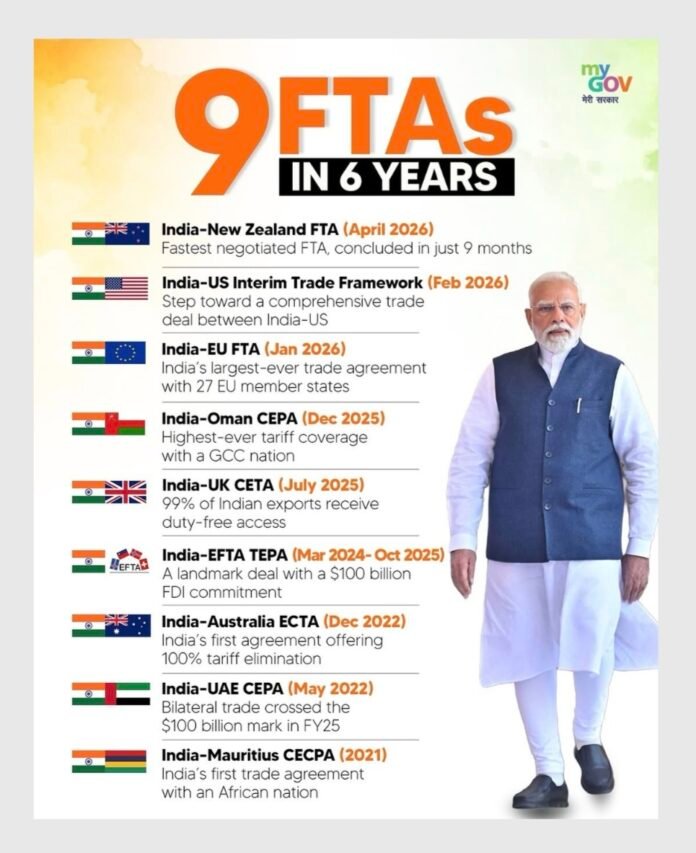
Over the past few years, India has undergone a quiet but significant transformation in its trade policy. Long perceived as cautious in entering Free Trade Agreements (FTAs), the country is now actively negotiating, concluding, and operationalising a series of trade deals across continents. This shift reflects not only economic ambition but also a broader strategic recalibration in a rapidly evolving global order.
Under the leadership of Narendra Modi, India’s trade outreach has expanded markedly—though the narrative of “nine FTAs in six years” requires nuance. While several agreements have indeed been signed and implemented, others remain under negotiation or in early-stage frameworks. Taken together, however, they signal a clear and deliberate pivot: India is positioning itself as a more integrated and influential player in global trade.
From Caution to Calculated Openness
Historically, India adopted a guarded approach to FTAs, concerned about protecting domestic industries, particularly agriculture and small-scale manufacturing. However, disruptions in global supply chains, shifting geopolitical alignments, and the need to boost exports have driven a rethink.
The result is a more pragmatic strategy—one that balances market access with safeguards, while targeting sectors where India holds competitive advantage.
Key Agreements Driving Momentum
Among the most impactful agreements already in force is the India–UAE Comprehensive Economic Partnership Agreement (CEPA) with the United Arab Emirates, signed in 2022. It has significantly boosted bilateral trade, with both nations targeting sustained high growth in goods and services exchange.
Similarly, the India–Australia Economic Cooperation and Trade Agreement (ECTA) with Australia, also signed in 2022, has opened up substantial tariff reductions across a wide range of sectors. While not eliminating all tariffs immediately, it provides phased liberalisation benefiting industries such as textiles, pharmaceuticals, and education.
India’s first trade pact with an African nation, the India–Mauritius Comprehensive Economic Cooperation and Partnership Agreement (CECPA) (2021) with Mauritius, marked an important step in strengthening its presence in the Global South.
A landmark development came with the agreement signed with the European Free Trade Association bloc—comprising Switzerland, Norway, Iceland, and Liechtenstein. The deal includes a long-term investment commitment of $100 billion over 15 years, underscoring confidence in India’s economic trajectory.
Agreements in Advanced Stages
Several high-profile FTAs are currently under negotiation and, once concluded, could significantly expand India’s trade footprint.
Talks with the European Union represent one of the most ambitious efforts, covering 27 member states and spanning goods, services, sustainability, and digital trade. If finalised, this would be India’s largest and most complex trade agreement.
Negotiations with the United Kingdom are also in advanced stages. While both sides have indicated broad agreement on key areas, the deal is yet to be formally concluded and ratified.
India is also exploring deeper trade engagement with the United States through an interim trade framework. While not an FTA, it reflects growing convergence in areas such as technology, supply chains, and critical sectors.
Similarly, discussions with New Zealand are ongoing, with both sides aiming to conclude a mutually beneficial agreement, though no final deal has yet been signed.
Strategic and Economic Significance
This renewed trade push serves multiple objectives:
●Export expansion: Improved market access for Indian goods and services
●Investment inflows: Greater investor confidence through stable frameworks
●Supply chain integration: Positioning India as a reliable global manufacturing hub
●Geopolitical alignment: Strengthening ties with key regions and partners
Importantly, these agreements are aligned with India’s broader vision of becoming a major global economic power while reducing overdependence on any single market.
Balancing Opportunity with Preparedness
Despite the optimism, FTAs bring inherent challenges. Increased competition can pressure domestic industries, particularly MSMEs and agriculture. To fully leverage these agreements, India must continue improving logistics, regulatory efficiency, and ease of doing business.
Equally crucial is ensuring that Indian exporters are equipped to take advantage of new market access—through awareness, quality standards, and policy support.
Conclusion
India’s evolving trade strategy marks a decisive shift from hesitation to engagement. While not all announced agreements are finalised, the direction is unmistakable: India is actively shaping its place in the global economic architecture.
Rather than a simple tally of FTAs, what emerges is a broader narrative—of a nation recalibrating its economic diplomacy, forging strategic partnerships, and preparing to play a larger role in global trade.
If this momentum is sustained and matched with domestic reforms, India’s current trade push could well define its economic trajectory in the decades to come.