


PC(Artisera)
The unique art form created by the Saura (Sora) tribe of Odisha is locally known as ‘Idital’ (Idital). These paintings are traditionally made on red mud walls using white colour prepared from lime and rice paste. Their geometric style bears a close resemblance to Maharashtra’s famous Warli paintings, yet they stand apart with their elongated, fluid, and less angular figures. A Living Tradition Thousands of Years Old Saura painting is regarded as one of the oldest and most vibrant indigenous art traditions in India. Anthropologists estimate that this art form may be 2,500 to 3,000 years old. Its style shows strong similarities with the prehistoric rock art of Odisha.
The Saura tribe has deep connections with Indian epics. In the Ramayana, Mata Shabari, the devoted woman who offered berries to Lord Rama, is believed belong to the Saura community. Similarly, in the Mahabharata, the hunter Jara Savara, whose arrow accidentally struck Lord Krishna, is also associated with the Saura tribe. Additionally, legends link the tribe to Lord Jagannath of Puri, as the original wooden idol (Nilamadhava) is said to have been secretly worshipped by a Saura chieftain named Viswavasu before it was installed in the temple.
More Than Art: A Sacred Ritual Saura paintings are not merely decorative; they serve as a sacred medium to appease deities and ancestral spirits. Traditionally, only the village priest or shaman, known as ‘Kudan’ or ‘Idital Mars’, was permitted to create these artworks. The artists often painted based on messages received in dreams or visions. These paintings are made during important life events such as childbirth, marriage, and harvest seasons. They act as a spiritual bridge to invite blessings, protection, and healing for the family.
GI Tag and Modern Evolution recognising its cultural significance, Lanjia Saura Painting was officially granted the Geographical Indication (GI) Tag in January 2024. Over time, this art has moved beyond mud walls and is now created on handmade paper, cloth, sarees, and canvas. Contemporary Saura artists have begun incorporating modern elements such as bicycles, buses, cars, and aeroplanes alongside traditional motifs, reflecting the tribe’s adaptability and their way of documenting a changing world. Saura Paintings Are Created Preparing the Surface: Traditionally painted on mud-plastered walls coated with a layer of red or yellow ochre clay (geru) to create an earthy base.Natural Pigments: The primary colour is white, made from sun-dried rice paste or white stone powder. Red and yellow come from mineral-rich earth or vermilion, while black is obtained from charcoal or lamp soot.
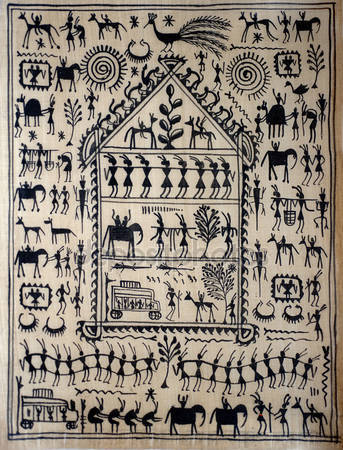
Brushes: Handmade brushes are crafted from tender bamboo shoots or twigs frayed at the ends. Unique “Fish-Net” Technique: Unlike many other folk arts, Saura artists first draw a decorative geometric border around the entire composition. They then fill the patterns from the outer edges towards the centre a method often described as the “fish-net” approach.
Human and animal figures are formed using simple geometric shapes, appearing more elongated and flowing compared to the sharp triangular figures of Warli art. Symbolic Meaning of Key Motifs every element in a Saura painting carries deep symbolic significance tree of Life: Represents growth, fertility, and the interconnectedness of sky (heaven), earth (humans), and underworld (ancestors). Elephants and Horses: Symbols of strength, stability, and prosperity. Sun and Moon: Seen as divine witnesses to rituals, representing the eternal cycle of time and cosmic order.
Triangles: Symbolise the three realms earth, sky, and underworld. Circles: Denote the continuity of life and the unity of the community. Modern elements like vehicles and technology are increasingly included, showcasing the tribe’s evolving relationship with the contemporary world. The Essence of Saura Art since the Saura language traditionally had no written script, Idital served as a visual language preserving the tribe’s history, philosophy, religious beliefs, and folk tales across generations. For the Saura people, these paintings are a sacred bridge between the human and spiritual worlds. They honour the deity Idital and ancestral spirits to ensure family well-being, prevent misfortune, and maintain harmony with nature.