

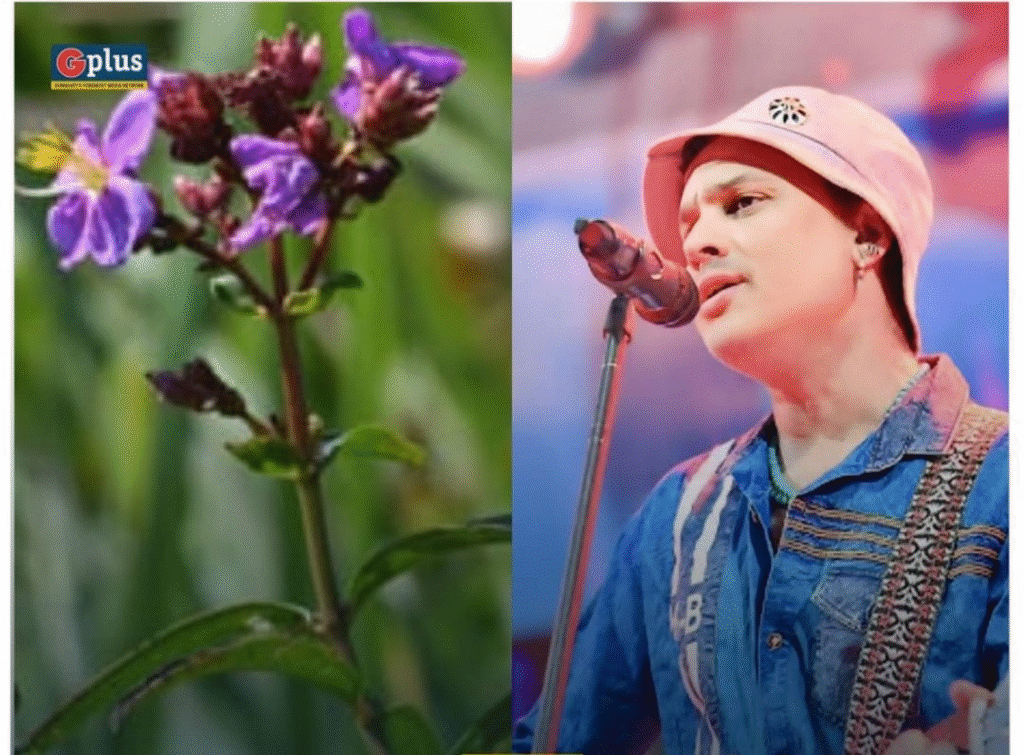
In a heartwarming fusion of science and culture, researchers have identified a new perennial shrub species from the grasslands of Manas National Park in Assam and named it Osbeckia zubeengargiana in honour of acclaimed Assamese singer and cultural icon Zubeen Garg.
About the New Species osbeckia zubeengargiana belongs to the Melastomataceae family, commonly known for its attractive “princess flowers.” It is a perennial shrub that grows 2.5 to 3.5 metres tall and thrives in moist soil in open grassland habitats. The plant produces eye-catching purple to pinkish flowers in clusters, with individual flowers measuring roughly 2.5 to 3 cm in length. It typically blooms from mid-September to January, making it easier for botanists to spot during field surveys. While it shares similarities with other members of the genus Osbeckia (such as Osbeckia rostrata), distinct botanical features-including leaf shape, flower structure, and seed characteristics-confirmed it as a new species. The genus Osbeckia includes over 40 species, mostly distributed across South and Southeast Asia.
Significance of the Naming the specific epithet “zubeengargiana” serves as a fitting tribute to Zubeen Garg’s immense contributions to Assamese music, culture, and his deep love for nature. Family members, including Garima Saikia Garg, have welcomed the honour, noting that “Zubeen was a child of nature, and now his name is attached to nature itself.” This naming immortalises the singer’s legacy while highlighting Assam’s rich biodiversity.
Conservation Status and Ecological Context researchers observed a significant population of the plant within Manas National Park, a UNESCO World Heritage Site located along the India-Bhutan border and part of the Manas Tiger Reserve. The park’s divers ecosystems-including tropical forests, alluvial grasslands, and riverine habitats-support numerous rare and endangered species. However, its distribution outside the protected area remains unknown. Due to insufficient ecological data, the species has been categorised as “Data Deficient” on the IUCN Red List. This underscores the need for further studies on its population size, geographic range, and conservation requirements.
The discovery reinforces the fact that India’s northeastern region, particularly areas like Manas National Park, continues to harbour unexplored biodiversity hotspots despite ongoing conservation efforts.
A Poetic Blend of Nature and Culture this find not only adds to the botanical wealth of Assam but also beautifully bridges natural heritage with cultural pride. As the purple-pink blooms of Osbeckia zubeengargiana brighten the grasslands of Manas every autumn and winter, they will serve as a living memorial to one of Assam’s most beloved voices. The discovery is a proud moment for the state and a reminder of the vast scientific potential that still lies within India’s protected natural landscapes.