

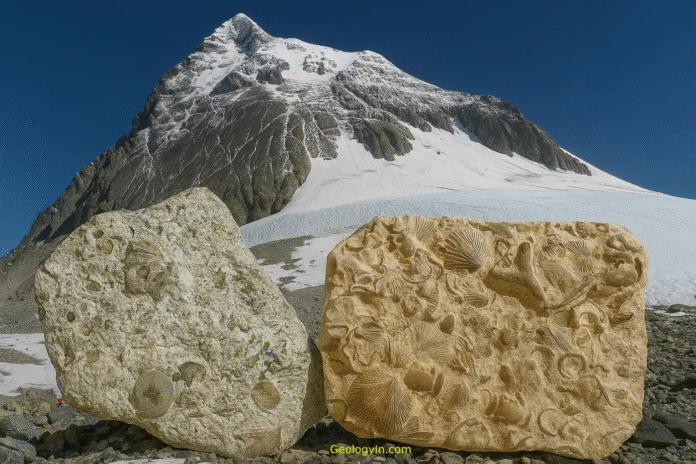
PC(Geolog.in, Instagram)
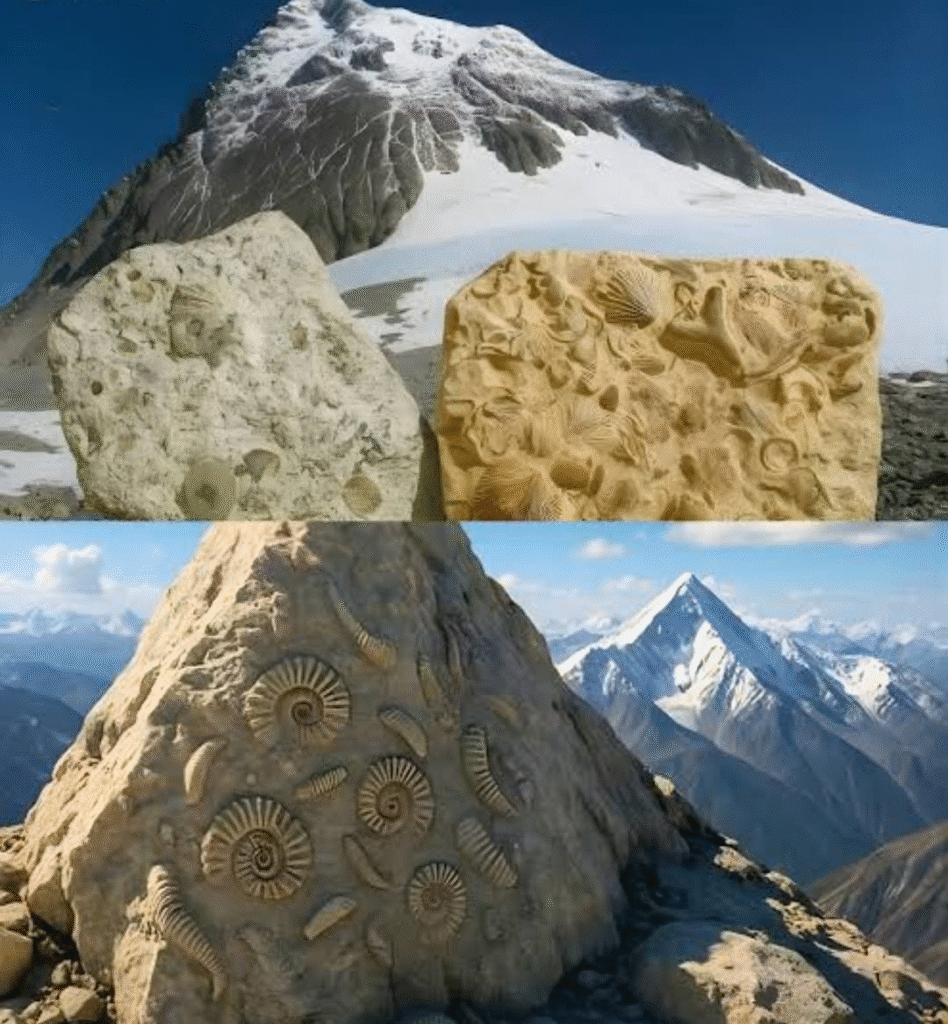
The highest point on Earth carries a remarkable secret – the rocky summit of Mount Everest is made of ancient seabed, lifted nearly nine kilometres into the sky by the relentless forces of plate tectonics. Near the peak of the world’s tallest mountain sits the Qomolangma Limestone, a sedimentary rock packed with well-preserved marine fossils dating back roughly 450 million years to the Ordovician Period. These include the remains of trilobites, brachiopods, ostracods, crinoids, and other creatures that once thrived in a warm, shallow tropical sea.
From Ocean Floor to Roof of the World
Around 450 million years ago, the sediments that now form Everest’s summit were laid down on the seafloor as layers of limestone rich in the shells and skeletons of marine life. At that time, the region was part of a vast ocean basin along the northern edge of the ancient supercontinent Gondwana. Then, beginning approximately 50 million years ago, the Indian tectonic plate began its dramatic collision with the Eurasian plate. This slow but powerful crunch closed the ancient Tethys Ocean, crumpled the continental crust, and thrust the old seafloor sediments upward to form the mighty Himalayan range and the Tibetan Plateau. Neither plate could easily subduct because of their buoyancy, so the crust thickened, folded, and rose dramatically.
Earth Still Building in Real Time
The story of Everest is far from over. The Indian plate continues to push northward into Eurasia at several centimetres per year, causing the Himalayas including Everest – to rise by more than one centimetre annually (with some recent measurements suggesting net growth around 4-5 mm per year after accounting for erosion). pubs. This ongoing uplift means Everest feels less like a finished monument and more like a mountain still under construction by the living planet itself.
Not Evidence of a Global Flood
The presence of these marine fossils has occasionally sparked confusion online, with some suggesting they prove a worldwide flood. In reality, they provide some of the clearest evidence for plate tectonics – the theory that Earth’s crust is divided into moving plates whose collisions and separations shape continents and mountain ranges over deep geological time.
Sedimentary rocks like limestone almost always form in water through the accumulation of eroded material and biological remains. The fossils at Everest simply show that these particular rocks originated underwater before being dramatically uplifted. Similar marine fossils appear across the entire Himalayan chain, telling the same powerful story of ancient
oceans and continental collision.
A Powerful Reminder of Deep Time
Few places on Earth display the immensity of geological time as vividly as Mount Everest. In its summit rocks, you can hold a piece of an ocean floor from half a billion years ago – now perched at 8,848.86 metres above sea level – while the mountain itself continues to grow beneath your feet. It is a humbling reminder that our planet is dynamic, ever-changing, and still actively reshaping its surface. The highest mountain in the world carries both the memory of an ancient sea and the living force that keeps lifting it higher, centimetre by centimetre, year by year.