

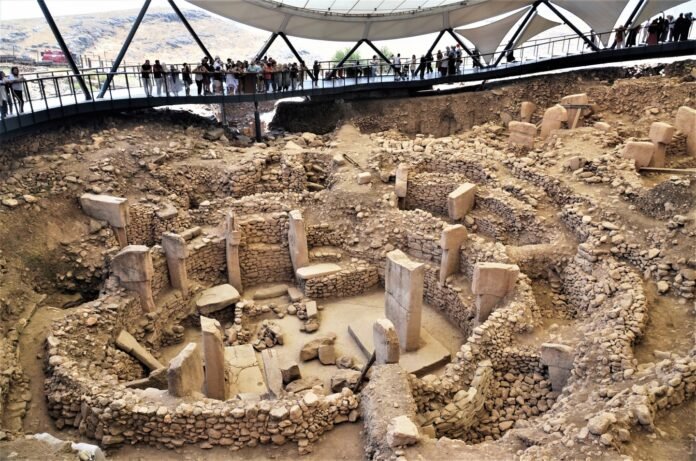
The ancient site of Göbekli Tepe has transformed our understanding of early human history. Located in southeastern Turkey, this remarkable archaeological discovery dates back to around 9600 BCE, making it significantly older than iconic structures like the Egyptian pyramids and Stonehenge. What makes Göbekli Tepe extraordinary is not just its age, but the questions it raises about how and when civilization truly began.
For decades, historians believed that agriculture was the foundation of civilization—that once humans settled and began farming, they developed social structures, religion, and monumental architecture. However, Göbekli Tepe challenges this long-held belief. Evidence suggests that it was constructed by hunter-gatherer communities, long before the advent of farming or permanent settlements. Despite their seemingly simple way of life, these early humans built massive circular enclosures with towering T-shaped stone pillars, some weighing over 20 tons. The pillars are intricately carved with images of animals such as lions, snakes, and birds, indicating a strong symbolic or spiritual significance.
The construction of such a complex site without the use of metal tools, wheels, or domesticated animals raises significant questions about the technological and organizational capabilities of early societies. Researchers believe that the builders of Göbekli Tepe must have possessed advanced knowledge of planning and cooperation, suggesting that social and religious motivations may have brought people together even before the development of agriculture.
Another enduring mystery surrounding Göbekli Tepe is its purpose. Many scholars consider it to be one of the world’s earliest known temple complexes, possibly used for rituals, gatherings, or ceremonial activities. The detailed carvings and the deliberate arrangement of the pillars point towards a culture rich in symbolism and belief systems.
Perhaps the most puzzling aspect of Göbekli Tepe is that it was intentionally buried around 8000 BCE. Unlike other ancient sites that were abandoned over time, this one appears to have been carefully covered with soil and debris. The reasons behind this act remain unknown, adding another layer of intrigue to the site’s history.
Today, Göbekli Tepe stands as a groundbreaking discovery in the field of archeology, forcing historians to reconsider the sequence of human development. It suggests that religion and social organization may have preceded agriculture, rather than the other way around.
In essence, Göbekli Tepe is not just an archaeological site—it is a powerful reminder that human history is far more complex than once imagined, and that many of its earliest chapters are still waiting to be fully understood.