

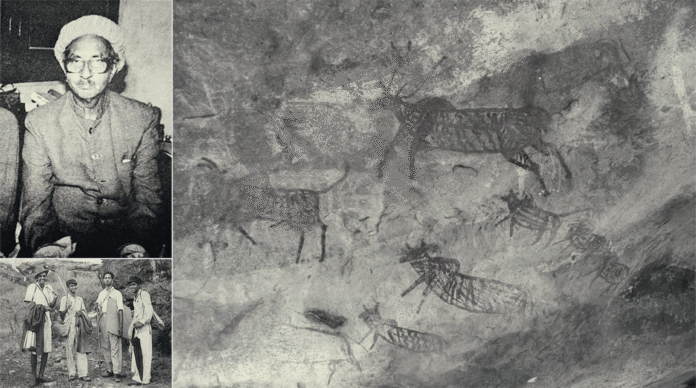
PC: (Bradshaw Foundation, Tripadvisor)
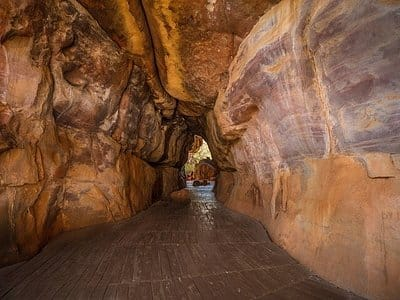
The Rock Shelters of Bhimbetka, located in the Raisen district of Madhya Pradesh, India, are among the world’s most significant archaeological sites.Situated in the foothills of the Vindhyan Mountains on the southern edge of the central Indian plateau, these natural sandstone outcrops rise above dense forests and contain five clusters of rock shelters. The site features over 750 rock shelters spread across about 10 km, with more than 400 containing prehistoric paintings. Designated a UNESCO World Heritage Site in 2003, Bhimbetka showcases a remarkable record of human artistic expression and cultural evolution.
Discovery and Historical Significance
The site was discovered in 1957 by renowned Indian archaeologist Dr. Vishnu Shridhar Wakankar. While traveling by train from Bhopal to Itarsi, he noticed striking sandstone rock formations resembling cave sites he had studied in France and Spain. Intrigued, he disembarked at the next station, explored the area, and uncovered prehistoric paintings in the shelters. Wakankar, often called the “Father of Prehistoric Rock Art Studies in India,” documented hundreds of shelters here and thousands more across the country. Excavations and studies since the 1970s have revealed evidence of human habitation dating back over 100,000 years, making Bhimbetka one of the oldest traces of human presence in India.
Age and Chronological Periods
Evidence of human occupation at Bhimbetka spans from the Paleolithic era to historical times. Habitation traces go back more than 100,000 years, but the rock paintings primarily date from the Upper Paleolithic (around 30,000-40,000 years ago) through the Mesolithic, Chalcolithic, and even into medieval periods. The art reflects continuous human activity, unlike many European sites that were abandoned earlier.
V. S. Wakankar classified the paintings into seven periods based on style, technique, and superimposition:
Period I (Upper Paleolithic): Large, linear figures in green and dark red, focusing on huge animals.
Period II (Mesolithic): Smaller, dynamic scenes with hunting, dancing, and community life.
Period III (Chalcolithic): Community activities, early agriculture, and geometric patterns.
Later periods: Warriors, horses, elephants, and decorative motifs from historic and medieval times.
Key Features of the Rock Art
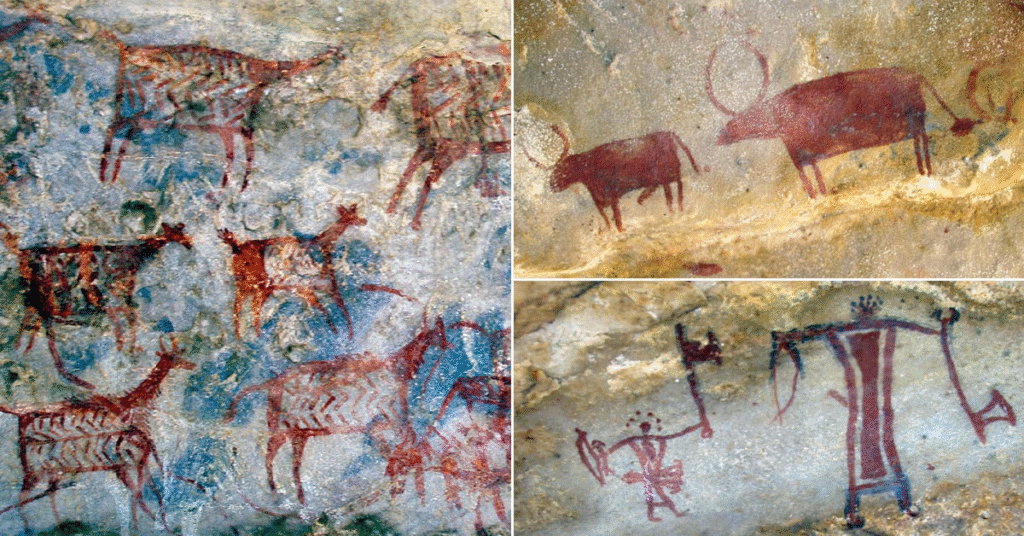
The paintings vividly depict early human life, including hunting scenes, dancing, music, communal activities, religious rituals, and daily tasks like honey collection and foraging. Children’s handprints are also common.
Depicted Animals: Wild species such as bison, elephants, tigers, rhinoceros, boars, deer, bears, monkeys, peacocks, snakes, and more.”Zoo Rock” features elephants, barasingha (swamp deer), bison, and deer in herds.
Colors and Techniques: Natural pigments from minerals (hematite for red ochre), kaolin (white), vegetables, and animal fats for binding. Main colors: red, white, green, yellow, brown, and black. Techniques include transparent (diluted pigment), opaque, and crayon-like direct application.Styles range from simple linear outlines to silhouettes, partially filled figures, and “X-ray” views showing internal details.The art evolves from naturalistic representations in early periods to more stylized and geometric forms later. Similarities and Differences with European Cave Paintings
Bhimbetka shares striking parallels with famous European sites like Lascaux (France) and Altamira (Spain):Similarities: Both date to the Upper Paleolithic (roughly 10,000-40,000 years ago), feature animals (bison, deer, boars), hunting themes, natural pigments (ochre reds, blacks), silhouettes, and line drawings. They reflect a deep connection to nature and hunter-gatherer life.
Differences: European sites often emphasize
large fauna in dramatic, isolated compositions and were largely abandoned after the Paleolithic. Bhimbetka shows broader diversity-daily life, dancing, community scenes, and music-plus remarkable continuity across millennia to medieval times, including later agricultural and warrior motifs. Bhimbetka’s art is more narrative and evolving, with ongoing habitation nearby.
Cultural and UNESCO Importance
UNESCO inscribed Bhimbetka under Criterion (iii) for illustrating long-term human-landscape interaction through its rock art quantity and quality, and Criterion (v) for its association with a hunting-gathering economy, echoed in traditions of nearby Adivasi villages.
Bhimbetka stands as a living document of human civilization’s development-from nomadic hunter-gatherers to settled communities. Surrounded by the Ratapani Wildlife Sanctuary, it remains a vital site for researchers and visitors, where ancient walls continue to tell stories of our shared prehistoric past.