

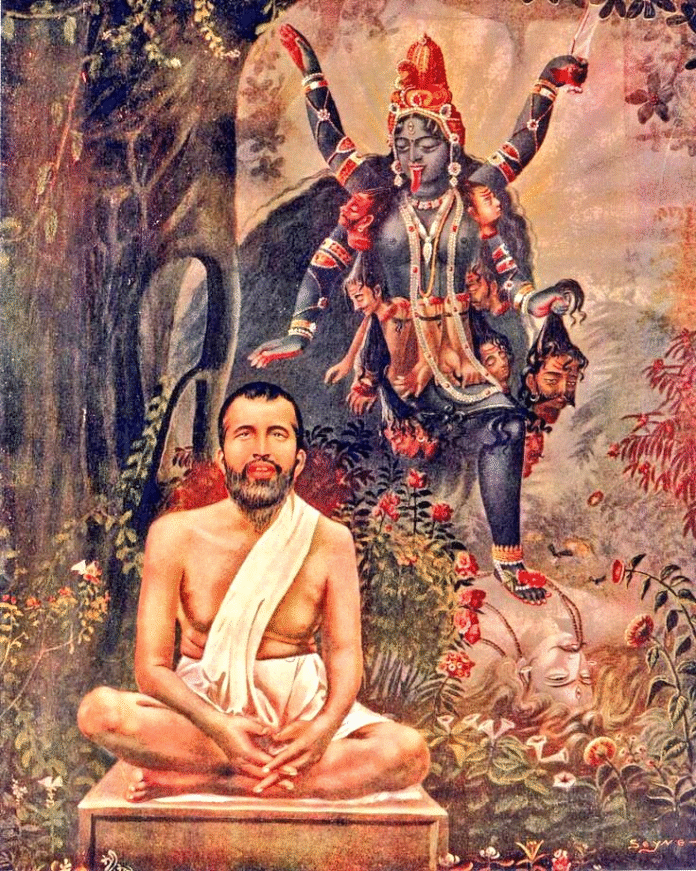
Sri Ramakrishna Paramahansa (18 February 1836 – 16 August 1886), born Ramakrishna “Gadadhar” Chattopadhyay, was a 19th-century Indian Hindu mystic and saint whose spiritual experiences profoundly shaped modern Hindu thought. From a young age, he experienced intense spiritual ecstasies and pursued direct realisation of the Divine through multiple religious paths. His spiritual journey was deeply influenced by devotion to Goddess Kali, Tantric practices, Vaishnava bhakti traditions, and the non-dual philosophy of Advaita Vedanta.
On the 191st birth anniversary of Sri Ramakrishna Paramahamsa, his words continue to echo across centuries—challenging how we understand knowledge, faith, and the purpose of life.
As a priest at the Dakshineshwar Kali Temple near Calcutta, his mystical temperament and states of divine absorption drew the attention of spiritual teachers, social reformers, and seekers from across India.
The reverence he inspired among Bengal’s intellectual and spiritual elite led his chief disciple, Swami Vivekananda, to establish the Ramakrishna Math and the Ramakrishna Mission—institutions dedicated to spiritual practice, education, and humanitarian service. Through these institutions, Ramakrishna’s vision of universal spirituality and service to humanity continues to influence millions across the world.
From the nature of Brahman—beyond description and untouched by language—to the idea that service to humanity is service to God, Ramakrishna’s philosophy urges humility, discipline, and inner awakening. As India remembers the mystic saint today, his timeless message invites a new generation to question, seek, and realise the infinite within. Here comes his quotes:
“Only two kinds of people can attain self-knowledge: those who are not encumbered at all with learning, that is to say, whose minds are not over-crowded with thoughts borrowed from others; and those who, after studying all the scriptures and sciences, have come to realise that they know nothing.”
“You see many stars in the sky at night, but not when the sun rises. Can you therefore say that there are no stars in the heavens during the day? Because you cannot find God in the days of your ignorance, say not that there is no God.”
“One man may read the Bhagavata by the light of a lamp, and another may commit a forgery by that very light; but the lamp is unaffected. The sun sheds its light on the wicked as well as on the virtuous.”
“You speak of doing good to the world. Is the world such a small thing? And who are you, pray, to do good to the world? First realise God, see Him by means of spiritual discipline. If He imparts power you can do good to others; otherwise not.”
“What Brahman is cannot be described. All things in the world — the Vedas, the Puranas, the Tantras, the six systems of philosophy — have been defiled, like food that has been touched by the tongue, for they have been read or uttered by the tongue. Only one thing has not been defiled in this way, and that is Brahman. No one has ever been able to say what Brahman is.”
“As long as I live, so long do I learn.”
“The Man who works for others, without any selfish motive, really does good to himself.”
“God is in all men, but all men are not in God; that is why we suffer.”
“The winds of God’s grace are always blowing, it is for us to raise our sails.”
“Different creeds are but different paths to reach the same God.”
“