

China’s Fengyun-3D meteorological satellite has detected that iceberg A23a, once the largest iceberg in the world by surface area, has entered the final stage of disintegration. Recent satellite observations indicate that the massive ice body, which detached from Antarctica nearly four decades ago, is rapidly shrinking and may completely disappear in the coming weeks.
Satellite Observations Confirm Rapid Shrinkage
According to data released by the China Meteorological Administration, true-colour images captured by the Fengyun-3D satellite on January 14 revealed that A23a’s main body has reduced to around 506 square kilometres. This marks a dramatic decline from its original size of about 4,170 square kilometres when it broke away in 1986. Just three weeks earlier, the iceberg still covered nearly 948 square kilometres, highlighting the speed of its ongoing disintegration.
Role of Fengyun-3 Satellite Constellation
The monitoring has been conducted using the Fengyun-3D, part of China’s Fengyun-3 satellite constellation, which has tracked A23a continuously since 2023. The satellite provides high-resolution imagery with a spatial resolution of 250 metres, allowing scientists to closely analyse changes in the iceberg’s structure and surface conditions. Experts note that the rate of breakup accelerated sharply earlier this year.
Why A23a Is Breaking Apart
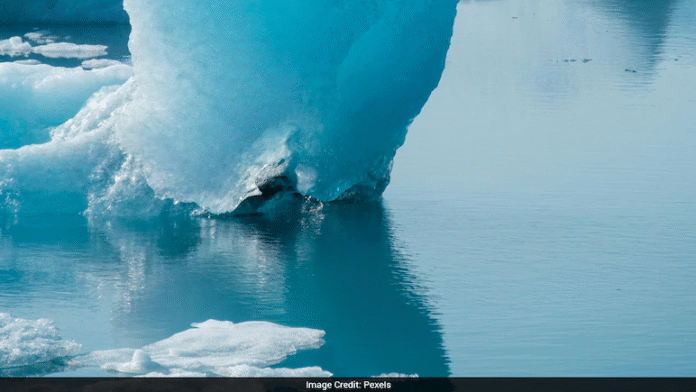
Scientists attribute the rapid fragmentation primarily to hydrofracturing. This process occurs when meltwater accumulates on the iceberg’s surface, forming ponds and glacial lakes that exert pressure on internal cracks. Satellite imagery has shown blue meltwater pooling in A23a’s central region, trapped by natural ridges along its edges. Seasonal factors are also playing a role, with summer conditions in the Southern Hemisphere bringing clearer skies, higher air temperatures, and warmer seawater exceeding 3°C, all of which accelerate melting.
Facts
- A23a was the world’s largest iceberg by area after calving in 1986.
- It broke away from Antarctica’s Filchner Ice Shelf.
- Hydrofracturing is a key mechanism behind iceberg breakup.
- Polar-orbiting satellites monitor cryospheric changes.
From Antarctic Giant to Near Extinction
A23a separated from the Filchner Ice Shelf in Antarctica in 1986 and drifted for decades across the Southern Ocean. According to Zheng Zhaojun of China’s National Satellite Meteorological Center, the iceberg is now nearing complete disintegration. Ocean currents are carrying smaller fragments toward warmer northern waters, further weakening the remaining ice. The event underscores the vulnerability of large Antarctic ice masses to climatic and oceanic changes.