

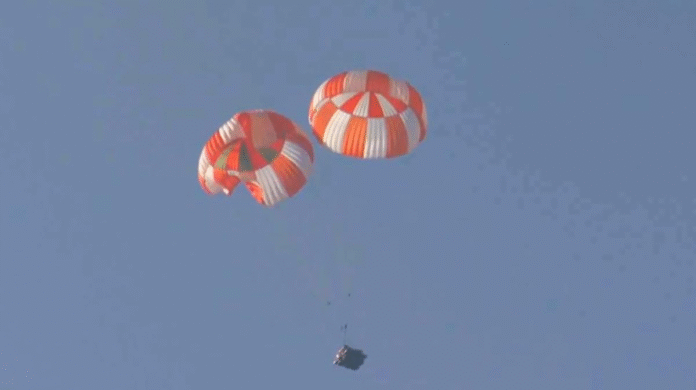
The Indian Space Research Organisation (ISRO) achieved another milestone in its Gaganyaan human spaceflight programme by successfully completing the Integrated Main Parachute Airdrop Test at the Babina Field Firing Range in Jhansi, Uttar Pradesh. The test simulated extreme re-entry conditions for the Gaganyaan crew module, validating the robustness and redundancy of its parachute system.
The critical test demonstrated that even with asymmetric deployment—a delay in the full opening of one of the main parachutes—the system ensured a stable descent and soft landing. This confirmed that two parachutes are sufficient for safe crew module recovery, reinforcing the design’s safety and reliability.
The experiment involved dropping a simulated crew module mass from an altitude of 2.5 km using an Indian Air Force IL-76 aircraft. The parachute deployment sequence unfolded exactly as planned, with flawless execution through all stages, culminating in a smooth touchdown.
ISRO explained that the Gaganyaan main parachutes deploy through a process known as reefed inflation, where the canopy first opens partially (reefing) and then fully after a controlled delay (disreefing), using pyro devices. This method ensures a gradual reduction of descent speed, minimizing mechanical stress on the spacecraft.
The test specifically evaluated asymmetric disreefing, one of the most demanding conditions expected during actual mission descent. It assessed the system’s structural integrity, load distribution, and dynamic performance, ensuring that the parachute assembly can handle real-world challenges during crew re-entry.
The success of this test represents a major step forward in qualifying the parachute system for human spaceflight. It was conducted through a coordinated effort involving the Vikram Sarabhai Space Centre (VSSC), Aerial Delivery Research and Development Establishment (ADRDE) of DRDO, the Indian Air Force, and the Indian Army.
With this validation, ISRO is now closer to its next milestones — an uncrewed Gaganyaan mission in 2026, followed by India’s first crewed spaceflight in 2027, marking a historic leap in the nation’s space exploration journey.