

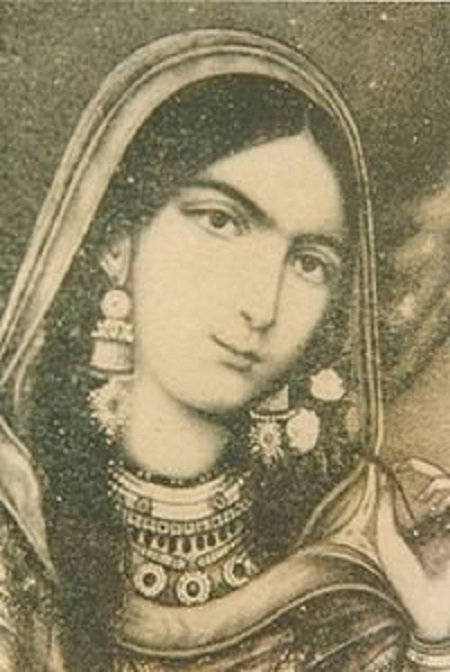
Heeramandi, a recently released OTT series, captured audiences with its vibrant portrayal of courtesans’ lives, love stories, and struggles. While the on-screen world was rich in music, poetry, and drama, history holds real-life tales where courtesans stepped far beyond the world of entertainment—taking up the mantle of resistance and fighting for the nation’s freedom. Among them stands one name that continues to inspire generations: Begum Hazrat Mahal, the courtesan-turned-rebel queen who challenged the British Empire and etched her place in India’s struggle for independence.
In the dusty lanes of 19th-century Faizabad, few could have imagined that a girl born into poverty, abandoned by her parents, and sold into the courtesan quarters of Lucknow would one day stand as one of India’s fiercest freedom fighters. Yet, Muhammadi Khanam—later known as Begum Hazrat Mahal—did exactly that. She not only defied the British during the First War of Independence in 1857 but also became a rare voice calling for unity between Hindus and Muslims in the fight for freedom.
From Courtesan Quarters to Royal Court
Born in 1820, Muhammadi’s life began in hardship. Orphaned by the age of 12, she was taken in by relatives struggling to make ends meet. One day, a palanquin arrived at her uncle’s home, and with a handful of rupees, she was taken to Chowk—the courtesan district of Lucknow.
There, under strict training in music, dance, Persian, and courtly manners, Muhammadi grew into a graceful and skilled performer. Her beauty and talent eventually caught the attention of Nawab Wajid Ali Shah, ruler of Awadh. Entering his ‘Parikhana’ (royal harem), she rose in favor, earning the name Mehak Pari. The Nawab later married her in a contract marriage, granting her the title Iftikhar-un-Nisha. History would remember her as Begum Hazrat Mahal.
When the British Took Awadh
In 1856, the British East India Company annexed Awadh and exiled Wajid Ali Shah to Calcutta. Before leaving, the Nawab divorced nine of his wives, including Hazrat Mahal. While staying behind in Lucknow, she focused on raising their young son, Birjis Qadr—until 1857 changed everything.
The Woman Who Defied an Empire
When revolt swept across India in 1857, Begum Hazrat Mahal emerged as the leader in Awadh. She declared Birjis Qadr as Nawab and took command of the resistance. Her forces dealt the British stinging defeats in Chinhat and Dilkusha, freeing Lucknow and surrounding districts.
Rulers like Nana Saheb, Raja Jailal, and Raja Mansingh rallied to her side, united under her banner of Hindu-Muslim solidarity. She openly accused the British of dividing communities to weaken India and instead forged a united front that fought shoulder to shoulder.
Her leadership was not confined to palaces—she traveled into rural Awadh and forest strongholds, rallying peasants and soldiers alike. Guerrilla warfare, strategic alliances, and unwavering resolve kept the British at bay for months.
The Last Stand and Exile
Eventually, with key allies like Maulvi Ahmad Shah dead and the British regaining ground, Begum Hazrat Mahal was forced to retreat. Refusing to surrender, she crossed into Nepal, where King Rana Jung Bahadur granted her asylum. She lived quietly until her death in 1879, far from the city she once liberated.
Today, Begum Hazrat Mahal’s story stands as a reminder that the fight for freedom was not only fought by men in uniform but also by women who broke every boundary society set for them. She was a courtesan, a queen, a warrior, and above all, a patriot who dared to dream of an India united beyond religion.