

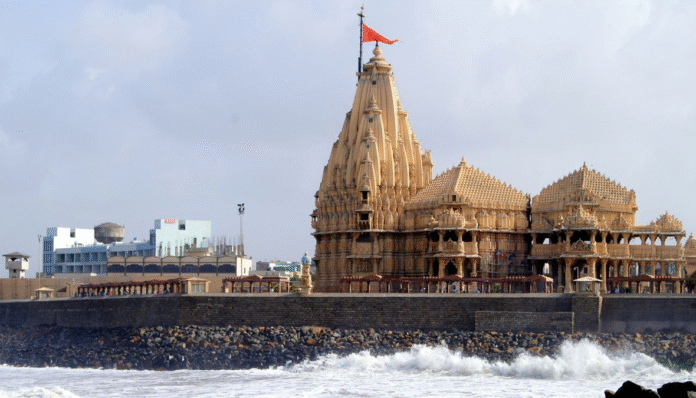
The very name Somnath fills the mind and heart with pride and devotion. Situated at Prabhas Patan on the western coast of Gujarat, Somnath stands as an eternal expression of the soul of India. The Dwadasa Jyotirlinga Stotram mentions the twelve Jyotirlingas of India, and it begins with the line “Saurashtrae Somnatham cha…”—placing Somnath first among all Jyotirlingas. This itself reflects the profound civilizational and spiritual significance of this sacred shrine.
The scriptures proclaim:
“Somalingam naro drishtva sarva-paapaih pramuchyate;
Labhate phalam manovanchhitam mritah swargam samashrayet.”
Meaning, by beholding the Somnath Shivling, a person is freed from all sins, attains fulfillment of virtuous desires, and after death, the soul finds its place in heaven.
Tragically, this very Somnath—once the focal point of faith and prayer for millions—became a target of foreign invaders driven by destruction. The year 2026 holds special significance, as it marks 1,000 years since the first attack on the Somnath Temple. In January 1026, Mahmud of Ghazni launched a brutal assault on the shrine, demolishing it in an attempt to destroy a great symbol of faith and civilization.
The attack on Somnath stands among the greatest tragedies in human history. Yet, even after a thousand years, the temple stands today in all its glory. After 1026, repeated efforts were made across generations to rebuild the temple in its full splendor. The present structure took shape in 1951, making 2026 also the 75th anniversary of Somnath’s reconstruction. On 11 May 1951, the temple was ceremonially reopened in the presence of India’s first President, Dr. Rajendra Prasad, marking a historic moment.
Historical records vividly describe the cruelty and devastation inflicted during the first invasion—accounts that still send shivers down the spine. One can only imagine the profound impact it must have had on the morale of the people and the nation. Somnath was not only spiritually significant but also a center of prosperity and inspiration. Its grandeur was carried far and wide by India’s seafaring traders and merchants.
Despite repeated attacks and a long period of subjugation, the story of Somnath is not one of destruction, but of self-respect, resilience, and unbroken faith. For the last thousand years, it has symbolized the indomitable spirit of millions of Indians. Each time the temple was attacked, brave men and women stood in its defense, offering supreme sacrifices. Time and again, generations rose from the ruins to rebuild and revive it.
Mahmud of Ghazni looted and left, but he could not take away India’s faith in Somnath. On the contrary, that faith only grew stronger. Even in 2026, a thousand years later, Somnath sends a powerful message to the world: those driven by the urge to destroy eventually fade away, while faith endures and shines brighter.
India is fortunate to have given birth to great souls like Devi Ahilyabai Holkar, who ensured that worship at Somnath could continue. In the 1890s, Swami Vivekananda also visited Somnath, an experience that deeply moved him. In a lecture delivered in Chennai in 1897, he said:
“Ancient temples of South India and temples like Somnath in Gujarat will teach you more lessons of wisdom than any number of books.
They bear the marks of hundreds of attacks and hundreds of revivals. Destroyed again and again, they rose from their own ruins—strong and alive as ever. This is the national spirit, the national life force. To follow it fills one with pride; to abandon it is death.”
After Independence, the sacred responsibility of rebuilding Somnath came into the capable hands of Sardar Vallabhbhai Patel. During his visit to Somnath on Diwali in 1947, he resolved that the temple would be rebuilt there itself. Though he did not live to witness its completion, his dream was realized when the temple doors were opened in 1951.
Despite reservations from then Prime Minister Pandit Jawaharlal Nehru, President Dr. Rajendra Prasad stood firm and participated in the ceremony—an act that created history.
Any mention of Somnath remains incomplete without acknowledging K.M. Munshi, whose unwavering support and literary contribution, especially his book “Somnath: The Shrine Eternal,” remains deeply influential.
As Munshi’s title suggests, Indian civilization believes in the immortality of the soul and ideas—“Naineṁ chindanti shastrani, naineṁ dahati pavakah.” The physical structure of Somnath may have been destroyed, but its consciousness remained eternal.
These very values have enabled India to rise stronger through every era. Today, the world looks to India with hope and trust—investing in its youth, embracing its culture, art, music, yoga, and Ayurveda. For solutions to global challenges, the world increasingly turns toward India.
For centuries, Somnath has united people across traditions. Jain scholar Acharya Hemchandracharya once prayed here, expressing reverence to the supreme element free from worldly bonds. Even today, a visit to Somnath brings a deep sense of calm—an indescribable, spiritual experience.
As in 1026, even in 2026 the waves of the Arabian Sea roar with the same intensity, narrating Somnath’s timeless saga. The invaders have turned to dust, remembered only as symbols of destruction, while Somnath continues to shine as a beacon of hope.
Somnath teaches us that hatred and fanaticism may possess destructive power, but faith holds the power of creation. For millions, Somnath remains an eternal call of hope—an inspiration to rise again after every fall.
If a temple shattered a thousand years ago can stand today in full glory, then India too can reclaim the prosperity of its civilizational past. Let us move forward with this inspiration—towards building a Viksit Bharat, guided by timeless wisdom for the welfare of the world.