

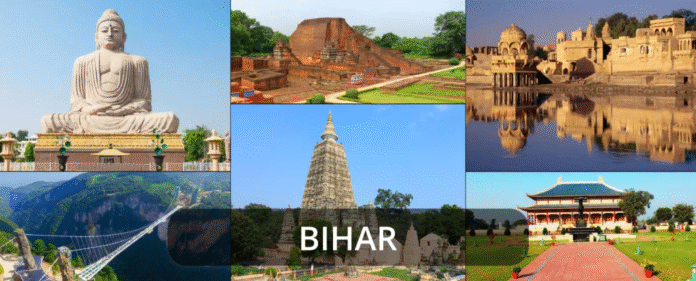
The Buddhist Samyak Darshan Museum‐cum‐Memorial Stupa being constructed in Vaishali, Bihar, will open its doors to the public in the last week of July. On this historic occasion, Buddhist monks from fifteen countries—China, Japan, Sri Lanka, Thailand, Nepal, Tibet, Myanmar, Malaysia, Bhutan, Vietnam, Cambodia, Mongolia, Laos, Bangladesh, and Indonesia—will convene in Vaishali to participate in the inauguration. Spanning 72 acres and built at a cost of ₹550.48 crore, this monument’s centerpiece will be the relic casket discovered during archaeological excavations between 1958 and 1962. With reverence, the casket will be installed on the museum’s ground floor as the focal point for visitors and worshippers alike.
Historical Significance of Bihar
Ancient Empires and the Cradle of Civilization
Bihar’s Magadha region was the powerhouse of early Indian empires. From the rise of the Nanda dynasty through the Maurya Empire—under Chandragupta and Ashoka—the capital at Pataliputra became the heart of politics, economy, and learning in ancient South Asia.
Birthplace of Major Religions
This land witnessed the dawn of two world religions. Gautama Buddha attained enlightenment under the Bodhi Tree in Bodh Gaya and delivered his first sermon nearby. Jainism’s 24th Tirthankara, Mahavira, also spent key years here, making Bihar the cradle of both Buddhism and Jainism.
Seat of Ancient Learning
Beyond empires and faiths, Bihar nurtured legendary centers of knowledge such as Nalanda and Vikramashila. Scholars from across Asia flocked here to study philosophy, astronomy, medicine, and linguistics, cementing Bihar’s legacy as an intellectual hub.
Bihar as a Japanese Buddhist Pilgrimage Hub
Nipponji Temple, Bodh Gaya
Built in traditional Japanese style, Nipponji (Japanese Temple) offers serene gardens, wooden prayer halls, and a tranquil Zen atmosphere. For Japanese visitors, it represents homeland architecture amid the very soil where Buddha’s enlightenment unfolded.
International Monastic Community
Adjacent to Bodh Gaya’s main stupa, the Indosan Nipponji Monastery houses monks and nuns from Japan and other Buddhist nations. Visitors often join guided meditation sessions, observe Japanese sutra-chanting rituals, and experience the blend of Indian and Japanese Buddhist traditions.